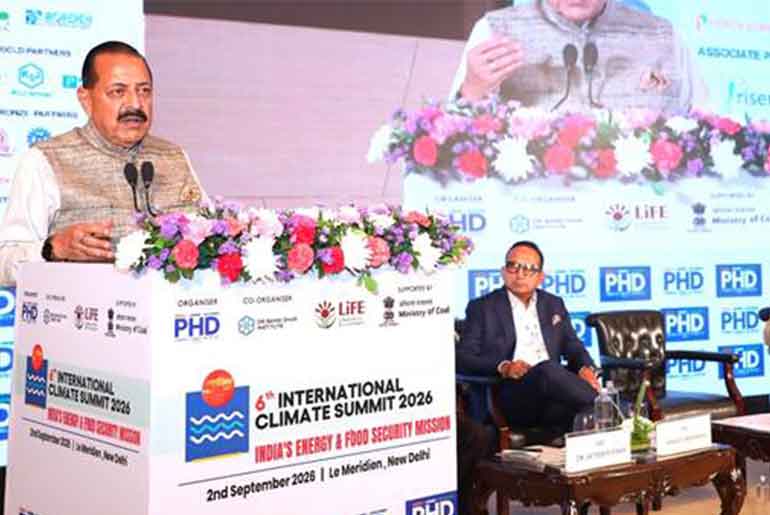
“Energy security is inseparable from national security, strategic autonomy and economic resilience,” Union Minister of State (Independent Charge) for the Ministry of Science and Technology and Ministry of Earth Sciences, and Minister of State in the PMO, Dr. Jitendra Singh, said at the 6th International Climate Summit 2026 in New Delhi. Addressing the summit, organised by the PHD Chamber of Commerce and Industry, Singh called for India to strengthen its energy self-reliance amid geopolitical uncertainties, disrupted global supply chains and volatile energy markets. He emphasised the need for a more indigenous, affordable and technology-driven energy ecosystem, highlighting the importance of advanced technologies in strengthening India’s long-term energy security and resilience.
Dr. Jitendra Singh said that technological advancement and self-reliance are closely interlinked, and affordability is equally important for ensuring that the benefits of emerging technologies reach their full potential. He said that with the emergence of an AI-driven data-centre era, India would require affordable as well as clean sources of energy to derive maximum outcomes from these technologies.
The Minister described the present period as a time of transition towards a secure and sustainable energy future, including a transition towards clean energy. He said that as India seeks to assume a greater global role, it would also have to keep pace with global trends and technological developments in the energy sector.
Highlighting the Government’s approach of pursuing energy security through multiple pathways, Dr. Jitendra Singh said that nuclear energy is one of the important areas being pursued. He highlighted the nuclear energy mission with a target of 100 GW by 2047, describing the opening up of the nuclear sector to private players as a significant development. He said that an integrated approach and an enlarged resource pool would be necessary to meet the country’s ambitious energy targets.
The Minister also referred to the target of five Small Modular Reactors by 2033, saying that the years ahead would see such technologies becoming increasingly important. He also highlighted the efforts being undertaken in the area of green hydrogen, including the recently flagged-off green hydrogen train.
Dr. Jitendra Singh emphasised that biofuels and the circular economy would form an important part of India’s clean-energy transition. He further mentioned that the next industrial revolution would be driven significantly by the circular economy and new technology pathways, including biofuels, ethanol and sustainable fuels. He stressed that India’s growing requirements in sectors such as agriculture, health, irrigation, fertiliser and transport make it necessary to continuously increase the pace of development and adoption of clean-energy technologies.
Highlighting the role of the Ministry of Science & Technology and its associated departments, the Minister said that scientific institutions, teaching institutions, universities and StartUps are actively contributing to India’s emerging technology ecosystem. He noted the rapid expansion of the country’s start-up ecosystem, which has grown from around 350 start-ups to almost 2.4 lakh, with India now ranking third in the world.
Dr. Jitendra Singh also emphasised the importance of greater participation of the private sector in India’s technology and innovation journey. He said that the Government cannot undertake everything on its own and that the private sector needs to increasingly participate in areas that are opening up to new players.
Referring to the ₹1 lakh crore RDI Fund, the Minister said that it has been introduced to accelerate private participation in research and development. He said that the initiative represents an effort to incentivise the private sector and encourage it to participate in new and emerging areas.
The Minister also highlighted the importance of non-government participation in research, noting that the Anusandhan National Research Foundation envisages greater participation from non-government sources, with around 50–60 per cent of resources expected from non-government sources. He said that such participation would be necessary for India to remain globally competitive.
Dr. Jitendra Singh observed that the earlier skepticism between the public and private sectors has been gradually declining and that both sides have increasingly learnt to work together. He said that achieving ambitious national targets would require the Government, industry and other stakeholders to put their collective efforts together.
The Minister called upon the PHD Chamber of Commerce and Industry to act as a bridge and catalyst between the Government and the non-government sector. He said that industry and professional bodies can play an important role in bringing the two sides together and contributing to India’s collective journey towards 2047.
Dr. Jitendra Singh emphasised that India’s energy transition cannot be viewed in isolation and would require simultaneous progress in technology, self-reliance, affordability, clean energy, private participation and innovation. He said that the country’s growing energy requirements and its aspiration to remain globally competitive make it essential to continue developing indigenous and technologically advanced solutions.
 Electrify your feed! Click here to join our Whatsapp group and to get the latest updates, expert insights, and innovations driving India’s energy storage revolution.