Electric vehicles are becoming a central part of the global transition toward cleaner transportation. According to the International Energy Agency, global EV sales crossed 14 million units in 2023, representing about 18% of total car sales worldwide. As EV adoption grows, conversations around battery technology have also intensified.
Although the development of technology has progressed at a rapidly developing pace, there are plenty of myths regarding the EV battery that are still being perpetuated throughout the community. Many people regularly discuss various myths relating to short battery life, exorbitant replacement costs, and the inability to reuse batteries.
Actual operational data from EV fleets, manufacturers, and energy research organizations presents a much clearer and more factually-based understanding of the topic. This article takes a closer look at the most common misconceptions surrounding EV batteries—and separates myth from reality.
Myth 1: Electric Vehicle (EV) Batteries Last Only 3-5 years.
This is one of the biggest misconceptions surrounding EVs, as many people believe that the battery on an electric vehicle will deteriorate rapidly, requiring replacement after 3-5 years. In actuality, EV batteries are engineered to last longer than traditional gas or diesel vehicles.
Nearly all EV manufacturers provide an 8-year or 160,000 km warranty on their batteries that demonstrates manufacturers’ expectations that EV batteries will provide an extended service life.
More importantly, large datasets from real-world EV usage show that degradation occurs gradually rather than rapidly.
Fleet analytics firm Geotab performed a study identifying how quickly EVs lose performance over time. Their data sampled dozens of EVs worldwide, and they concluded that the average amount of loss in productivity related to the vehicle’s battery will be approximately 2.32% annually for an average life span of 10 years. Therefore, it is reasonable to expect that many EVs could have approximately 75-80% of their original performance.
The following are some of the most significant reasons for enhancing battery performance:
- Advanced battery management systems management (BMS) control both charging and discharging of an electric vehicle.
- A highly efficient thermal management system is in place for managing the battery temperature at all times.
- Improvements in lithium-ion chemistries such as Lithium Iron Phosphate (LFP) and Nickel-Manganese-Cobalt (NMC).
Better charging strategies that reduce stress on the battery.
For many EVs, the battery can remain usable for 10 to 15 years, often matching or exceeding the lifespan of the vehicle itself.
Myth 2: Replacing an EV Battery Costs More Than the Car
Another widespread misconception is that replacing an EV battery would cost more than the vehicle itself. While battery packs were indeed very expensive in the early stages of EV development, the economics of batteries have changed significantly over the past decade.
According to the annual battery price survey conducted by BloombergNEF, the average cost of lithium-ion battery packs has fallen dramatically.
In 2010, the average cost was approximately $1,200 per kWh.
Nearly $139 per kilowatt-hour by the year 2023 is how much the average price fell.
Driving factors of this change have been manufacturing scale upgrades, battery chemistry developments and supply chain advancements.
For instance, a 60 kilowatt hour electric vehicle (EV) battery pack generally will cost between $8000-$12000 based on the manufacturer and technology utilized.
It should also be noted that battery replacements and the need for such replacements within a vehicle are not common according to normal usage. Typically EVs will continue to run well with the same battery for multiple years before ever needing a new one.
As the size of battery manufacturing continues its ongoing global growth, industry experts expect battery prices will continue to see reductions in the future.
Myth 3: EV Batteries Cannot Be Reused
Another misconception is that once an EV battery reaches the end of its automotive life, it becomes unusable. In reality, EV batteries often retain substantial capacity even after they are no longer suitable for vehicle use.
Typically, an EV battery is considered unsuitable for automotive applications when its capacity falls to around 70–80% of its original capacity. At this stage, the battery may no longer provide the driving range expected by vehicle owners.
However, the remaining capacity can still be highly valuable for other applications.
This is where the concept of second-life batteries comes into play.
Second-life EV batteries can be repurposed for stationary energy storage systems such as:
- Residential solar energy storage
- Commercial backup power systems
- Grid-scale energy storage
- Microgrid and remote energy applications
Stationary storage alternatives do not have the same limitations on weight, volume or power density as vehicles do and so batteries that were previously out of service from vehicle operations can continue to be serviced for a number of years as energy storage systems.
Automakers and energy companies have started to use second-life battery systems. Some examples include retired EV batteries being used to support renewable energy integration and provide grid stability.
With continued global growth in battery manufacturing, industry analysts are predicting continued cost reductions related to battery manufacturing efforts.
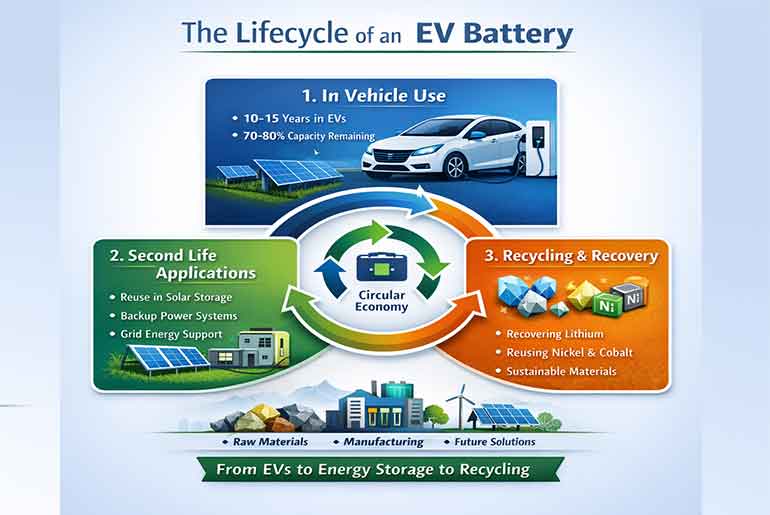
The Lifecycle of an EV Battery
To fully understand the value of EV batteries, it is useful to examine their entire lifecycle.
1. Vehicle Use Phase
In the first stage, the battery powers the electric vehicle for many years of daily driving.
2. Second-Life Applications
When the battery’s performance declines for automotive use, it can be repurposed for stationary energy storage applications.
3. Recycling
Eventually, when the battery reaches the end of its useful life, it can be recycled. Battery recycling technologies allow valuable materials such as lithium, nickel, cobalt, and copper to be recovered and reused in new batteries.
Several companies around the world are investing heavily in EV battery recycling infrastructure, recognizing the long-term value of these materials.
The reason why people still believe in the misconception that there are serious flaws in EV batteries even though there is an increasing number of battery tests showing that they perform well and last long is that EVs have only recently entered the market when compared to ICE vehicles (roughly 10-20 years) and most new technology tends to generate scepticism.
Another reason is that early EVs released more than a decade ago had limitations with respect to battery chemistry, thermal management, and manufacturing methods, but most of these limitations have been or are being addressed today due to advancements in those areas.
Public perception often takes time to catch up with technological progress.
The Bigger Picture
Electric vehicle batteries are not only transforming transportation but are also becoming an essential component of the broader energy transition.
As renewable energy capacity expands globally, batteries are increasingly being used to store electricity generated from solar and wind power.
When examined through real-world data rather than assumptions, it becomes clear that EV batteries are far more durable, reusable, and economically viable than many myths suggest.
Understanding these realities is important as the world continues moving toward cleaner mobility and more sustainable energy systems.
 Electrify your feed! Click here to join our Whatsapp group and to get the latest updates, expert insights, and innovations driving India’s energy storage revolution.