For much of the past decade, batteries have been celebrated for one defining trait: speed. They respond in milliseconds, stabilise frequency in seconds, and shave peaks within minutes. In the early years of India’s renewable energy transition, this fast response made batteries indispensable. They filled the gaps solar and wind created and allowed variable power to coexist with a grid designed for predictability. But as India’s power system enters a new phase—one shaped by massive renewable penetration, electrification of transport, and rising demand for round-the-clock clean power—speed alone is no longer enough. The grid is now asking a different question, one that goes beyond response time:
How long can storage endure?
This shift marks the beginning of the next act of energy storage—one where long endurance battery storage becomes central to grid stability, industrial reliability, and India’s broader clean-energy ambitions.
The First Act: When Fast Response Was Enough
In the first act of battery storage deployment, the problem was clear. Solar generation peaked at noon, demand peaked in the evening, and grid frequency fluctuated with every cloud movement or wind lull. Batteries stepped in as rapid responders.
Battery Energy Storage Systems (BESS) proved their value in:
- Frequency regulation and grid balancing
- Peak shaving and ramp-rate control
- Voltage support at weak grid nodes
- Supporting renewable integration at utility scale
Most deployments were designed for short durations—typically one to four hours. This made sense. The aim was not to replace power plants but to smooth variability. Lithium-ion batteries, driven by scale from the EV industry, were perfectly suited for this role.
Without these fast-response systems, India’s renewable build-out would have faced far steeper technical barriers. In that sense, batteries did not just support the energy transition—they enabled it.
Why Fast Response Alone No Longer Works
Today, India’s grid faces a different reality.
Renewable energy is no longer a marginal contributor. Solar and wind capacities have grown so rapidly that variability is no longer an hourly problem—it is a multi-hour, multi-day, and even seasonal challenge. Evening peak demand continues to rise, solar generation drops sharply after sunset, and wind patterns vary unpredictably across regions.
This is where the limitations of short-duration storage become visible.
Even the most efficient lithium-ion systems begin to face economic and technical constraints beyond six to eight hours of discharge. Costs rise, degradation accelerates, and the value proposition shifts. A battery optimised for fast response struggles when asked to deliver sustained energy over long periods.
In simple terms, the grid no longer needs batteries that act quickly for a short while—it needs storage that can stay in the game longer.
This is the moment where long endurance battery storage enters the conversation.
The Second Act Begins: Why Endurance Matters
Long endurance battery storage refers to systems capable of delivering power for eight hours or more, extending into multi-day support in some cases. This is not about responding to momentary fluctuations; it is about energy availability over time.
Endurance matters because:
- Renewable generation does not always align with demand cycles
- Curtailment is increasing as grids struggle to absorb surplus power
- Industrial users require stable, uninterrupted supply
- Extreme weather events demand resilient backup systems
As renewables scale, the grid’s challenge shifts from balancing power to ensuring continuity. Storage must now act as a buffer across hours and days, not just minutes.
In this context, long endurance battery storage is not a luxury—it is a necessity.
How Batteries Themselves Are Evolving
Contrary to the idea that batteries are reaching their limits, the reality is more nuanced. Batteries are not static technologies; they are evolving to meet new demands.
Several trends are shaping the future of long endurance battery storage:
- Chemistry optimisation: LFP batteries, with longer cycle life and better thermal stability, are increasingly favoured for stationary applications.
- Emerging chemistries: Sodium-ion and flow batteries are gaining attention for their suitability in longer-duration use cases.
- System-level innovation: Modular architectures allow scaling duration without linear cost increases.
- Software intelligence: Advanced Energy Management Systems (EMS) and AI-driven forecasting are turning batteries into adaptive assets rather than passive hardware.
The result is a new generation of storage systems designed not just to respond quickly, but to operate strategically over extended periods.
The Evolution of Hybrid Storage Architecture
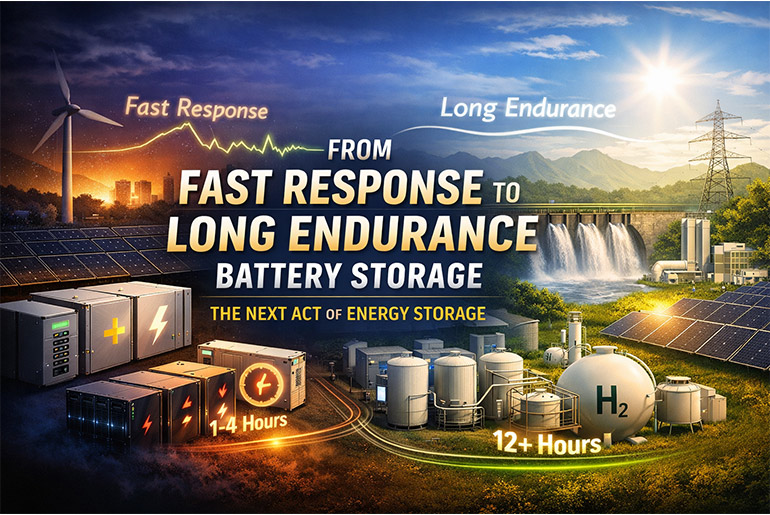
One of the major transformations that is taking place in energy storage today involves developing hybrid storage designs instead of depending solely on one technology. As such, utilities and developers are assembling diverse resources into an architecture with many layers of redundancy.
With this hybrid storage structure,
Batteries provide rapid-response and short-term balance, while
Pumped Hydro Electric Storage (PHES) offers bulk long-duration capacity, and
Green Hydrogen provides Seasonal or Strategic Energy Storage (SES).
Long-duration battery storage supports the transition between short-duration batteries and ultra long-duration options to enable the continuity of energy across a variety of time scales.
This layered approach reflects a deeper understanding of grid behaviour. No single technology can address all storage needs—but together, they can form a resilient, flexible system.
What Policy Signals Are Telling Us
In India, the ongoing and current changes in the electricity landscape are reinforcing these changes.
The National Electricity Plan forecasts a steep increase to a large number of the energy storage requirements. Tenders from the last few months have tended to specify longer discharge times and hybrid systems on an increasing basis. The developers of renewable energy are now encouraged to provide both a sustained balancing of supply and dispatchable capacity, not simply additions to the overall capacity.
In parallel to the previous statement, the National Green Hydrogen Mission supports this effort, and highlights the importance of not only long-duration but also seasonal storage and supply of renewable energy. Rather than being seen as mutually exclusive technologies, batteries and hydrogen production can therefore be viewed as being mutually supportive and complementary (rather than potentially competing) technologies, and components of a broader energy storage system.
Overall, the National Electricity Plan and National Green Hydrogen Mission ultimately signify that the Indian power network will be designed primarily to be reliable, durable, and resilient, and only secondarily to be fast.
What This Means for the Battery Industry
For battery manufacturers, integrators, and solution providers, this transition carries profound implications.
The industry is moving:
- From selling hardware to delivering performance-backed solutions
- From one-time installations to lifecycle management and optimisation
- From capacity-based metrics to availability and endurance-based value
Long endurance battery storage opens new revenue streams through:
- Capacity payments and reliability services
- Energy arbitrage across longer time windows
- Grid support during extreme events
- Integration with renewable and industrial microgrids
It also raises the bar. Safety, thermal management, degradation control, and predictive maintenance become even more critical when systems are expected to operate for longer durations and under higher utilisation.
The Human Side of Endurance
Beyond technology and policy, there is a human dimension to this transition.
Long-term battery storage helps gain the public’s confidence in the clean energy transition because it lets us provide power to customers and businesses reliably during all ho urs, when we are experiencing prolonged times of darkness or during extreme weather events like hurricanes. Power is usually available 24/7, when the sun shines and most people will be home or near their businesses needing electric. And even if people do not see it on the news, at least they now have the assurance of long-term battery storage being available to them when they need it.
The Next Act of Energy Storage
The first act of battery storage was about proving possibility. Batteries showed that renewables could be integrated, stabilised, and scaled.
The second act is about dependability.
As India moves toward a renewable-heavy grid, storage must evolve from fast response to sustained support. In this transition, long endurance battery storage becomes the connective tissue between speed and scale, between variability and reliability.
The future of energy storage will not be decided by how quickly batteries respond—but by how long they can endure.
And in that endurance lies the next chapter of India’s clean energy story.
 Electrify your feed! Click here to join our Whatsapp group and to get the latest updates, expert insights, and innovations driving India’s energy storage revolution.