If you’ve ever thought about buying an electric car, two questions have probably crossed your mind: “Is it safe?” and “Will it get me where I need to go without running out of power?”
For years, the battery world has been split. On one side, you had super-safe and long-lasting batteries (like LFP) that didn’t offer a huge driving range. On the other hand, you had batteries with longer range (like NMC) that were more expensive and had greater safety concerns.
But what if you didn’t have to choose? What if a new type of battery could give you the best of both worlds? Enter LMFP—the quiet upgrade that’s about to make mid-range electric cars safer, cheaper, and far more practical for everyday drivers. This article breaks down exactly how it works and why it matters to you.
For years, LFP (Lithium Iron Phosphate) batteries dominated the market, but now LFMP (Lithium Manganese Iron Phosphate), an upgraded version of LFP, has entered the market and is proving itself. LFP (Lithium Iron Phosphate) and LFMP (Lithium Manganese Iron Phosphate) are two important lithium-ion battery chemistries competing for their safety and cost advantages over nickel-based alternatives like NMC.
Let’s explore more about these two batteries in this article:
LFP (Lithium Iron Phosphate) Batteries: These batteries are made from using lithium, iron, phosphate, and graphite. The core chemistry of LiFePO4 is known for string thermal stability, long life cycle, and excellent safety. Commonly, LFP cells are produced using cathodes made of iron-phosphate powder coated into aluminium foils, paired with graphite anodes.
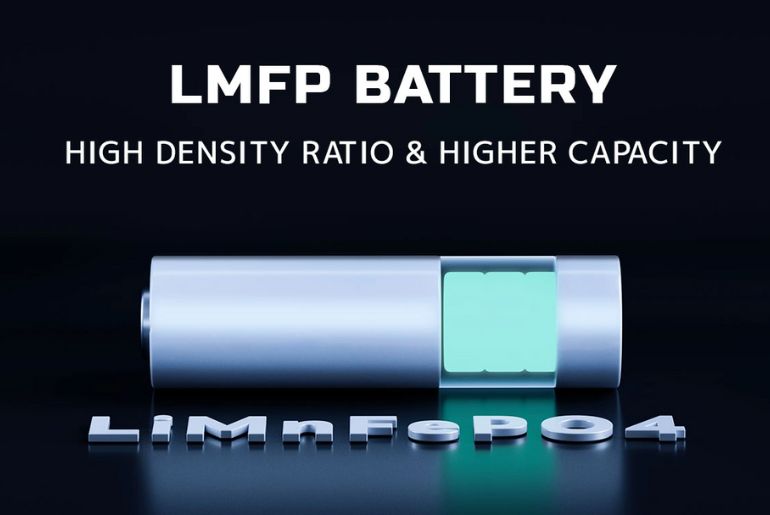
LMFP (Lithium Manganese Iron Phosphate): An upgraded version of LFP. It has manganese in the LFP structure, which creates a more energy-dense chemistry: LiMnₓFe₁₋ₓPO₄
Performance & Uses
LFP: These batteries are known for exceptional cycle life (often over 3,000 cycles) and safety, but has a lower nominal voltage (~3.2V), resulting in lower energy density. That’s the reason it has been dominant choice for standard-range EVs, commercial vehicles, and energy storage system (ESS) where longevity and cost are priorities.
LFMP: The addition of manganese in it increases the material’s voltage (~3.8-4.1V), boosting its energy density by 15-20% compared to LFP. This allows for longer driving range in similarly sized EV packs. It maintains the excellent safety and cycle life of LFP but can sometimes have slightly lower conductivity.
Impact on the Global Mid-Range EV Market
Increased Range: EV buyers suffer from range-anxiety, they often find themselves asking the same question “How far can I drive on a single charge?” Traditional LFP batteries are safe and affordable and have limited range and LFMP improves this by increasing energy density by 15-20%. It means they can store more energy without any changes in their size and weight. For vehicle manufacturers, this is a huge advantage- they can offer longer-range EVs without worrying about designs of the vehicle and for EV buyers, it simply means they do not have to worry about charging stops and have more confidence in everyday driving.
Cost-Effectiveness: In terms of cost, LFMP is affordable as it uses iron and manganese, which is cheap and easily available worldwide. It helps bring down the cost per kWh, making mid-range EVs more budget-friendly for the average consumer. That is why automakers looking at the mass market are excited about this chemistry.
Enhanced Safety: A major priority for EV manufacturers. LFP is already in the safest chemistry list especially when it heats up, LFMP also keep this same safety level because it’s built on the same LFP foundation. Compared to nickel-rich batteries like NCM, LMFP is much less likely to overheat or catch fire. For users in hot climate countries- or during long summer drives- this extra thermal stability is a big benefit.
Supply Chain Resilience: LMFP also solves another major issue of the industry, which is supply chain risk. The prices of nickel and cobalt can become very volatile due to global politics, mining restrictions, and limited reserves. Iron and manganese are widely available and very stable in price. Shifting to LFMP will allow battery makers and electric vehicle manufacturers to reduce supply disruptions and dependency on a few countries. This stability keeps electric vehicle prices predictable.
Industry Adoption & Commercial Push: Global industrial leaders such as CATL, BYD, and LG Energy Solution are investing heavily in LMFP due to its long-term potential.
History & Background
It was in the late 1990s when Nobel Prize–winning scientist John B. Goodenough and his team developed a type of lithium-ion battery chemistry specifically called Lithium Iron Phosphate. They found that iron phosphate could act as a very stable and safe cathode material, which constituted a breakthrough in the development of batteries. Later on, when scientists enhanced the conductivity of LFP with methods such as carbon coating, it was commercialized for more general use in the early 2000s. It became great for large-scale applications in electric vehicles and energy storage systems, paving the way to what would be one of the most used and trusted battery chemistries in the world.
Lithium Manganese Iron Phosphate represents the advanced evolution of LFP battery chemistry, targeted to meet demands for higher energy density without sacrificing safety or cost. While early research into LMFP started in the mid-2000s, it wasn’t until the early 2020s that significant commercial momentum really took over, thanks to the likes of Samsung SDI, CATL, BYD, and Integrals Power. These manufacturers refined the chemistry, improved conductivity, and adapted production lines previously used for LFP to make LMFP a commercially viable option. Today, LMFP is emerging as a promising breakthrough that offers longer driving range, strong thermal stability, and affordability—positioning it as the next significant battery technology for mass-market EVs.
Conclusion
The journey to a cleaner, electric future is paved with constant innovation, especially in the technology that powers it all: the battery. In this article, we looked closely at one of the most promising developments in this space—the shift from Lithium Iron Phosphate (LFP) to Lithium Manganese Iron Phosphate (LMFP) batteries.
This isn’t just a minor tweak in chemistry; it’s a meaningful evolution. LMFP builds upon the proven, safe foundation of LFP but adds a key ingredient manganese that directly tackles the biggest concern for most potential EV owners: range anxiety.
 Electrify your feed! Click here to join our Whatsapp group and to get the latest updates, expert insights, and innovations driving India’s energy storage revolution.