In the last few years, India has rapidly positioned itself as a rising powerhouse in battery manufacturing. With multi-billion-dollar investments under the Production-Linked Incentive (PLI) schemes, major gigafactory announcements, and strategic mineral sourcing initiatives, the country is laying the foundation to meet its ambitious electric mobility and renewable integration goals. But amid this physical transformation, there’s a less visible—yet equally vital—challenge emerging: Can India build the intelligence behind the battery supply chain?
Because in the future of clean energy, value doesn’t just lie in lithium—it lies in knowledge.
The Hidden Layer: Why Physical Infrastructure Isn’t Enough
India’s battery journey is currently dominated by visible milestones: refining lithium, building cathode/anode plants, and scaling cell-to-pack assembly. However, true global competitive advantage requires more than just the surface connection – and especially a data-connected, digital supply chain that can provide transparency, safety, efficiency, and traceability for all materials or products back to raw materials and then on to that item’s second life.
For example, the European Union is implementing a battery passport with full regulatory force by 2027, that will have intricate requirements of detailed materials origin, materials environmental performance data, and defined performance metrics for the battery. Meanwhile, Tesla is collecting real-time cell performance and traceability data for every battery they sell across their vertically integrated ecosystem.
In contrast, India is only beginning to explore this invisible layer. Without it, the sector risks poor quality assurance, lower yields, limited recall capability, and inefficient recycling strategies. In short, India might build batteries, but not understand them well enough to lead.
What Is Supply Chain Intelligence in the Battery World?
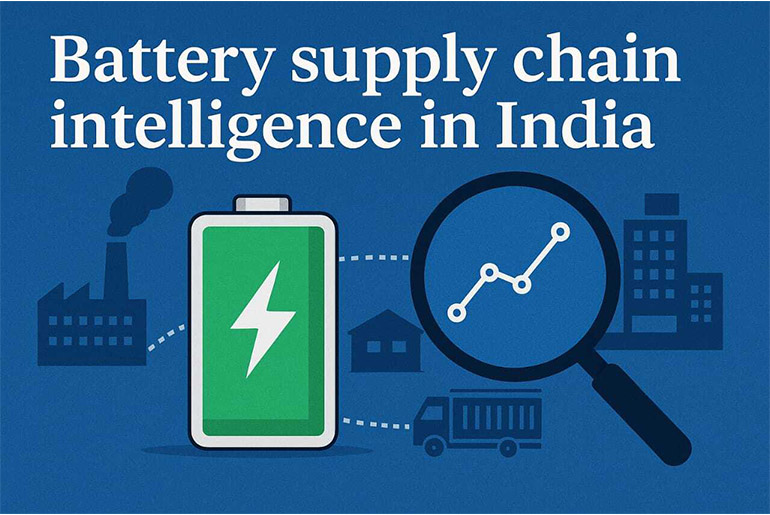
Battery supply chain intelligence refers to the digital infrastructure, software, and data systems that give full visibility and predictability across the battery lifecycle. It includes:
- Material Traceability: Tracking minerals like lithium, cobalt, graphite from mines to module using digital IDs or blockchain systems.
- AI-Based Battery Analytics: Predictive diagnostics of battery health, safety issues, and performance from inside vehicles or storage units.
- Smart Manufacturing: Using data analytics and machine learning for quality control, cell balancing, yield optimization, and process improvement.
- Lifecycle Optimization: Matching used batteries to appropriate second-life applications using real-world usage data.
- Regulatory Compliance & Reporting: Automating documentation for EPR, safety, BIS, CE, and other compliance formats.
According to a report by McKinsey, supply chain digitization can reduce operating costs by up to 30% and enhance forecasting accuracy by up to 85%.
Where India Stands Today
While the physical layer of the supply chain is proliferating, the digital layer is still scattered.
- Policy Vacuum: There is currently no policy direction on battery passports, traceability standards, or digital lifecycle documentation.
- Underskilled Talent: India lacks enough engineers and qualified specialists who are skilled in AI, BMS software, embedded diagnostics, and digital twin modeling.
- Fragmented Tech Stack: Most battery, and pack assemblers are using imported BMS software or legacy monitoring systems without real-time analytics.
Yet there are green shoots.
- Startups like ION Energy (acquired by Freyr) are building battery intelligence platforms.
- Companies like Metastable Materials are trying to create closed-loop recycling systems with traceability built in.
- Institutions like IIT-Madras are developing AI-enabled tools to assess cell degradation and lifecycle potential.
Still, scale and systemic integration remain elusive.
What Needs to Change?
To meet its gigafactory vision with data intelligence, India should take these necessary steps:
- Create a National Battery Data Policy: As we have an EV policy and PLI schemes, a legislated framework needs to be developed that makes data reporting, battery passports, and digital traceability part of the process.
- Invest in Software-Driven Battery Startups: Publicly and privately funded initiatives should focus on establishing funding and grant opportunities for those startups that are creating an ecosystem of battery manufacturers including BMS, cloud- based diagnostics, and battery analytic platforms.
- Skill India for Battery 4.0: As part of the broader ‘Skill India’ approach, upskilling and educational programs need to be launched. However, these need to go beyond just manufacturers and cover software, analytics, cyber security, systems engineering, etc.
- Incentivize Data Use in PLI assessment: The criteria for evaluating PLI proposals should promote and reward more companies in the two schemes to embrace the use of end-to-end digital supply chain tracking similar to localization to access companies’ innovation incentives for reducing reliance on China.
- Establish a public private digital structure: India needs to create an open digital infrastructure with the same significance as UPI as it relates to FinTech to enable battery traceability, reporting, recycling mapping, etc.
Intelligence is the Real Battery Power
India has all the raw ingredients to become a battery superpower—minerals, manpower, and market scale. But without the intelligence layer, we risk becoming the world’s assembly line rather than its innovation hub.
As we mine lithium and build microchips, we must also mine insights and build understanding.
Because in the clean energy race, it’s not just about who can build the biggest factory, but who can build the smartest battery.
 Electrify your feed! Click here to join our Whatsapp group and to get the latest updates, expert insights, and innovations driving India’s energy storage revolution.