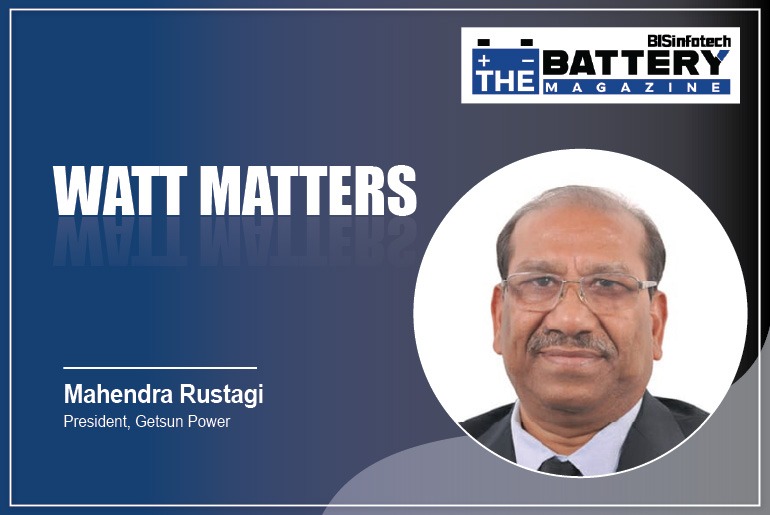
At The Battery Show India 2025, The Battery Magazine interacted with Mr. Mahendra Rustagi, President – Getsun Power, to explore the company’s strategic focus, manufacturing outlook, and growth roadmap in India’s rapidly evolving energy-storage ecosystem. Mr. Manas Nandi, Editor-in-Chief of The Battery Magazine, sat down with Mr. Rustagi for an insightful discussion on Getsun Power’s technological priorities and its contribution to shaping the nation’s clean-energy transition.
During the conversation, Mr. Rustagi shared how Getsun Power has built a strong presence in the lithium-ion battery space, focusing on five high-potential segments — solar street lighting, energy storage, telecom, home-energy systems, and e-mobility. He also discussed the company’s adoption of LFP technology, the ongoing challenges in cell supply and logistics, and the growing importance of energy storage as a stabilising force for renewables.
With an ambitious vision to scale into the C&I segment and reach a ₹1,000-crore milestone by 2030, Getsun Power is positioning itself as a committed, innovation-driven player in India’s lithium ecosystem. Let’s delve into this exclusive conversation to understand how Getsun Power is driving sustainable energy reliability for the decade ahead.
How was The Battery Show India 2025 for Getsun Power this year?
The Battery Show India 2025 has been a fantastic experience for us. The response from visitors has been tremendous, and it’s encouraging to see the rising level of awareness in this rapidly evolving sector. The exhibition has served as an excellent platform to showcase our latest products and technologies, and to engage with customers, partners, and industry peers.
It’s clear that the energy-storage segment is no longer limited to discussions around innovation — it’s now about implementation. People are showing genuine interest in the practicality and scalability of new technologies, which is a very positive sign for India’s clean-energy journey.
Could you tell us more about the innovations and product segments that Getsun Power is currently focusing on?
Getsun Power is positioned as a comprehensive energy-storage solution provider, and our product range reflects the versatility of lithium-ion technology. Today, lithium batteries have penetrated nearly every aspect of life — from mobile phones to large-scale power systems.
We have carefully identified five core application areas that represent both immediate demand and long-term growth potential for us:
- Solar street lighting systems, where lithium batteries are increasingly replacing older chemistries due to higher efficiency and compactness;
- Energy storage Solutions (EES) solutions for telecom towers and DG-replacement setups;
- Residential home-storage systems, which are becoming essential with the rise of rooftop solar and hybrid inverters;
- Industrial and commercial backup solutions, where we foresee major expansion in the coming years; and
- Electric mobility, particularly the E-rickshaw segment, which remains one of the most dynamic markets for lithium batteries in India.
These verticals allow us to cater to both decentralised and large-scale energy requirements — staying true to our core strength in lithium-based energy storage.
Are you working on any new chemistries or advanced battery technologies?
To be very transparent, while cell chemistry development in India is progressing, the majority of indigenous R&D is still concentrated with large conglomerates such as Reliance and Adani. At Getsun Power, our approach is pragmatic. We have chosen to focus on Lithium Iron Phosphate (LFP) chemistry — a technology that is globally recognised for its safety, stability, and cost efficiency.
LFP offers a balanced mix of high cycle life, thermal stability, and affordability, making it the ideal chemistry for the diverse climatic and usage conditions across India. We believe that adopting a stable, proven chemistry allows us to focus our innovation on system-level engineering — pack design, safety architecture, and integration efficiency — which directly benefits our customers.
As a manufacturer, what key challenges do you currently face in India?
The most significant challenge remains cell supply. At present, India still imports nearly all its cells from China. Supply consistency is unpredictable — manufacturers sometimes discontinue specific cell formats or face production bottlenecks, leaving limited alternatives.
Moreover, the logistics ecosystem adds to the complexity. Port congestion and shipping delays are frequent, leading to uncertainty in delivery timelines. On top of that, currency depreciation against the dollar has escalated input costs substantially. These combined factors make planning and pricing very challenging, especially for manufacturers who rely on steady production schedules.
However, we are navigating these hurdles by maintaining close coordination with suppliers and optimising our inventory strategy. The situation also reinforces the need for India to develop its own cell-manufacturing ecosystem, which will be critical for the sector’s self-reliance.
What role do you believe energy storage plays in the success of renewable energy?
In my view, energy storage is the backbone of renewable energy success. Without adequate storage, renewable generation cannot achieve grid stability or long-term scalability.
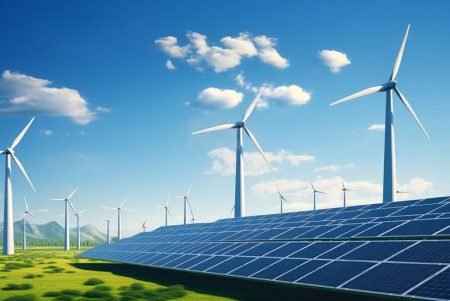
Over the past decade, the renewable sector has faced challenges due to the mismatch between generation and consumption. Solar, wind, or hydro projects generate power at specific times of the day, while demand fluctuates independently. This creates instability and energy wastage. With energy storage integrated into the grid, renewables become dependable and dispatchable — allowing consistent power supply even when natural resources are unavailable.
In essence, energy storage transforms renewable energy from an intermittent source to a reliable utility asset.
Given the supply challenges, have you formed any strategic partnerships to strengthen your value chain?
Yes, we have. While most of our cell supply comes from Chinese partners, we are moving toward more collaborative, long-term relationships rather than simple buyer-seller dynamics. In certain applications, our customers also prefer specific brands of cells, so we work with those manufacturers to ensure compliance and consistency.
On the Battery Management System (BMS) front, we have partnered with specialised suppliers capable of customising the BMS to suit different applications — from solar storage to mobility. These partnerships allow us to enhance functionality, safety, and data analytics, giving customers more control over their systems.
What are Getsun Power’s growth ambitions for the coming decade? Where do you see the company by 2030?
We are in a high-growth sector, and our vision is both ambitious and achievable. By 2030, we aim to become a ₹1,000-crore enterprise, scaling across our five chosen verticals while gradually expanding into commercial and industrial (C&I) energy-storage applications.
We plan to strengthen our R&D, manufacturing, and service capabilities year-on-year. The Indian market is expanding exponentially, and there is ample space for serious, quality-driven players like us. Our approach is to grow steadily — segment by segment, building reliability and brand strength at every step before diversifying further.
Any final message you’d like to share with your customers and industry partners?
My message would be simple — the future belongs to lithium-ion energy storage. Lead-acid served its purpose, but the era has changed. Lithium offers better energy density, safety, lifecycle value, and environmental sustainability.
Customers should choose brands that offer not only reliable products but also dependable after-sales support and long-term service assurance. At Getsun Power, we are committed to being that brand — one that delivers performance, trust, and technical excellence.
 Electrify your feed! Click here to join our Whatsapp group and to get the latest updates, expert insights, and innovations driving India’s energy storage revolution.