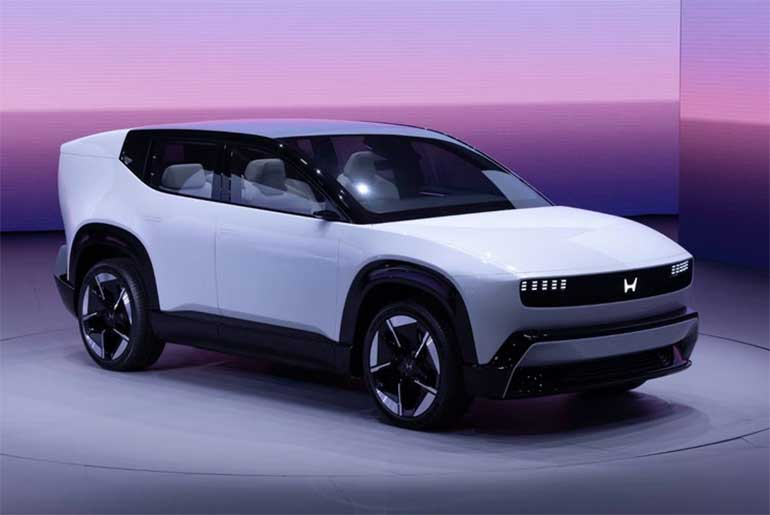
Honda Motor Company has revealed its first battery electric vehicle (BEV) for India, the O Series Alpha, which will come onto the market in 2027. Honda announced its rollout plan, a localized battery sourcing strategy, at the annual shareholders meeting to begin reducing its importation reliance on China. The vehicle model will utilize battery cells from the Chinese manufacturing firm CATL, manufactured in the company’s plant in Indonesia.
“The battery for the Zero Series Alpha, even though we use the technology of CATL, the cells that are produced in Indonesia, will be brought over to India. So, you could say those batteries are from Indonesia,” Honda President and CEO Toshihiro Mibe told reporters at the Japan Mobility Show on Friday.
India’s electric vehicle (EV) market is heavily reliant on China for battery cells, which causes significant vulnerabilities in the supply chain, especially in light of temperamental geopolitical issues. Following the recent difficulties related to sourcing rare earth magnets and sophisticated battery technologies from China, automakers are exploring other sources.
The Indian government has implemented incentive programs to grow domestic cell production, but these have yet to change the local EV supply chains significantly. Recently, Maruti Suzuki, the largest carmaker in India, admitted that their battery strategy is the biggest challenge they face and cited a lack of cell production capacity domestically as a huge obstacle.
Automakers now are turning to other regional sources like Indonesia, Thailand, and South Korea to secure a reliable battery supply without the immediate reliance on China, particularly given the lack of new major cell producers and the scarcity of cell capacity domestically.
On the global front, Honda is adopting a regional battery sourcing strategy as it establishes partnerships and joint ventures to localize battery sourcing since the effort of transporting very large batteries very far distances is impractical. For instance, in North America, Honda is working to construct a battery plant in Ohio under a joint venture called L-H Battery Company with LG Energy Solution.
India’s electric vehicle (EV) market is heavily reliant on China for battery cells, which causes significant vulnerabilities in the supply chain, especially in light of temperamental geopolitical issues. Following the recent difficulties related to sourcing rare earth magnets and sophisticated battery technologies from China, automakers are exploring other sources.
The Indian government has implemented incentive programs to grow domestic cell production, but these have yet to change the local EV supply chains significantly. Recently, Maruti Suzuki, the largest carmaker in India, admitted that their battery strategy is the biggest challenge they face and cited a lack of cell production capacity domestically as a huge obstacle.
Automakers now are turning to other regional sources like Indonesia, Thailand, and South Korea to secure a reliable battery supply without the immediate reliance on China, particularly given the lack of new major cell producers and the scarcity of cell capacity domestically.
On the global front, Honda is adopting a regional battery sourcing strategy as it establishes partnerships and joint ventures to localize battery sourcing since the effort of transporting very large batteries very far distances is impractical. For instance, in North America, Honda is working to construct a battery plant in Ohio under a joint venture called L-H Battery Company with LG Energy Solution.
“We will procure the batteries in the optimum way for each of the regions. For North America, we do have a joint venture there with LG for batteries. We will procure the battery from there for North America. For China, the Chinese market will procure the battery from CATL itself. For vehicles made in Japan, batteries will be procured in Japan and mounted on EV vehicles,” Mibe explained.
In addition to launching electric vehicles, Honda is planning a rapid expansion of its product offerings in India. The company is looking to introduce 10 new models by 2030, with BEVs being a focus area of Honda. Aside from BEVs, the company is also committed to expanding its hybrid technology portfolio. Honda currently sells one hybrid model out of three offered in the Indian market.
“We plan to put more effort into hybrid as well. We will be expanding the hybrid product range for the Indian market as well. Therefore, across all the different types of internal combustion engines, like gasoline engines and hybrids, and battery EVs, we want to deliver attractive products to our customers in India,” Mibe added.
 Electrify your feed! Click here to join our Whatsapp group and to get the latest updates, expert insights, and innovations driving India’s energy storage revolution.