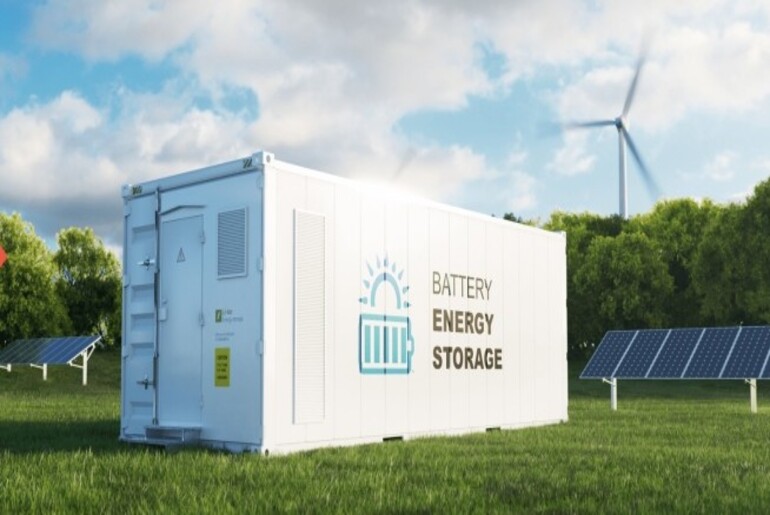
Owing to the India’s 500 GW non-fossil energy target for 2030, the demand for Battery Energy Storage Systems (BESS) in India has increased manifold. Government is backing the demand with policies like the 10% storage co-location mandate and the Production-Linked Incentive (PLI) for battery cells to support domestic manufacturing.
Currently, however, the local companies are unable to fully meet domestic storage needs.
This means Indian manufacturers need to both scale their capabilities and compete with established global players like China, which dominate the supply chain.
Learning from the Global Leaders
BloombergNEF’s Ranking places Battery Energy Storage Systems in India 15th globally. China, the United States, and Germany hold the top three spots. China’s dominance is deep rooted from successful vertical integration, massive scale, and decisive policy support. South Korea and Japan’s growth factor has been their investment in precision manufacturing and uncompromising quality standards. The U.S. is securing its supply chain through domestic manufacturing incentives and critical mineral partnerships.
These trends indicate that India must grow capacity and quality in parallel to build a competitive BESS manufacturing ecosystem. It also needs public–private partnerships that bridge gaps in technology, infrastructure, and upstream supply. Matching low-cost manufacturing with global reliability standards will be essential to moving up in these rankings and gaining a foothold in the export market.
Competing Through Technology
Technology choices-whether its lithium iron phosphate (LFP) for safety and cost stability or nickel manganese cobalt (NMC) for higher energy density, will determine competitiveness of Battery Energy Storage Systems in India. The choice must be aligned with target markets.
Investing in advanced module and pack designs optimized for India’s diverse climate will strengthen domestic performance and boost export appeal.
Innovation in thermal stability, modular scalability, and grid interoperability will be essential for differentiating Indian-made BESS from low-cost imports.
Balancing Cost and Quality
Battery costs are down 80% since 2015. This gives India a natural pricing advantage in cost reduction and profitability. In 2024, merchant BESS in India became commercially viable for the first time, according to an Ember report. Standalone projects participating in the day-ahead market achieved internal rates of return (IRRs) of up to 17%, while those also offering ancillary services reached up to 24%. Revenues have increased fivefold since 2015, creating strong market incentives for scaling domestic capacity.
However, competing purely on cost risks credibility.
Rigorous quality control while scaling up and automation-driven throughput, will add to the reliability and warranty performance, which the global BESS buyers prefer over marginal price savings.
Securing the Supply Chain
Today, India imports around 80% of its lithium-ion cells. While domestic mineral exploration is progressing, India lacks adequate refining capacity. What India needs today is a consolidates BESS ecosystem with vertical integration from raw material processing to the Battery Cell to BESS Container Production .
Strategic alliances with mineral-rich nations key to making battery energy storage systems in India cost-efficient and reliable at a global scale. Initiatives like the U.S.–India clean energy supply chain partnership underline the value of securing upstream inputs.
Looking Beyond the Domestic Market
The Asia–Pacific region is projected to account for nearly 70% of global BESS demand by 2026. This is a good market for Indian BESS manufacturers as many emerging markets lack local manufacturing and are seeking competitively priced, regionally supported storage solutions.
Indian companies like Exide, with its ₹3,700 crore investment in lithium-ion cell manufacturing and plans focused on exports, are already moving in this direction.
The Road Ahead
India’s opportunity lies in combining cost competitiveness with quality, supply chain resilience, and export strategy. India can transition from being a storage project consumer to a key global supplier by strengthening its domestic manufacturing capabilities rather than depending on imports. energy security and establishing itself as a clean energy manufacturing leader.
Digital ecosystems like Mappes.io, which connect manufacturers, suppliers, and project developers, can further streamline operations, enhance collaboration, and support India’s emergence as a globally competitive BESS hub.
 Electrify your feed! Click here to join our Whatsapp group and to get the latest updates, expert insights, and innovations driving India’s energy storage revolution.