A new study by researchers at the Indian Institute of Technology Madras (IIT Madras) has delivered a stark assessment of the global energy transition, warning that renewable energy is unlikely to surpass fossil fuels in the global energy mix until the mid-2050s under current growth trends. The findings, published in the Transactions of the Indian National Academy of Engineering, underline the significant gap between global climate ambitions and actual progress on the ground.
The study says that renewable energy could only take over the global energy sector by the late 2040s if investment levels had to double right away in very aggressive situations. The research further underscores that meeting COP28 objectives necessitates an approximate 73% augmentation in investment in power grids and energy storage infrastructure to adequately facilitate the transition.
Renewables Growth Strong, But Fossil Fuels Still Dominant
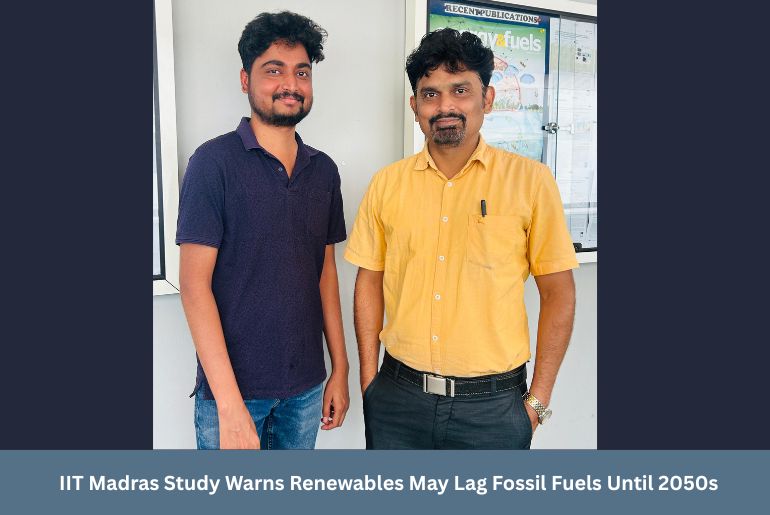
The study, co-authored by Prof. Jitendra S. Sangwai and doctoral scholar Rajat Dehury, highlights that while global renewable energy capacity has grown by 128% over the past decade, it still represents just 14.56% of total primary energy consumption. In contrast, fossil fuels continue to account for over 81% of global energy demand.
Prof. Sangwai noted that the transition to clean energy is not only an environmental necessity but also an economic and geopolitical imperative. He stressed that while the technological solutions required for this shift are already available, global investment levels remain insufficient to drive the transition at the required pace.
India’s Balancing Act in Energy Transition
The analysis also shows how India is different from other countries when it comes to energy. India’s economy is growing quickly, and it needs a lot of infrastructure. At the same time, it needs to support economic growth and meet its clean energy goals. The goal for the country is to have 485 GW of renewable energy capacity by 2030.
Call for Multi-Technology Approach and Policy Acceleration
The researchers from IIT Madras say that a successful shift to net-zero will need a variety of technologies and approaches. Fossil fuels are likely to remain a significant component of the energy mix for the next two to three decades, especially in developing economies. Therefore, supplementary solutions such as Carbon Capture, Utilisation and Storage (CCUS), green hydrogen, advanced energy storage, and smart grid modernisation will be crucial.
The study ends with a warning that if policy reforms, infrastructure investment, and financial commitment don’t speed up a lot, the world could miss its big climate goals in the next few decades.
 Electrify your feed! Click here to join our Whatsapp group and to get the latest updates, expert insights, and innovations driving India’s energy storage revolution.