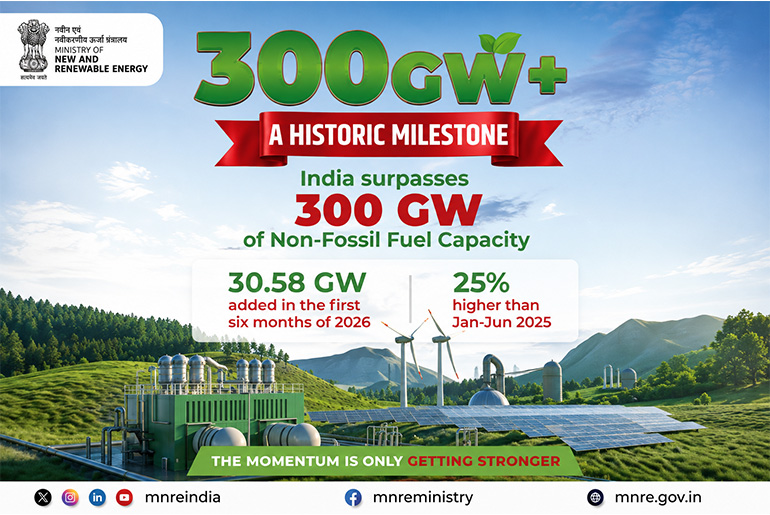
India has crossed a landmark 300 GW of non-fossil fuel-based installed electricity generation capacity, reaching 300.50 GW as of July 31, 2026, according to the Ministry of New and Renewable Energy. The milestone puts India at over 60% of its target to achieve 500 GW of non-fossil fuel capacity by 2030, marking a significant step in the country’s clean-energy transition and long-term energy-security strategy.
The achievement comes as India’s total installed electricity generation capacity stands at around 552 GW, with non-fossil sources now accounting for more than 54% of the country’s overall installed capacity.
Solar Leads India’s Non-Fossil Capacity
Solar power remains the largest contributor to India’s non-fossil capacity, with 164.59 GW installed as of July 31, 2026.
The capacity breakdown is:
- Solar power: 164.59 GW
- Wind power: 58.14 GW
- Hydro power, including large and small hydro: 57.24 GW
- Bio-power: 11.75 GW
- Nuclear power: 8.78 GW
- Total non-fossil capacity: 300.50 GW
Solar has emerged as the principal driver of India’s capacity expansion. From just 2.8 GW in 2014, India’s solar capacity has grown to nearly 165 GW.
Wind power has also expanded substantially, increasing from 21 GW in 2014 to more than 58 GW currently.
Record 55.29 GW Added in FY26
The pace of capacity addition has accelerated further. During 2025-26, India added a record 55.29 GW of non-fossil fuel-based electricity generation capacity.
Solar contributed the largest share of this addition at 44.6 GW, while 6 GW of wind capacity was added during the year.
The expansion in installed capacity has been accompanied by a sharp increase in renewable electricity generation. Renewable energy generation rose from 190.96 billion units (BU) in 2014-15 to 477.79 BU in 2025-26, according to the government.
Domestic Solar Manufacturing Crosses 200 GW
Alongside generation capacity, India has also expanded its domestic clean-energy manufacturing ecosystem.
The capacity enlisted under the Approved List of Models and Manufacturers (ALMM) for Solar PV Modules has crossed 200 GW, compared with just 2.3 GW in 2014.
The government has attributed this expansion to policy support, including the Production Linked Incentive (PLI) scheme, which has focused on strengthening domestic manufacturing of high-efficiency solar modules.
The growth in domestic manufacturing is aimed at strengthening supply-chain independence and supporting India’s broader objective of building an Aatmanirbhar energy ecosystem.
Beyond Renewable Power
India’s clean-energy strategy is also extending into emerging areas such as green hydrogen and its derivatives.
The Ministry of New and Renewable Energy (MNRE) is implementing the National Green Hydrogen Mission, with the objective of supporting industrial decarbonisation and positioning India as a potential global hub for the production, use and export of green hydrogen and its derivatives.
The latest capacity milestone therefore represents more than an increase in renewable generation. It reflects the expanding role of clean energy in India’s industrial competitiveness, energy independence and economic resilience.
With 300.50 GW already installed against the 500 GW non-fossil capacity target for 2030, India has crossed the 60% mark and now has less than 200 GW of additional capacity to build to reach the stated target.
India’s 300.50 GW non-fossil capacity milestone strengthens the country’s position on its 2030 clean-energy pathway. Continued solar and wind additions, domestic manufacturing expansion and emerging green-hydrogen investments will be critical to closing the remaining gap to 500 GW by 2030.
 Electrify your feed! Click here to join our Whatsapp group and to get the latest updates, expert insights, and innovations driving India’s energy storage revolution.