
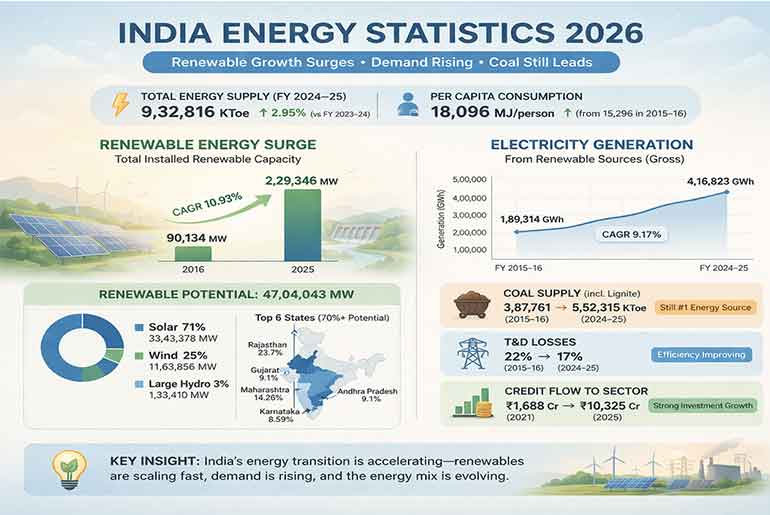
The National Statistics Office (NSO), under the Ministry of Statistics and Programme Implementation, has released the latest edition of Energy Statistics India 2026, presenting a comprehensive overview of the country’s evolving energy landscape. The report highlights India’s steady progress in expanding energy supply, accelerating renewable capacity, and improving efficiency, while also underlining the continued dominance of conventional energy sources.
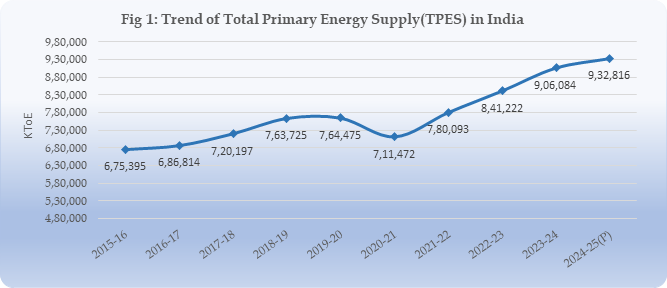
A key highlight of the report is the growth in Total Primary Energy Supply (TPES), which increased by 2.95% in FY 2024–25, reaching 9,32,816 KToe, reflecting sustained economic expansion and rising energy demand across sectors.
Renewable Energy: Rapid Expansion Led by Solar
India’s renewable energy sector continues to demonstrate strong momentum. The total renewable energy potential has reached 47,04,043 MW as of March 2025, with solar energy emerging as the clear frontrunner. Solar potential witnessed a sharp surge to 33,43,378 MW, accounting for nearly 71% of total renewable potential.
Wind energy follows with 11,63,856 MW, while large hydro contributes 1,33,410 MW. Notably, over 70% of India’s renewable potential is concentrated across six key states—Rajasthan, Maharashtra, Gujarat, Andhra Pradesh, Karnataka, and Madhya Pradesh—indicating regional clusters of clean energy opportunity.
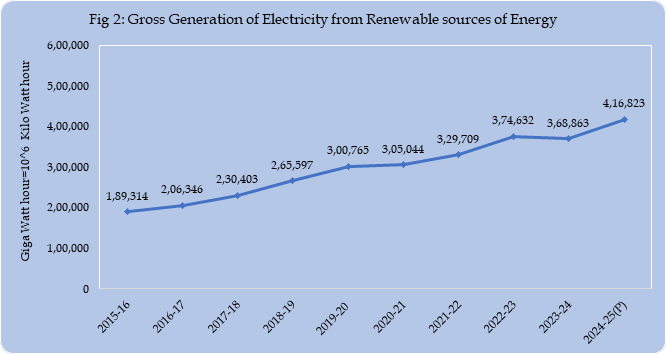
Installed renewable capacity has also grown significantly, rising from 90,134 MW in 2016 to 2,29,346 MW in 2025, registering a CAGR of 10.93%. Similarly, renewable electricity generation more than doubled from 1,89,314 GWh to 4,16,823 GWh, reflecting consistent expansion.
Rising Consumption and Improved Efficiency
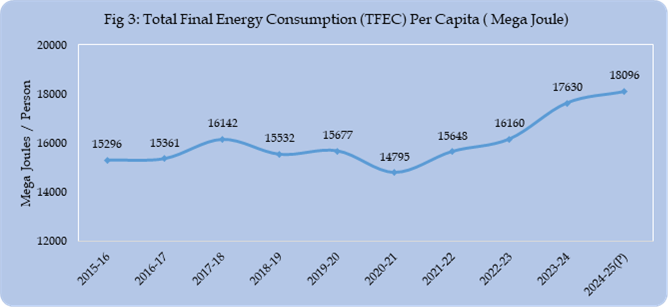
India’s growing economy is driving higher energy consumption. Per capita energy consumption increased from 15,296 MJ/person in FY 2015–16 to 18,096 MJ/person in FY 2024–25, indicating gradual improvement in energy access and usage.
At the same time, efficiency gains are evident. Transmission and distribution (T&D) losses have reduced from around 22% to 17% over the same period, showcasing improvements in grid infrastructure and operational efficiency.
Coal Remains Dominant Despite Transition Push
Despite rapid renewable growth, coal continues to dominate India’s energy mix. Energy supply from coal (including lignite) increased from 3,87,761 KToe in FY 2015–16 to 5,52,315 KToe in FY 2024–25, maintaining its position as the primary energy source.
The Total Final Consumption (TFC) of energy also rose significantly by over 30%, reaching 608,578 KToe, driven by industrialisation, urbanisation, and infrastructure development.
Financial and Structural Improvements
The report also highlights improved financial support for the energy sector. Credit flow increased sharply from ₹1,688 crore in 2021 to ₹10,325 crore in 2025, reflecting growing investor confidence and sectoral expansion.
Additionally, the 33rd edition of the publication introduces enhanced datasets, including credit flow analysis, international benchmarks, and improved sectoral consumption mapping, making it more aligned with global standards.
 Electrify your feed! Click here to join our Whatsapp group and to get the latest updates, expert insights, and innovations driving India’s energy storage revolution.