Over the past decade, India’s battery policy has undergone a sea change. It used to be just about promoting electric vehicles but it’s now a wider strategy to support battery manufacturing, renewable energy integration, energy security and industrial growth. Initiatives such as the FAME scheme, ACC Production Linked Incentive (PLI) Scheme, Battery Waste Management Rules, Energy Storage Obligation (ESO), and the National Critical Mineral Mission have collectively laid the foundation for a domestic battery ecosystem.
These policies are already changing the energy landscape of India. Battery manufacturing capacity is increasing, Battery Energy Storage Systems (BESS) are becoming critical for grid integration of renewable energy, and battery recycling companies in India are preparing for the first wave of end-of-life lithium-ion batteries. At the same time, investments in critical minerals and gigafactories signal India’s desire to be a global hub for battery manufacturing.
But the challenges facing the battery industry of 2035 will be quite different from today’s. Just making batteries won’t be enough. India will also need policies to enable long-duration energy storage, circular economy, digital battery traceability, AI-enabled battery infrastructure, grid flexibility, export competitiveness and innovation across the full battery value chain.
This is where India’s battery policy needs to evolve again. The next decade isn’t just about building more batteries — it’s about building a resilient, globally competitive battery ecosystem that connects raw materials, manufacturing, deployment, recycling and international markets.
In this article, we discuss the next generation of India’s battery policy and list eight policy priorities that could enable the country to cement its battery industry and become a world leader by 2035.
How India’s Battery Policy Has Evolved
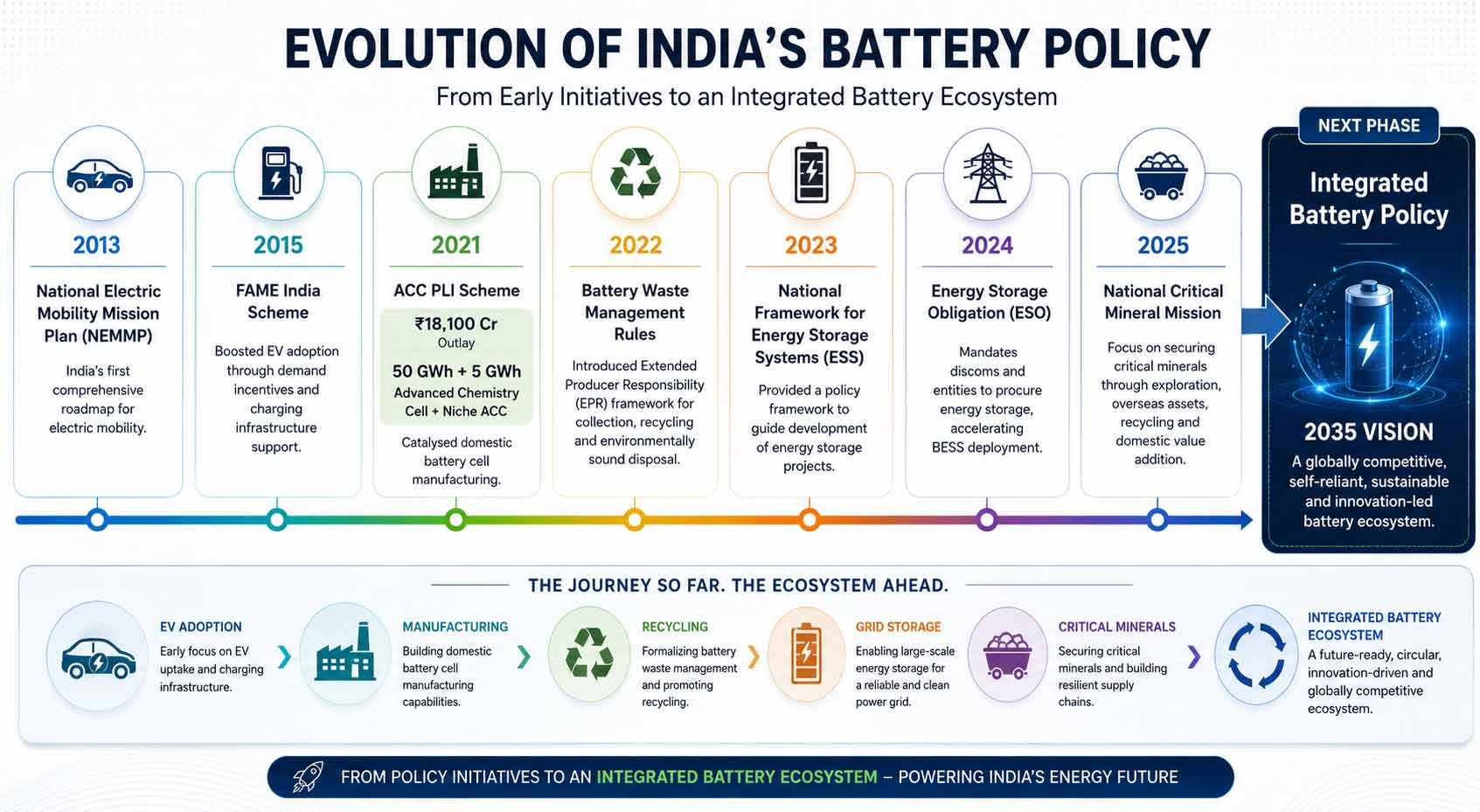
India’s battery policy has moved from promoting electric mobility to creating an entire industrial ecosystem. What started as a way to speed up the adoption of electric vehicles has slowly morphed into a multi-billion dollar strategy encompassing battery manufacturing, energy storage, recycling and critical minerals. This evolution is a reflection of the deeper understanding that batteries are not just electric vehicle components, but strategic assets for energy security, industrial competitiveness and the clean energy transition.
The first major shift came with the National Electric Mobility Mission Plan (NEMMP) 2020 and later the FAME schemes, which focused on accelerating EV adoption. As demand for advanced batteries increased, the government’s attention turned to domestic manufacturing.With the increased demand for advanced batteries, the focus shifted to local production. Consequently, in 2021, India launched the ACC Production Linked Incentive (PLI) program with an allocation of ₹18,100 crore to produce 50 GWh of capacity for advanced chemistry batteries and an additional 5 GWh of capacity for other technologies.
As batteries are used more and more in applications other than transportation and logistics, the policy environment started to move faster. The 2022 Batteries Waste Management Rules introduced an Extended Producer Responsibility (EPR) mechanism to ensure effective collection, recycling, and material recovery. The National Energy Storage System (ESS) framework and the Energy Storage Obligation (ESO) formulated battery storage as an essential component of India’s electric sector. According to the Central Electricity Authority (CEA), India could require over 70 GW/400 GWh of battery energy storage capacity by 2031–32 to support the rapid integration of renewable energy.
More recently, the National Critical Mineral Mission has expanded the policy focus upstream, addressing the security of lithium, cobalt, nickel, graphite, and other essential minerals that underpin battery manufacturing.
These initiatives have in turn made India’s battery policy not a collection of EV incentives but a full-fledged industrial policy. But the next challenge is not the creation of individual schemes, but how to bring them together in a coherent policy framework that can underpin a globally competitive battery ecosystem through 2035. Demand for batteries is soaring across transport, power and manufacturing.
Why India Needs a New Battery Policy Roadmap
India has made good progress in developing its battery industry but the next phase requires a wider vision. Successful electric mobility, domestic manufacturing, energy storage and battery recycling have been enabled by policies in place. However, many of these actions were targeted at specific issues rather than the whole battery value chain.
But as battery deployment accelerates, new questions are arising. What will India do with millions of EV batteries at end of life? Can Battery Energy Storage Systems (BESS) survive financially without government support? How can domestic manufacturers compete in export markets with increasing demands for battery passports and transparent supply chains? And how does India secure the critical minerals it needs to power long-term growth?
These challenges will not be met by simply expanding existing schemes. India’s battery policy needs to evolve from a collection of ad-hoc interventions to an integrated framework that covers all elements of the battery lifecycle: raw material security, manufacturing, grid integration, recycling, digitalisation, innovation, and global competitiveness.
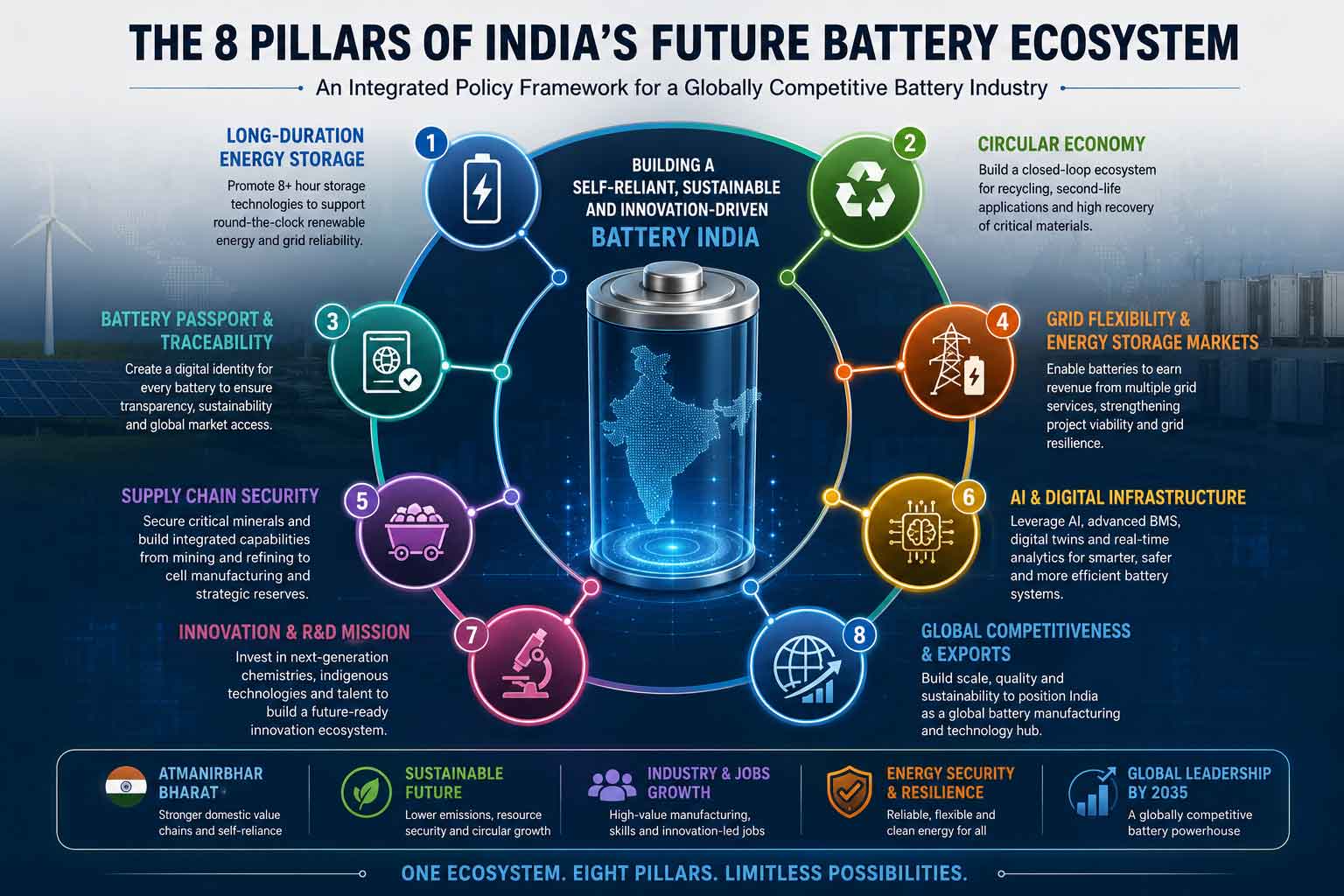
The following eight policy priorities outline how India can build a future-ready battery ecosystem and strengthen its position in the global battery economy by 2035.
Policy 1 – A National Long-Duration Energy Storage Policy
India has been taking proactive steps to promote Battery Energy Storage Systems (BESS) through initiatives like the Energy Storage Obligation (ESO), viability gap funding, and competitive bidding for standalone storage projects. But most efforts are aimed at lithium-ion batteries, which are best for short-duration applications of four hours or less. India’s renewable goals are growing rapidly, and the country’s storage needs are getting much more complicated. As per the CEA, India will have to install battery energy storage capacity of around 74 GW (411 GWh) for ensuring optimal integration of rising share of solar and wind energy by 2031–32. While lithium-ion systems with four-hour discharge period will meet a major part of this requirement, they may not solve issues such as seasonality, extended duration of low renewable generation and balancing the grid over several days.
A dedicated National Long-Duration Energy Storage (LDES) Policy would bridge this gap by supporting technologies capable of storing electricity for eight hours or more, including flow batteries, sodium-ion batteries, iron-air batteries, compressed air energy storage, and thermal energy storage. These technologies can significantly reduce renewable energy curtailment, provide round-the-clock clean power, improve grid resilience during extreme weather events, and reduce dependence on fossil-fuel-based peaking plants.
Globally, governments are already investing in this transition. The U.S. Department of Energy’s Long Duration Storage Shot aims to reduce the cost of grid-scale long-duration storage by 90% before 2030, while the United Kingdom and Australia have introduced dedicated funding programmes and market mechanisms to accelerate commercial deployment.India too can adopt a similar technology-neutral approach by funding pilot projects, encouraging domestic manufacturing, creating research partnerships and developing long-term procurement pathways for utilities.
By expanding its focus beyond conventional lithium-ion batteries, India’s battery policy can build a more diversified energy storage ecosystem that not only supports the country’s target of 500 GW of non-fossil electricity capacity by 2030 but also strengthens long-term energy security and grid reliability.
Policy 2 – A National Battery Circular Economy Policy
The battery industry in India is growing at a fast pace but the challenge of managing the end-of-life batteries has just started. The concept of Extended Producer Responsibility (EPR) was introduced in the Battery Waste Management Rules, 2022. However, India’s battery policy is yet to see a holistic solution for recycling, second life applications, material recovery and circular manufacturing.
This gap is becoming increasingly significant as the country’s electric vehicle fleet grows. According to NITI Aayog, India could generate over 128 GWh of retired lithium-ion batteries by 2030, creating one of the world’s largest emerging streams of battery waste and recyclable materials.
But a National Battery Circular Economy Policy would go further than waste management to build a closed-loop battery ecosystem. It could incentivise higher recovery rates of critical minerals such as lithium, cobalt, nickel, manganese and graphite, promote reuse of EV batteries in stationary energy storage, establish quality and safety standards for second life batteries, and accelerate investment in advanced hydrometallurgical and direct recycling technologies. Indeed, the world’s best recycling facilities are now capable of recovering over 95% of the critical metals in batteries, proving that end-of-life batteries can be a valuable secondary source of raw materials and not a waste product.
Such a policy would also strengthen the rapidly expanding EV battery recycling market in India, creating opportunities for battery recycling companies in India, black mass recovery companies, and startups developing innovative lithium battery recycling processes. According to industry estimates, the Indian battery recycling market is projected to grow at a double-digit CAGR through the next decade, driven by rising EV adoption, stricter environmental regulations, and increasing demand for domestically recovered critical minerals.
As millions of electric vehicle batteries reach the end of their first life over the coming decade, the question is no longer whether India should recycle batteries, but whether it can transform battery waste into a strategic industrial resource. A well-designed circular economy policy would reduce import dependence, improve resource security, lower the environmental footprint of battery manufacturing, and position India as a leader in sustainable battery value chains.
Policy 3 – A Battery Passport & Traceability Policy
As global battery supply chains become more transparent, product quality alone will no longer determine competitiveness. Increasingly, manufacturers will also need to prove where battery materials came from, how they were produced, their carbon footprint, and how they will be recycled. While the European Union has already introduced Battery Passport requirements, India’s battery policy has yet to establish a comparable national framework.
The Battery Passport & Traceability Policy aims to establish a distinct digital identity for batteries, combatting battery counterfeiters by tracking and storing relevant data pertaining to each battery’s raw materials, manufacturing, ownership, performance, repairs, and recycling once end-of-life.
Battery passports could be a competitive advantage for Indian companies eyeing global markets, not a compliance burden. They would increase consumer confidence, facilitate battery lifecycle management, promote recycling and facilitate access to export markets with higher sustainability requirements.j
India’s objective to be a leading battery supplier in the world calls for its battery policies to go further than being focused exclusively on production incentives but also include aspects of digital traceability. The concept of a Battery Passport will help Indian manufacturers to be ready for any eventualities in terms of export obligations and enhance the reliability and sustainability of the growing battery industry in the nation.
Policy 4 – A Grid Flexibility & Energy Storage Market Policy
India is rapidly deploying Battery Energy Storage Systems (BESS) to support renewable energy integration, but most projects still depend on government tenders, viability gap funding, and long-term contracts for financial viability. As renewable energy capacity expands towards 500 GW of non-fossil electricity capacity by 2030, the role of batteries will extend far beyond simply storing electricity. India’s battery policy must therefore create electricity market mechanisms that allow storage projects to earn revenue from the full range of grid services they provide.
A Grid Flexibility & Energy Storage Market Policy would recognise batteries as multi-functional grid assets rather than standalone storage systems. In addition to energy arbitrage, batteries can provide frequency regulation, voltage support, peak shaving, congestion management, spinning reserves, and black start capabilities—services that are becoming increasingly valuable as renewable energy penetration rises. According to the Central Electricity Authority (CEA), India is expected to require around 74 GW (411 GWh) of battery storage by 2031–32, making commercially viable storage markets essential for future grid stability.
Countries such as Australia, the United States, and the United Kingdom already allow battery operators to participate in ancillary service and flexibility markets, enabling multiple revenue streams while improving grid reliability. By adopting a similar framework, India’s battery policy can reduce reliance on government support, attract greater private investment, and accelerate the deployment of storage systems needed to build a cleaner, more resilient, and flexible power grid.
Policy 5 – A Battery Supply Chain Security Framework
India has taken important steps to strengthen access to critical minerals through the National Critical Minerals Mission, partnerships for overseas minerals and domestic exploration. However, India’s battery policy should do more than secure raw materials. It should create a robust battery supply chain from mine to market. India has reserves of some of the critical minerals but is heavily dependent on imports for refined battery materials, making manufacturers vulnerable to supply disruptions, price volatility and geopolitical risks.
A Battery Supply Chain Security Framework would embrace all aspects of the battery supply chain, such as mineral exploration, mineral refining, chemical processing, precursor production, cathode production, cell manufacturing, battery recycling, and strategic stockpiling. The International Energy Agency (IEA) estimates China accounts for about 60% of global lithium refining, approximately 70% of cobalt refining, and over 90% of global graphite processing, clearly emphasizing the concentration of the world battery supply chain. Reducing dependence on these bottlenecks will require India to invest not only in mining but also in midstream processing and advanced material manufacturing.
Instead of mimicking China’s model, India could develop a more diversified and resilient supply chain by combining domestic production, international mineral partnerships, urban mining through battery recycling and technological innovation. A comprehensive supply chain strategy would boost manufacturing competitiveness, secure resources, reduce import dependence and secure India’s battery policy to enable not just the manufacturing of batteries but the entire ecosystem needed to sustain long-term industrial growth.
Policy 6 – An AI & Digital Battery Infrastructure Policy
As batteries get bigger, smarter and more connected, software will be as important as the chemistry of the battery. But India’s battery policy remains largely focused on manufacturing capacity and physical infrastructure, with less emphasis on digital technologies that will define the next generation of battery systems. Battery energy storage deployments are expected to increase several fold over the next decade, BloombergNEF says, and smart battery management will be key to improving reliability, safety and asset performance at scale.
An AI & Digital Battery Infrastructure Policy would accelerate the adoption of artificial intelligence (AI), digital twins, advanced Battery Management Systems (BMS), Energy Management Systems (EMS), predictive maintenance, and real-time battery analytics across the battery value chain. Studies indicate that AI-driven predictive analytics can extend battery life by 15–25%, improve charging efficiency, and significantly reduce unexpected equipment failures, lowering lifecycle costs for both electric vehicles and grid-scale storage systems.
It could also help AI-enabled gigafactories, autonomous quality inspection, smart battery manufacturing, and interoperable data standards that allow batteries to talk to power grids, renewable energy systems and charging infrastructure without a hitch. The battery policy can help position India as a global leader not only in manufacturing batteries, but also in intelligent energy storage technologies, if India can combine advanced manufacturing with digital innovation, where the competitive advantage will increasingly be determined as much by software, data and analytics as battery chemistry itself.
Policy 7 – A Battery Export Competitiveness Policy
India’s battery targets should go beyond serving the needs of the domestic market. India’s battery policy must also aim at building an export-led industry that can compete with established manufacturing hubs such as China, South Korea and Japan, as global demand for batteries is growing at a fast pace.
A Battery Export Competitiveness Policy will help Indian manufacturers to meet international quality, sustainability and certification standards while improving access to global markets. This might involve help with product certification, export finance, trade agreements, logistics infrastructure and keeping up with new regulations like battery passports and carbon footprint reporting.
ACC PLI Scheme has laid the foundation for domestic manufacturing but the long-term success will depend on whether the Indian companies can establish themselves as reliable suppliers in the global battery supply chains. To compete globally, we will need more than production capacity. We will need world-class quality, innovation, dependable supply chains and globally accepted standards.
By shifting from an import substitution strategy to an export-led growth model, India’s battery policy can attract more investment, create high-value manufacturing jobs and position India as a major player in the global battery economy rather than just one of its largest consumers.
Policy 8 – A Battery Innovation & Commercialisation Mission
India has built a strong research ecosystem with institutions such as the IITs, CSIR laboratories, and a growing number of battery startups working on next-generation technologies. However, many promising innovations struggle to move beyond the laboratory. India’s battery policy should therefore focus not only on research but also on accelerating commercialisation.
A Battery Innovation & Commercialisation Mission would fill the gap between research and industry through support for pilot manufacturing plants, demonstration projects, technology validation, university-industry partnerships and scale-up funding for start-ups. It would also speed up the development of new technologies like solid-state batteries, sodium-ion batteries, silicon-anode batteries and other new chemistries that could be the future of energy storage.
Such a mission would also reduce India’s dependence on imported technologies by promoting indigenous innovation and creating a pipeline of commercially viable battery solutions. Rather than waiting for global breakthroughs to reach India, home-grown companies could spearhead the development and production of next-generation batteries.
As the global battery industry is becoming more innovation-driven, India’s battery policy needs to move from supporting manufacturing to nurturing technologies that define the future. “Investing in innovation today will ensure that India remains competitive not only as a battery producer but also as a creator of next generation battery technologies.
Conclusion – Building the Next Chapter of India’s Battery Policy
India has already laid a strong foundation for its battery industry through initiatives such as the FAME scheme, ACC PLI Scheme, Energy Storage Obligation (ESO), Battery Waste Management Rules, and the National Critical Mineral Mission. These policies have accelerated battery manufacturing, encouraged renewable energy integration, and strengthened the country’s position in the global energy transition.
However, the next decade will demand far more than expanding production capacity. As battery manufacturing scales, Battery Energy Storage Systems (BESS) become central to the power grid, electric vehicles generate millions of end-of-life batteries, and global markets introduce stricter sustainability standards, India’s battery policy must evolve into a comprehensive ecosystem strategy.
The article’s eight policy priorities – ranging from long-duration energy storage and circular economy practices to battery passports, grid flexibility, supply chain security, AI-driven infrastructure, export competitiveness and innovation – are the next stage in that evolution. Together they address every stage of the battery value chain, ensuring that India’s battery ecosystem is not only bigger but also more resilient, sustainable and globally competitive.
If India can make the right links between these policy priorities, it has a chance to be more than a big battery manufacturer. It can become a world leader in battery innovation, energy storage, recycling and clean energy technologies. No one scheme or incentive will determine the future of India’s battery policy; it will be how well it combines manufacturing, technology, sustainability and global competitiveness into one long-term vision.
India’s success in 2035 should not be measured merely by the batteries it produces but by the ecosystem it creates around them. That will decide whether the country becomes one of the world’s biggest battery markets, or one of its most influential battery powers.
 Electrify your feed! Click here to join our Whatsapp group and to get the latest updates, expert insights, and innovations driving India’s energy storage revolution.