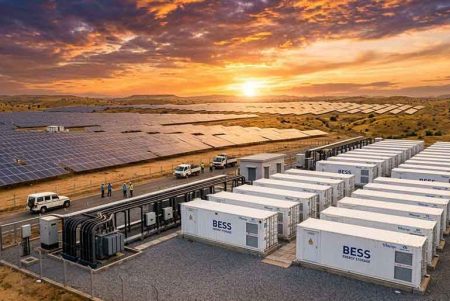

India stands at the threshold of a decisive energy inflection point. As renewable capacity scales at unprecedented speed, the country’s power system is confronting a deeper, more complex question—how to store, stabilise, and dispatch energy in a grid no longer defined by predictability. Battery Energy Storage Systems (BESS), once peripheral and experimental, are now moving decisively into the centre of India’s power market architecture.
The year 2026 is emerging as a defining milestone. Falling battery costs, diversified chemistries, and a surge of large-scale tenders are converging with regulatory reform and grid modernisation. What was once a future-facing technology is fast becoming a bankable infrastructure asset—one capable of reshaping peak management, frequency regulation, and renewable firming across the country. Yet this transformation is not merely technological. It is equally about execution, safety, skills, financing discipline, and policy clarity.
In this cover story, The Battery Magazine brings together voices from across the industry to decode what will truly determine India’s BESS competitiveness—beyond headlines and capacity numbers. From chemistry choices and system intelligence to grid integration and long-term bankability, these perspectives offer a grounded, forward-looking view of how India’s storage market will evolve—and what it must get right—to lead globally by the end of this decade.
Industry Voices Featured in This Cover Story
Nishant Arya
Vice Chairman, JBM Group
A leading voice on India’s clean mobility and energy transition, Nishant Arya offers a systems-level perspective on how technology, policy, manufacturing scale, and finance must align for BESS to mature into a mainstream grid asset. His insights span battery chemistries, safety architecture, tender design, and the regulatory reforms required for long-term leadership.
Kartik Hajela
Director, Jupiter Electric Mobility (JEM)
Representing the execution and deployment lens, Kartik Hajela brings sharp on-ground realism to the discussion—highlighting reliability, workforce readiness, cost discovery, and the practical challenges of scaling BESS from pilots to gigawatt-hours. His perspective underscores that India’s storage success will be won as much in implementation as in innovation.
-
What technological and market factors will determine the competitiveness of grid-scale BESS in India by 2026 and beyond?
Nishant Arya, Vice Chairman, JBM Group said, “By 2026, the competitiveness of grid-scale BESS in India will pivot around the convergence of cost, battery chemistry, system efficiency and design. On the technology front, declining cell costs, driven by global scale-up and increasing domestic manufacturing under the ACC PLI framework, will be critical. At the same time, India will see a diversification beyond conventional LFP, with sodium-ion, LTO and hybrid chemistries gaining relevance for specific grid use cases such as high-cycling frequency regulation or long-duration storage. Equally important will be system-level efficiencies, optimised power electronics, intelligent BMS and modular architectures that reduce balance-of-system costs.”
Kartik Hajela, Director, Jupiter Electric Mobility (JEM) said, “The reliability of early deployments that various Indian BESS companies are doing will determine the future of BESS in India. Apart from market forces like enforcement of ESG compliance for DG replacement, Removal of Net Metering and moving towards Real Time Settlement for Green Solar Energy alongwith TOD tariffs, BESS Technology will be proving it’s first substantial year of BESS in India which will be critical.”
-
How will India’s upcoming standalone and renewable-linked storage tenders influence domestic manufacturing, pricing, and long-term bankability?
Nishant Arya, Vice Chairman, JBM Group said, “India’s storage tenders, both standalone and renewable-linked are a watershed moment for the domestic BESS ecosystem. These tenders will provide demand visibility at scale, which is essential for accelerating investments in local cell manufacturing, pack assembly, power electronics and energy management software. As volumes grow, we will see pricing discipline and standardisation, enabling India to move down the cost curve much faster. From a bankability standpoint, clearer availability-based payment mechanisms and defined performance obligations will significantly reduce risk perception. This will unlock lower-cost financing, including infrastructure funds and global climate capital. Over time, these tenders will help transition BESS from being viewed as an “emerging technology” to a mainstream grid asset class, similar to solar and wind today.”
Kartik Hajela, Director, Jupiter Electric Mobility (JEM) said, “Pricing though will become very competitive further for 1 year, I feel the market will see some rational building up by the end of 2026 once projects start executing as various costs will be discovered specifically for BESS deployment and EPC and also the assumption around LFP pricing further going down might see a stagnancy because the surplus supply will get rationalised.”
-
What advancements in safety, BMS, and thermal management are essential for scaling multi-MWh and GWh-level BESS deployments?
Nishant Arya, Vice Chairman, JBM Group said, “As India moves towards multi-MWh and GWh-scale deployments, safety will be non-negotiable. Advanced Battery Management Systems must evolve from basic monitoring to predictive intelligence, using AI-driven analytics to detect early signs of thermal runaway, cell imbalance, or degradation. Thermal management systems must be designed for India’s climatic conditions, high ambient temperatures, dust and humidity, requiring robust liquid cooling, compartmentalisation and fire suppression systems. Equally important is a system-level safety philosophy, from cell selection and module design to container layout, redundancy and emergency response protocols. Compliance with evolving global standards, coupled with indigenous testing and certification infrastructure, will be essential to build confidence among utilities, regulators and financiers.”
Kartik Hajela, Director, Jupiter Electric Mobility (JEM) said, “More than technology, skilled engineers in the field of BESS assembly, Testing and Deployment will be critical to the scale of BESS in India. Today technology more or less is globally and specifically in China stabilised. A real value holds at implementation, deployment and servicing wherein India has to train and create the required people who can manage the scale BESS is looking at in the coming years.”
-
How can BESS be integrated into India’s grid to support peak management, frequency regulation, and renewable firming at commercial scale?
Nishant Arya, Vice Chairman, JBM Group said, “BESS has the potential to become the flexibility backbone of India’s power system. For peak management, strategically located BESS can defer transmission upgrades and reduce dependence on expensive peaking power. In frequency regulation, fast-response storage can provide sub-second grid services, improving stability as renewable penetration rises. For renewable firming, co-located or hybrid BESS can convert intermittent solar and wind into dispatchable, schedule-compliant power.”
-
What policy, financing, and regulatory reforms will be necessary for India to achieve global leadership in stationary storage by 2030?
Nishant Arya, Vice Chairman, JBM Group said, “To achieve global leadership by 2030, India must take a systems-level approach to stationary storage. Policy clarity is paramount, recognising BESS as a distinct asset class with defined roles across generation, transmission and distribution. Long-term visibility on tenders, localisation incentives and R&D support will strengthen domestic capability. On the regulatory front, frameworks for ancillary services, capacity payments and multi-use revenue stacking must be formalised. Access to low-cost, long-tenure capital, blended finance mechanisms and risk guarantees can significantly accelerate deployment. Moreover, India must invest in skills, standards and indigenous innovation, positioning itself not just as a large market, but as a global hub for affordable, reliable, and scalable energy storage solutions.”
 Electrify your feed! Click here to join our Whatsapp group and to get the latest updates, expert insights, and innovations driving India’s energy storage revolution.