
India’s renewable energy story has predominantly revolved around solar for most of the last decade. Wind, the segment that powered the country’s first wave of clean energy ambition in the 2000s, witnessed a comparatively quieter phase of expansion. That perception, however, is rapidly changing. Wind energy is staging a decisive comeback, and the structure of that revival points to one clear conclusion: the next decade will belong to hybrid renewable projects that combine wind, solar and storage into a single, grid-ready asset.
A Record Year That Reset the Conversation
The scale of wind’s resurgence became impossible to ignore in the financial year 2025–26. India added 6.05 GW of new wind capacity during the year, the highest annual wind installation in the country’s history and a clear break from the slower additions of preceding years. That figure surpassed the previous record of 5.5 GW set in FY 2016–17 and represented an increase of roughly 46 per cent over the capacity added the year before. With this addition, India’s cumulative installed wind capacity crossed 56 GW, with official figures placing it at 56.09 GW as of 31 March 2026.
This was not an isolated achievement. India’s total non-fossil capacity addition in FY 2025–26 reached 55.29 GW, the highest in any single year and almost double the previous record of 29.5 GW achieved in FY 2024–25. By the close of the year, India’s non-fossil installed capacity stood at 283.46 GW, of which renewable energy alone accounted for 274.68 GW. Within that base, solar leads at around 150 GW, wind follows at just over 56 GW, and large hydro contributes another 51 GW. These numbers placed India third globally in renewable energy installed capacity, having moved ahead of Brazil.
The wind recovery, then, is happening inside a broader transformation of India’s power system. In July 2025, renewables met 51.5 per cent of the country’s total electricity demand, the highest-ever renewable share in generation. This is the context in which the case for hybrid renewable projects becomes compelling.
Why Wind Energy Came Back: Policy, Pricing and Pipeline
The renewed momentum has not happened by accident. The Ministry of New and Renewable Energy has attributed the FY 2025–26 surge to a combination of improved policy clarity, transmission readiness, competitive tariff discovery and a maturing project pipeline. Several specific interventions stand out.
First, the government has maintained a graded waiver of Inter-State Transmission System (ISTS) charges for wind and solar projects commissioned on or before 30 June 2028, a powerful incentive that materially improves project economics. Second, concessional customs duty on certain components and raw materials used in wind turbine manufacturing has supported a more cost-competitive domestic supply chain. Third, MNRE has introduced a separate wind renewable energy consumption obligation framework, distinct from the broader solar-led renewable purchase obligation. By creating dedicated demand specifically for wind-generated electricity, this framework guarantees a market for wind power and de-risks investment in a way a generic renewable obligation never could.
The states tell the same story. Gujarat, Karnataka and Maharashtra were the primary contributors to the FY 2025–26 addition, supported by a growing pipeline of wind-solar hybrid projects and the progressive rollout of green energy open access. India’s assessed onshore wind potential is substantial, estimated at 695 GW at 120 metres above ground level, meaning the resource base for sustained expansion is far from exhausted.
The Logic of Wind-Solar Hybrid Integration
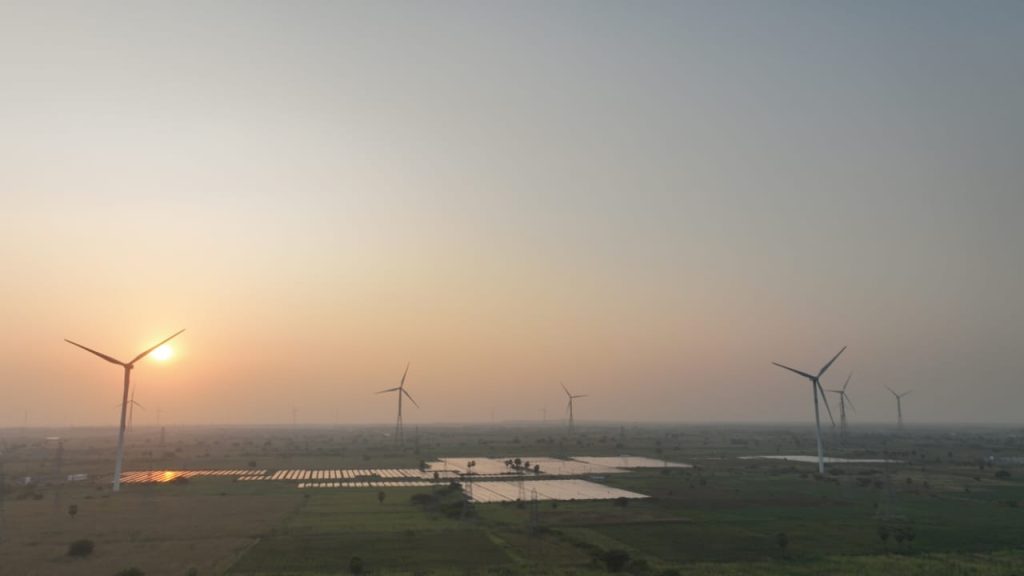
The most important structural shift is not simply that wind is growing again but that it is increasingly being deployed alongside solar rather than in isolation. The rationale for wind-solar hybrid integration is straightforward and powerful: wind and solar generation profiles are largely complementary. Solar generates through the daytime and peaks at midday; wind in many Indian resource zones strengthens through the evening, night and monsoon months when solar output falls. Co-locating the two technologies smooths the combined output curve, reduces variability and delivers a far more stable injection of power into the grid.
This logic was formally recognised in the National Wind-Solar Hybrid Policy, adopted by MNRE in May 2018. The policy provides a framework for large grid-connected wind-solar hybrid systems with the explicit aim of efficient use of transmission infrastructure and land while reducing variability and improving grid stability. It permits integration of the two resources at both AC and DC levels and offers flexibility in the share of wind and solar within a project, requiring only that the rated capacity of one resource be at least 25 per cent of the other to qualify as a hybrid.
The infrastructure efficiency argument is just as important. A standalone wind farm typically uses its evacuation infrastructure at a capacity utilisation factor in the low-to-mid thirties, leaving transmission lines and substations idle for much of the day. Adding solar to the same connection point raises utilisation of that shared infrastructure significantly without requiring new transmission capacity. In a country where transmission build-out is itself a constraint, extracting more energy from each circuit kilometre of line is a strategic advantage.
Storage: The Component That Makes Hybrids “Firm”
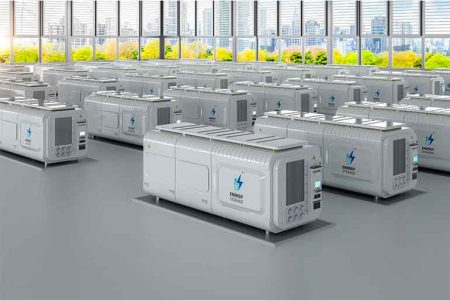
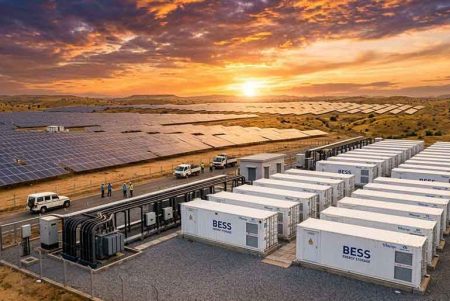
Hybridisation reduces variability, but it does not eliminate it. To convert variable renewable output into the dependable, dispatchable power that distribution companies and industrial buyers want, storage is essential. The National Wind-Solar Hybrid Policy permits storage to be added to a hybrid project to reduce output variability, deliver higher energy for a given sanctioned capacity, and ensure firm power availability over defined periods. A later amendment removed the word “battery” from the relevant clauses, clarifying that any form of storage, including pumped hydro, compressed air and flywheels, qualifies.
The storage build-out is now matched by a serious financial commitment. The government has introduced viability gap funding of roughly ₹91 billion to support around 43 GWh of battery energy storage capacity, with individual standalone projects able to access up to 40 per cent of capital cost as a grant. The Union Budget 2026–27 sharply increased the annual VGF allocation for battery storage. To anchor domestic manufacturing, a 20 per cent domestic content requirement now applies to projects seeking VGF support, and a production-linked incentive scheme targets 50 GWh of advanced chemistry cell manufacturing.
The demand-side numbers explain the urgency. The Central Electricity Authority has estimated that India will need on the order of 411 GWh of energy storage capacity by 2031–32. Tendering has surged ahead of installation: cumulative tendered storage capacity rose from under 7 GW in 2018 to roughly 90 GW by 2025. The implication is clear. Round-the-clock renewable power, firm and dispatchable, is fast becoming the product the market wants, and only a wind-solar-storage configuration can deliver it economically.
Grid Modernisation: The Decade’s Critical Enabler
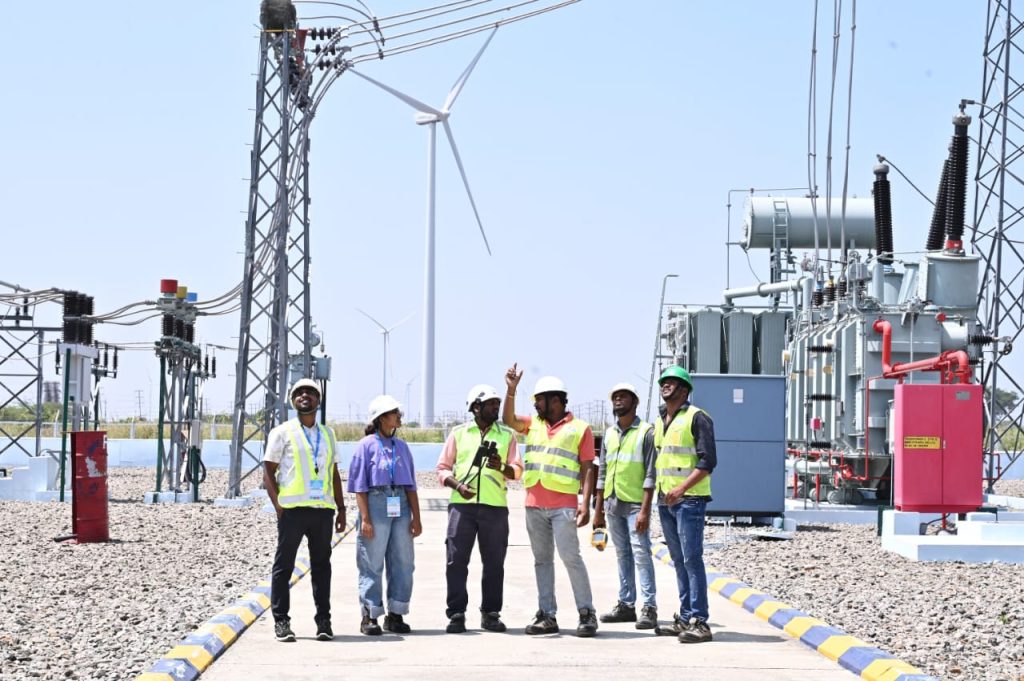
None of this scales without a transmission grid built to absorb it. The single largest risk to hybrid expansion is that generation capacity continues to outpace the wires needed to evacuate it, a gap that can take three to six years to close. The government has responded with the National Electricity Plan for transmission, a roughly ₹9.15 lakh crore programme to 2032 that maps the network required to support 500 GW of renewable capacity by 2030.
The plan envisages adding more than 191,000 circuit kilometres of transmission lines and around 1,270 GVA of transformation capacity over the decade, while explicitly accounting for offshore wind, battery storage and pumped hydro. Inter-regional transmission capacity is set to rise from around 120 GW today to 143 GW by 2027 and 168 GW by 2032. Alongside this, the Green Energy Corridors programme continues to build dedicated evacuation infrastructure linking renewable-rich states to demand centres.
Regulatory modernisation matters as much as steel and copper. Amendments to the General Network Access regulations have introduced time-segmented grid access, with separate “solar-hours” and “non-solar-hours” windows. This allows a single transmission corridor to be shared dynamically between solar, wind and storage projects, unlocking idle capacity and easing congestion. For hybrid developers, this directly rewards the complementary generation profile a wind-solar hybrid is designed to deliver.
Emerging Investment Opportunities and the Decade Ahead
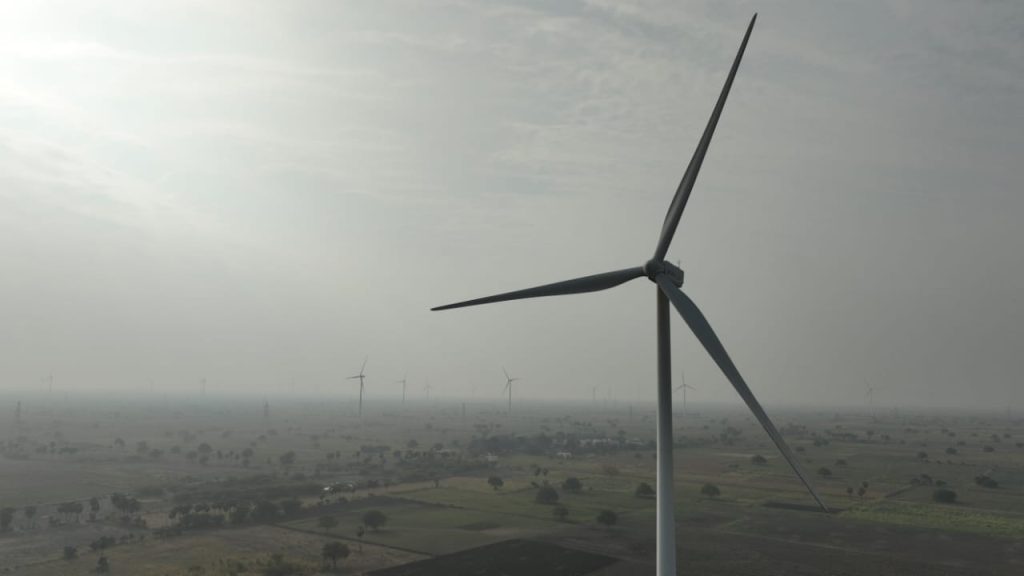
The investment landscape opening up around hybrid renewables is broad. Round-the-clock renewable tenders are creating a steady pipeline of bankable opportunities. Repowering is another avenue: India has several gigawatts of ageing, low-capacity turbines at prime sites that can be replaced with modern machines to multiply output from the same land. Offshore wind is the longer-horizon frontier, supported by a viability gap funding scheme for an initial 1 GW off the coasts of Gujarat and Tamil Nadu and a bidding trajectory extending to tens of gigawatts; the National Institute of Wind Energy has assessed offshore potential of around 70 GW across the two states.
India’s wind comeback is real, measured in a record 6.05 GW added in a single year. But the more important point is structural. Wind is returning not as a standalone segment but as one half of an integrated model, paired with solar, firmed by storage, and connected through a modernising grid. Every major policy lever now in motion points the same way. For developers, EPC contractors and investors, the message of the next decade is direct: the future of Indian renewables is hybrid, and the time to build for it is now.
 Electrify your feed! Click here to join our Whatsapp group and to get the latest updates, expert insights, and innovations driving India’s energy storage revolution.