Close Menu
The Battery MagazineThe Battery Magazine
  • Just In
  • Batteries
    • Battery Manufacturing (BESS)
    • Battery Materials & Chemistries
    • Battery Recycling
    • C&I Storage
  • Solar
  • Renewable energy
    • Wind Energy
    • Hydropower
    • Green Hydrogen
    • Bioenergy
  • Tenders
    • Energy Storage
    • Solar Energy
    • Wind Energy
  • Policy
    • Storage
    • Solar
    • Wind
    • EV
    • Transmission
  • EV
    • EV Batteries
    • EV Charging Infrastructure
    • Electric Mobility Trends
  • Grid
    • Transmission & Distribution
    • Grid Infrastructure
    • Power Generation
    • Power Equipments
  • Exclusive
    • Cover Story
    • Watt Matters
    • Perspective
    • Articles
  • More
    • E-Mag
    • Events
    • Contact Us
Facebook LinkedIn WhatsApp
The Battery MagazineThe Battery Magazine
  • Just In
  • Batteries
    • Battery Manufacturing (BESS)
    • Battery Materials & Chemistries
    • Battery Recycling
    • C&I Storage
  • Solar
  • Renewable energy
    • Wind Energy
    • Hydropower
    • Green Hydrogen
    • Bioenergy
  • Tenders
    • Energy Storage
    • Solar Energy
    • Wind Energy
  • Policy
    • Storage
    • Solar
    • Wind
    • EV
    • Transmission
  • EV
    • EV Batteries
    • EV Charging Infrastructure
    • Electric Mobility Trends
  • Grid
    • Transmission & Distribution
    • Grid Infrastructure
    • Power Generation
    • Power Equipments
  • Exclusive
    • Cover Story
    • Watt Matters
    • Perspective
    • Articles
  • More
    • E-Mag
    • Events
    • Contact Us
LinkedIn Facebook WhatsApp YouTube
The Battery MagazineThe Battery Magazine
Home » News » Ministry of Power Seeks Stakeholder Feedback on Draft Amendments to Captive Power Rules
News

Ministry of Power Seeks Stakeholder Feedback on Draft Amendments to Captive Power Rules

ManshiBy ManshiJanuary 7, 20263 Mins Read
Facebook Twitter LinkedIn WhatsApp
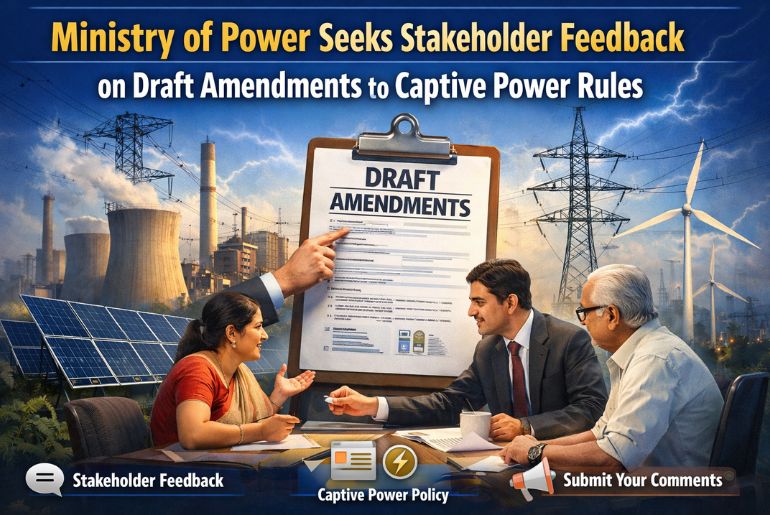
Ministry of Power Seeks Stakeholder Feedback on Draft Amendments to Captive Power Rules

The Ministry of Power (MoP) has issued draft amendments to Rule 3 of the Electricity Rules, 2005, which govern Captive Generating Plants (CGPs) or Captive Power Plants (CPPs) in India. The draft, notified as the Electricity (Amendment) Rules, 2026, invites comments from central ministries, state governments, regulators, power utilities, industry associations, and other stakeholders by January 17, 2026.

Objective of the Amendments

The proposed amendments aim to clarify long-standing ambiguities around ownership structures, captive consumption norms, and verification mechanisms for CPPs, particularly for group companies, Special Purpose Vehicles (SPVs), and Associations of Persons (AoPs). Stakeholders are requested to submit feedback to the Ministry via email.

Ownership and Consumption Norms

Under the draft rules:

  • Captive users must collectively hold at least 26% ownership in a generating plant.
  • 51% of electricity generated during the assessment period must be consumed for captive purposes.
  • Ownership now explicitly includes holding companies, subsidiaries, and group entities, recognizing legitimate corporate structures for captive qualification.

Flexible Assessment Period

To accommodate industrial realities, the draft introduces a flexible assessment period, allowing verification to align with operational cycles rather than a fixed financial year. Ownership and consumption entitlements will be calculated using a weighted average shareholding method.

Treatment of SPVs and AoPs

  • SPVs will be treated as AoPs for verification purposes.
  • Individual captive users may draw electricity based on operational needs.
  • Consumption beyond proportionate entitlement counts toward collective verification but not individual captive consumption.
  • Captive users holding 26% or more ownership are exempt from proportionate consumption restrictions.

Verification Process

  • Intra-state plants: Verified by nodal agencies appointed by state governments.
  • Inter-state plants: Verified by the National Load Despatch Centre (NLDC) with Central Government approval.
  • Disputes may be referred to a Grievance Redressal Committee.
  • Unit-level verification is allowed, benefiting multi-unit or phased plants.

Cross-Subsidy and Surcharges

Pending verification:

  • No cross-subsidy surcharge (CSS) or additional surcharge (AS) if a declaration is submitted.
  • If the plant fails captive criteria, surcharges and carrying costs under the Electricity (Late Payment Surcharge and Related Matters) Rules, 2022, apply.

Implementation Timeline

  • Provisions related to group captive consumption and verification take effect from April 1, 2026.
  • Remaining amendments are effective immediately.

Stakeholder Consultation

Stakeholders invited to comment include MNRE, CEA, CERC, state energy departments, DISCOMs, and industry associations such as FICCI, CIL, PHDCCI, and ASSOCHAM, along with academic and research institutions.

Strategic Impact

The MoP emphasized that these amendments aim to:

  • Modernize captive power regulations
  • Align rules with evolving corporate structures and industrial energy demands
  • Reduce compliance ambiguity
  • Facilitate renewable energy growth in India

The consultation reflects India’s commitment to enhancing industrial competitiveness, energy security, and clean energy adoption.

whatsapp icon Electrify your feed! Click here to join our Whatsapp group and to get the latest updates, expert insights, and innovations driving India’s energy storage revolution.
#policyupdate clean energy ficci India News Ministry of Power renewable energy
Manshi
  • Website

I'm journalism graduate with professional experience working across different news websites. I have been involved in news reporting, content writing, and digital media coverage, which has helped me develop a strong understanding of current affairs and storytelling. Currently, I am working with Battery Magazine, where I continue to create accurate, engaging, and reader-focused news content.

Keep Reading

NavPrakriti and IIT Kharagpur

NavPrakriti and IIT Kharagpur Partner to Advance Battery Recycling and Critical Mineral Recovery

IIT Guwahati

IIT Guwahati Develops Perovskite Technology Achieving 25.73% Solar Cell Efficiency

India’s Clean Energy Sector

India’s Clean Energy Workforce Grows by 6.6 Lakh, Rooftop Solar Leads Job Creation

Comments are closed.

Renewable energy
IIT Guwahati

IIT Guwahati Develops Perovskite Technology Achieving 25.73% Solar Cell Efficiency

June 4, 2026
India’s Clean Energy Sector

India’s Clean Energy Workforce Grows by 6.6 Lakh, Rooftop Solar Leads Job Creation

June 4, 2026
SJVN Flags

SJVN Flags Renewable Power Demand Gap Amid Rising Capacity Additions

June 4, 2026
Kyro Capital

Kyro Capital Launches ₹100 Crore Pre-IPO Fund Targeting Renewable Energy and Growth Sectors

June 3, 2026
Batteries
NavPrakriti and IIT Kharagpur

NavPrakriti and IIT Kharagpur Partner to Advance Battery Recycling and Critical Mineral Recovery

June 4, 2026
Advait Energy Secures 150 MW/300 MWh BESS Project from GUVNL

Advait Energy Secures 150 MW/300 MWh BESS Project from GUVNL

June 4, 2026
cylib and Vianode

cylib and Vianode Partner to Advance Recycled Graphite for EV Batteries

June 4, 2026
Trina Storage

Trina Storage Wins 160 MWh Ultra-High Voltage Battery Project in Japan’s Kyushu Region

June 3, 2026

Subscribe for Updates

Get the latest news about energy storage in your inbox.

    © 2026 Thebatterymagazine.com.
    • Home
    • About Us
    • Contact Us
    • Privacy Policy
    • Terms of Service

    Type above and press Enter to search. Press Esc to cancel.