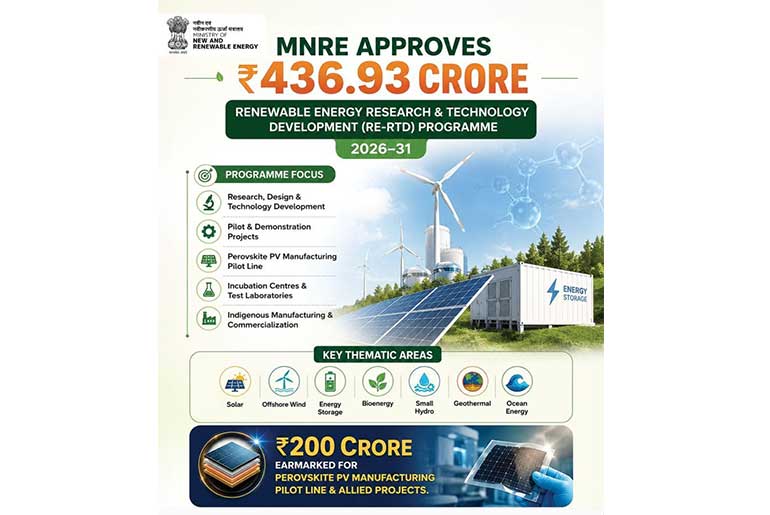
The Ministry of New and Renewable Energy (MNRE) has approved the Renewable Energy Research & Technology Development (RE-RTD) Programme for the 2026–31 period with a total financial outlay of ₹436.93 crore. The programme aims to strengthen indigenous research and development (R&D), accelerate technology innovation and support the demonstration of emerging renewable energy technologies in India.
The initiative is designed to promote the development of domestic technologies across the renewable energy value chain, while reducing dependence on imported technologies and strengthening India’s clean energy manufacturing ecosystem. The programme will provide support for research projects, pilot-scale initiatives and technology demonstration activities aimed at improving the performance, reliability and commercial readiness of renewable energy solutions.
Under the MNRE RE-RTD Programme, funding will be made available for a range of activities, including R&D projects, pilot and demonstration projects, testing infrastructure and incubation centres. The programme will also encourage greater collaboration between academic institutions, research organisations, startups and industry players to accelerate the transition of innovative technologies from laboratories to commercial applications.
The scope of the programme covers several renewable energy segments, including solar energy, wind power, energy storage, bioenergy, small hydropower, geothermal energy and ocean energy. By supporting research across multiple technology areas, the programme seeks to develop solutions that can contribute to India’s long-term clean energy and energy security goals.
Energy storage has also been identified as an important area under the programme, as the increasing share of variable renewable energy sources such as solar and wind creates a growing requirement for reliable and cost-effective storage technologies. Support for research and technology development in energy storage could help strengthen India’s ability to integrate renewable power into the grid while improving grid flexibility and reliability.
The programme will also focus on emerging areas such as artificial intelligence (AI), robotics, grid integration and circular economy solutions. The integration of AI and robotics into renewable energy systems could support improvements in areas such as asset monitoring, predictive maintenance, automation and operational efficiency. Meanwhile, research focused on circular economy approaches is expected to address resource efficiency, recycling and end-of-life management across renewable energy technologies.
A significant portion of the programme’s funding has been allocated to next-generation solar technology. Around ₹200 crore has been earmarked for the Perovskite PV Manufacturing Pilot Line and allied projects. The initiative is expected to support the development and manufacturing of perovskite photovoltaic (PV) technologies, which are being explored globally as a potential next-generation alternative or complement to conventional silicon-based solar cells.
The dedicated funding for a perovskite PV manufacturing pilot line is aimed at helping bridge the gap between laboratory-scale research and commercial manufacturing. Pilot-scale facilities can enable researchers and industry to test manufacturing processes, evaluate technology performance and address challenges related to scalability and reliability.
The RE-RTD Programme comes as India continues to expand its renewable energy capacity and strengthen its domestic clean energy technology ecosystem. By bringing together research institutions, startups, academia and industry, the initiative is expected to encourage innovation and facilitate the commercialisation of home-grown technologies.
With a focus on renewable generation, energy storage, advanced manufacturing and emerging technologies, the ₹436.93 crore programme could play a role in supporting India’s transition towards a more technology-driven and self-reliant renewable energy sector through 2031.
 Electrify your feed! Click here to join our Whatsapp group and to get the latest updates, expert insights, and innovations driving India’s energy storage revolution.