India’s energy-storage story did not begin with today’s large BESS tenders, viability-gap funding or storage obligations. It began with a question that was already becoming difficult for policymakers to ignore: if renewable energy was going to occupy a much larger share of India’s electricity system, where would the flexibility come from? In 2018, the Ministry of New and Renewable Energy (MNRE) constituted an Expert Committee to propose a draft National Energy Storage Mission (NESM).
The proposal sought to create an enabling policy and regulatory environment for manufacturing, deployment, innovation and cost reduction in energy storage. The government specifically identified renewable-energy integration, rural microgrids and electric mobility as important storage applications.
That mission, however, should not be confused with a current standalone national BESS mission.
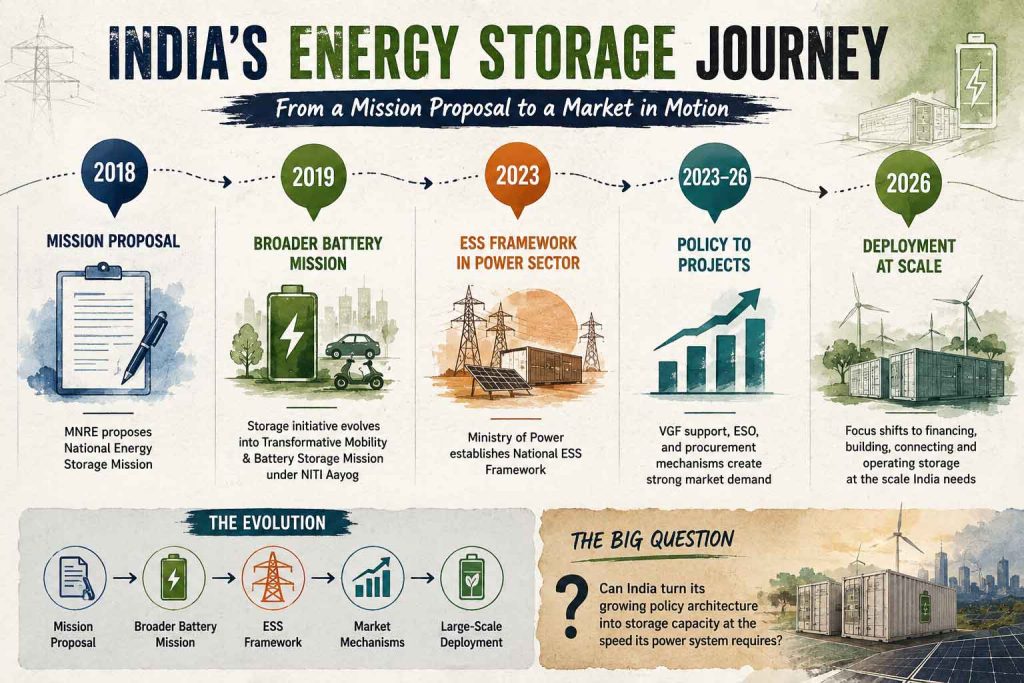
What followed was an evolution in policy architecture. The storage initiative moved into the broader National Mission on Transformative Mobility and Battery Storage, established under NITI Aayog in March 2019, while grid-scale energy storage subsequently acquired its own regulatory, planning, procurement and financial-support mechanisms.
By August 2026, India therefore has something more complicated—and arguably more consequential—than a single policy carrying the name “National Energy Storage Mission”: a growing national framework for energy storage spread across electricity regulation, system planning, financial support, procurement and manufacturing.
The question now is not simply whether India has a storage mission. It is whether this increasingly elaborate framework can deliver storage at the speed and scale the power system requires.
The National Energy Storage Mission was real—but it was a proposal
The first distinction needs to be made clearly.
The National Energy Storage Mission was not an invented industry phrase. It appeared in an official MNRE communication in August 2018.
In February that year, MNRE constituted an Expert Committee chaired by the MNRE Secretary, with representatives from relevant ministries, industry associations, research institutions and experts. Its mandate was to propose a draft for establishing a National Energy Storage Mission for India.
The committee’s proposed mission aimed to create an enabling policy and regulatory framework that would encourage manufacturing, deployment, innovation and cost reduction in energy storage.
The government also referred to a joint NITI Aayog–Rocky Mountain Institute report on India’s Energy Storage Mission, which proposed a three-stage approach:
- creating an environment for battery-manufacturing growth,
- scaling supply-chain strategies
- scaling battery-cell manufacturing.
This matters because the 2018 proposal was broader than simply installing lithium-ion batteries on the grid. Energy storage was already being viewed as infrastructure that could connect renewable generation to the electricity system, support rural energy systems and form part of India’s electric-mobility strategy.
But the wording in the government record is important: it says the committee proposed a draft NESM.
It does not say that a final, standalone National Energy Storage Mission was notified and operationalised under that exact name.
That distinction should remain intact.
Then came a different national mission
The next major step came in March 2019.
The Government established the National Mission on Transformative Mobility and Battery Storage under NITI Aayog. NITI Aayog continues to list the mission officially and describes it as a multidisciplinary mission chaired by the NITI Aayog CEO, with senior representation from the Ministry of Power, MNRE, Ministry of Road Transport and Highways, Department of Science and Technology, Department of Heavy Industry, DPIIT and BIS.
Its remit was broader than the 2018 NESM proposal’s title might suggest.
The mission focused on transformative mobility and phased manufacturing programmes for electric vehicles, EV components and batteries. Its responsibilities included manufacturing, specifications and standards, fiscal incentives, demand creation, regulation, R&D and localisation.
NITI Aayog’s own programme record identifies 7 March 2019 as the date for setting up the National Mission for Transformative Mobility and Battery Storage. It also lists the Advanced Chemistry Cell battery-storage programme among the major initiatives associated with the mission.
The distinction is therefore straightforward:
National Energy Storage Mission — 2018 proposal
versus
National Mission on Transformative Mobility and Battery Storage — 2019 government mission.
They are related historically, but they are not interchangeable names for the same current policy.
The 2019 mission put battery manufacturing at the centre
The shift toward battery manufacturing was significant.
India was trying to avoid building an electric-mobility market dependent entirely on imported cells and critical components. The 2019 mission therefore placed strong emphasis on domestic manufacturing, phased localisation and advanced battery technologies.
NITI Aayog’s own material describes the mission as seeking to create policy cohesiveness around e-mobility and battery storage and to facilitate Advanced Chemistry Cell and battery-storage manufacturing in India.
The government’s subsequent Production-Linked Incentive programme for Advanced Chemistry Cells, with an outlay of ₹18,100 crore, became one of the major instruments for developing domestic advanced-cell manufacturing. NITI Aayog continues to list the programme among the initiatives associated with the mission.
But this was not yet the same thing as today’s BESS policy architecture.
A battery-manufacturing programme answers one question:
Can India manufacture the cells and batteries it needs?
A grid-scale storage policy must answer several others:
- Who can own storage?
- How can storage connect to the grid?
- How is it procured?
- How does it earn revenue?
- Can it participate in electricity markets?
- Who pays for its capacity and services?
- How is it incorporated into resource planning?
Those questions increasingly moved into the electricity-policy domain.
The power sector began building a separate storage framework
The most important document for today’s BESS industry is therefore not the 2018 NESM proposal.
It is the Ministry of Power’s National Framework for Promoting Energy Storage Systems, issued in 2023.
The framework sets out objectives including deployment of storage for round-the-clock renewable power, reducing dependence on fossil-fuel generation, improving grid stability and reliability, enabling ESS participation in electricity markets, supporting innovation, and developing technical standards for safety, reliability and interoperability.
This is a significant change in the way storage is treated.
Storage is no longer simply a technology waiting for a subsidy.
It is increasingly being treated as an electricity-system resource.
The framework also incorporated the country’s projected storage requirement. Based on the National Electricity Plan, 2023, it estimated an energy-storage requirement of 60.63 GW / 336.4 GWh by 2029-30, including 41.65 GW / 208.25 GWh of BESS. By 2031-32, the total requirement was projected at 73.93 GW / 411.4 GWh, including 47.24 GW / 236.22 GWh of BESS.
These are planning requirements, not installed-capacity figures.
That distinction is critical.
India does not have 236 GWh of operational BESS today simply because CEA has projected that requirement for 2031-32.
Storage has also entered the electricity-system rulebook
The policy shift has gone beyond planning.
The Ministry of Power now describes Energy Storage Systems as part of the power system under the Electricity Act framework. Government documents also identify measures covering resource adequacy, BESS procurement, ancillary services, transmission-charge treatment and financial support.
This is where the difference between the old “mission” concept and today’s framework becomes visible.
A mission can set direction.
A functioning storage market needs rules.
It needs a route from a project developer’s balance sheet to a bankable revenue stream.
It needs procurement mechanisms that tell developers what service the buyer actually wants.
And it needs technical rules that determine how the asset connects and operates safely.
India is now building those layers.
VGF changed the economics of BESS
One of the clearest examples is the government’s Viability Gap Funding programme.
In September 2023, the Central Government approved VGF support for 4 GWh of BESS, with a budgetary outlay of ₹3,760 crore. As BESS costs declined, the capacity supported under the same approved budget was subsequently increased to 13.8 GWh.
The programme is important because VGF is not simply a consumer subsidy.
It is intended to make storage projects financially viable enough to be procured by utilities and other beneficiaries where project economics may otherwise be difficult.
And implementation provides an important reality check.
As of the Ministry of Power’s July 2026 update, BESPAs had been executed for 12.7 GWh under this scheme. Financial closure had been achieved for 6.54 GWh, while 0.5 GWh had been commissioned. The government reported VGF disbursement of ₹168.04 crore.
These numbers should not be interpreted as India’s total BESS deployment.
They describe the progress of this particular VGF programme.
But they reveal something important about implementation:
allocated capacity, contracted capacity, financially closed capacity and commissioned capacity are four different things.
For developers and investors, that distinction is far more useful than a headline announcing that a certain number of GWh has been “supported”.
The government has now expanded VGF support
India’s financial-support architecture has also grown.
In June 2025, the Ministry of Power initiated a second VGF scheme for 30 GWh of BESS, backed by ₹5,400 crore from the Power System Development Fund.
Of this, 25 GWh was allocated to 15 states and 5 GWh to NTPC.
By July 2026, the Ministry reported:
- 22.43 GWh with Letters of Award;
- 19.65 GWh with BESPAs executed;
- 5 GWh having achieved financial closure; and
- sanction for ₹180 crore in VGF disbursement following financial closure.
Taken together, the two VGF mechanisms envisage support for approximately 43.8 GWh of BESS.
Again, this is not the same as 43.8 GWh of commissioned BESS.
It is a supported development pipeline.
That distinction should be preserved in any discussion of India’s storage progress.
Procurement is turning policy into projects
The other major shift is procurement.
Government agencies and utilities are no longer discussing storage only in terms of future requirements. They are procuring it.
The Ministry of Power has issued tariff-based competitive-bidding guidelines covering storage capacity and stored energy from technologies including pumped storage, BESS and firm and dispatchable renewable energy.
This allows storage to be procured as a defined electricity-system service.
For a BESS developer, this is a fundamental change.
The commercial question moves from:
“Will batteries become important?”
to:
“Who is buying storage, what service are they buying, for how long, and under what payment structure?”
That is the point at which a policy framework begins to become a market.
CEA is now treating BESS as a planning category
The institutional architecture is also changing.
The Central Electricity Authority now has a dedicated Energy Storage & System Division.
Its responsibilities include formulation of a comprehensive National Energy Storage Policy and associated guidelines, technical regulations and standards, implementation of ESS VGF schemes, collection and dissemination of ESS data, R&D, ESS project databases, resource adequacy and storage trajectories. The CEA page was last updated on 1 August 2026.
This is an important current fact.
It means that as of August 2026, the government machinery is still working on the development of a comprehensive national storage policy framework.
At the same time, India already has the 2023 National Framework for Promoting Energy Storage Systems and a growing set of storage-related regulations and mechanisms.
There is therefore no need to manufacture a policy gap where one does not exist.
The more accurate observation is that India’s storage governance is still evolving and becoming more detailed.
The 2026 picture is therefore more layered than the word “mission” suggests
By August 2026, India’s storage ecosystem includes several layers:
National planning
CEA’s electricity and resource-adequacy planning identifies future storage requirements.
Policy framework
The Ministry of Power’s 2023 National Framework provides an overarching framework for promoting ESS.
Demand creation
Storage obligations and procurement mechanisms create routes for storage demand.
Financial support
VGF is being used to improve the economics of BESS deployment.
Market participation
Storage is being incorporated into electricity-market and ancillary-service mechanisms.
Technical regulation
CEA is developing and updating technical and safety requirements.
Manufacturing
ACC manufacturing incentives support India’s domestic battery-manufacturing ambitions.
Project monitoring
CEA now maintains a dedicated BESS project-status system, with reports covering deployment and development through June 2026.
That is not the architecture of a sector waiting for its first policy.
It is the architecture of a sector moving from policy formation toward implementation.
But a framework is not the same as deployment
This is where India’s storage story needs a more critical reading.
The country’s planning requirement is enormous. The 2023 National Electricity Plan projected 208.25 GWh of BESS by 2029-30 and 236.22 GWh by 2031-32.
Meanwhile, government-backed VGF projects are moving through different stages at different speeds.
Under the first VGF scheme, 12.7 GWh had BESPAs executed, but only 6.54 GWh had reached financial closure and 0.5 GWh had been commissioned as of the July 2026 government update.
That does not mean India’s entire BESS market is progressing at that rate.
It does mean that policy support does not automatically translate into commissioned assets.
Between announcement and operation sit land, transmission, financing, contracting, equipment supply, construction, grid connectivity, testing and commissioning.
For the industry, those execution layers may ultimately matter more than the existence of another policy document.
The next challenge is creating certainty around storage demand
For the industry, the question is increasingly shifting from whether India needs energy storage to how quickly and predictably that need can translate into actual procurement and deployment. Debmalya Sen, President of the India Energy Storage Alliance (IESA), has argued that India does not fundamentally have a storage-technology problem. The country has the technologies, developers, manufacturing ambitions and a growing pipeline of projects. The larger challenge is creating sufficient policy certainty and demand visibility for the industry to invest and scale at the pace required.
This is where the question of mandatory storage targets becomes relevant. A defined, long-term storage requirement can give developers greater visibility over future demand, help manufacturers plan capacity, and provide investors with a clearer basis for assessing projects. It can also encourage utilities to treat storage as a planned component of the electricity system rather than procuring it only when a specific tender or renewable project requires it.
India already has an Energy Storage Obligation (ESO), so the issue is not the complete absence of a storage mandate. The more important question is whether existing obligations are sufficiently ambitious, enforceable and aligned with the country’s rapidly increasing storage requirements. This distinction matters as India’s projected BESS requirement runs into hundreds of gigawatt-hours over the coming decade.
Sen’s perspective therefore adds another layer to the policy debate. India may not need another policy document simply to add another name to its storage architecture. What the industry needs is predictable demand, bankable procurement structures and clearer long-term signals that allow storage developers and manufacturers to plan beyond individual tenders.
The test of India’s storage strategy, ultimately, will not be the number of policies announced or gigawatt-hours identified on paper. It will be how much capacity reaches financial closure, construction, grid connection and commercial operation—and whether that capacity arrives before the power system actually needs it.
So, does India have a National Energy Storage Mission?
The answer depends on what exactly is meant by the phrase.
If it means the 2018 initiative:
Yes. A National Energy Storage Mission was formally proposed by an MNRE Expert Committee. It was a genuine government proposal, not an industry invention.
If it means a current standalone national BESS programme operating today under exactly that name:
That is not how the present policy architecture is officially described.
If it means a national government mission dealing with batteries and storage:
Yes. The National Mission on Transformative Mobility and Battery Storage was established under NITI Aayog in 2019 and remains listed by NITI Aayog as an official mission. Its principal focus, however, is transformative mobility, EVs, battery manufacturing and localisation rather than serving as the single regulatory framework for India’s grid-scale BESS market.
If it means the framework governing today’s BESS deployment:
The more accurate reference is the National Framework for Promoting Energy Storage Systems, alongside subsequent electricity-sector regulations, planning documents, procurement mechanisms and financial-support schemes.
And if it means a comprehensive National Energy Storage Policy, CEA’s current mandate shows that this remains an active area of institutional work.
The real story is no longer the name of the mission
India’s energy-storage journey has therefore moved through several stages.
In 2018, the government was considering how to create a national mission around energy storage.
In 2019, that effort became part of a broader mission focused on transformative mobility and battery storage.
In the years that followed, storage increasingly moved into the electricity system itself—through planning, regulation, procurement, storage obligations and financial support.
By 2026, the question is no longer whether India recognises the strategic importance of energy storage.
It clearly does.
The harder question is whether India’s multiple policy instruments can work together quickly enough to turn projected storage requirements into financially viable, safely connected and operational assets.
That is the real test of India’s energy-storage policy.
The country may not have a single current document carrying the exact title “National Energy Storage Mission.”
But it is building something more complex: a national storage architecture.
And for the BESS industry, how well that architecture works in practice will matter far more than what it is called.
 Electrify your feed! Click here to join our Whatsapp group and to get the latest updates, expert insights, and innovations driving India’s energy storage revolution.