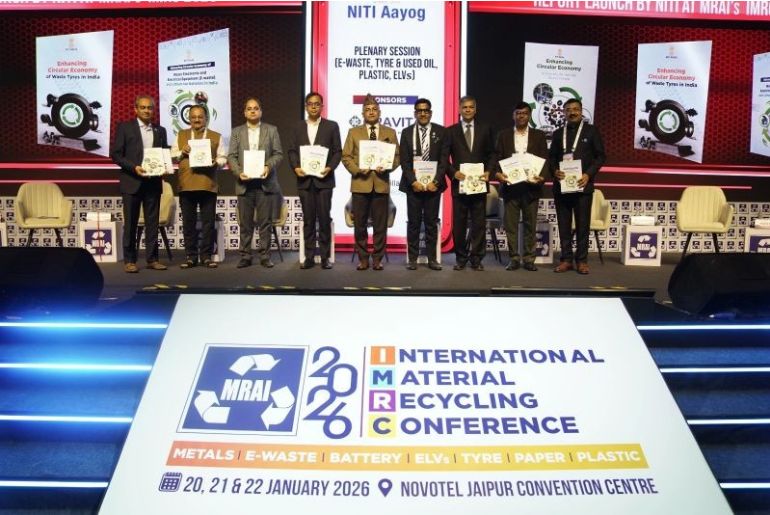
NITI Aayog launched three important reports on Wednesday. These reports focus on improving the circular economy in end-of-life vehicles (ELVs), waste tyres, e-waste, and lithium-ion batteries in India. The reports were shared during the International Material Recycling Conference (IMRC), organized by the Material Recycling Association of India (MRAI) in Jaipur.
The reports examine the current state of circular economy practices in India. They identify major gaps in managing end-of-life vehicles, waste tyres, e-waste, and lithium-ion batteries. The reports also offer practical suggestions to improve India’s recycling and resource recovery system.
Key Focus Areas of the Reports
The reports highlight challenges related to limited recycling infrastructure, a large informal sector, weak enforcement mechanisms, and low material recovery rates. To address these gaps, NITI Aayog has recommended:
- Development of modern recycling and processing infrastructure
- Formalisation of informal recycling activities
- Strengthening the Extended Producer Responsibility (EPR) framework
- Improving economic viability and revenue generation in recycling sectors
Circular Economy Critical for Viksit Bharat 2047
The reports highlight that the Hon’ble Prime Minister’s vision of “Viksit Bharat by 2047” is closely tied to a shift toward low-carbon and resource-efficient development. Clean energy systems, electric mobility, and digitalization will greatly increase the use of electronic equipment, batteries, and vehicles. This change makes sustainable waste management a key priority.
India’s electric vehicle (EV) market has grown rapidly, with EV sales rising from 50,000 units in 2016 to 2.08 million units in 2024. The government aims to achieve 30% EV penetration by 2030.
Growing Waste and Resource Challenges
With rising adoption of EVs and electronics:
- Lithium-ion battery demand is expected to grow from 29 GWh in 2025 to 248 GWh by 2035
- End-of-Life Vehicles (ELVs) are projected to increase from 23 million in 2025 to 50 million by 2030
- E-waste generation is expected to rise from 6.19 million metric tonnes in 2024 to 14 million metric tonnes by 2030
The reports stress that managing these waste streams sustainably is not only an environmental requirement but a strategic imperative for India’s long-term growth.
Stakeholder-Driven and Action-Oriented
Prepared through extensive consultations with ministries, regulators, industry stakeholders, and knowledge partners, the reports provide practical steps to speed up India’s shift to a circular economy. They aim to improve resource security and support environmental sustainability in key sectors.
The Reports can be accessed at:
- Enhancing Circular Economy of End-of-Life Vehicles (ELVs) in India:
2. Enhancing Circular Economy of Waste Tyres in India:
3. Advancing Circular Economy of Waste Electronic and Electrical Equipment (E-waste) and Lithium-Ion Batteries in India:
 Electrify your feed! Click here to join our Whatsapp group and to get the latest updates, expert insights, and innovations driving India’s energy storage revolution.