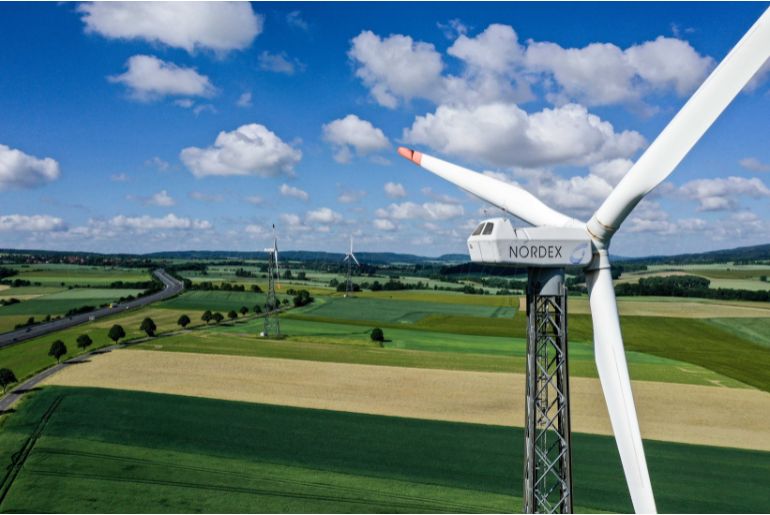
Nordex Group has secured repeat orders in Canada for the supply and installation of 73 wind turbines, marking a significant expansion of its footprint in the country’s onshore wind market. The two new orders comprise N163 turbines and, for the first time in Canada, the N175/6.X turbines, representing the market entry of the N175 platform.
The combined capacity of the two orders totals 508 MW. Each contract also includes long-term service agreements, reinforcing Nordex Group’s focus on lifecycle support and operational reliability. The company stated that turbine deliveries for the projects are scheduled for 2027 and 2028.
The turbines supplied under these contracts will be cold-climate variants equipped with the Nordex Advanced Anti-Icing System for rotor blades. According to the company, this technology is designed to ensure high turbine availability and minimise ice-related downtime during Canada’s severe winter conditions.
Commenting on the development, Manav Sharma, Chief Executive Officer North America of the Nordex Group, said, “We are thankful for the continued trust of our customers. The orders further strengthen Nordex Group’s market position in Canada.” He added, “Our proven anti-icing technology continues to be a key factor for success in cold climate regions, and now with the addition of the N175 to our offered products in Canada, we can help our customers maximise energy production year-round and help further reduce the Levelized Cost of Energy.”
The company has not disclosed the names of the customers or the specific wind farm locations associated with the orders.
Nordex Group has installed approximately 57 GW of wind power capacity across more than 40 markets worldwide and reported consolidated sales of around EUR 7.3 billion in 2024. The company operates manufacturing facilities in Germany, Spain, Brazil, India, the United States, and Mexico. Its product portfolio focuses on onshore wind turbines in the 4 MW to 7 MW-plus range, designed to meet the needs of markets with limited space availability and constrained grid capacity.
 Electrify your feed! Click here to join our Whatsapp group and to get the latest updates, expert insights, and innovations driving India’s energy storage revolution.