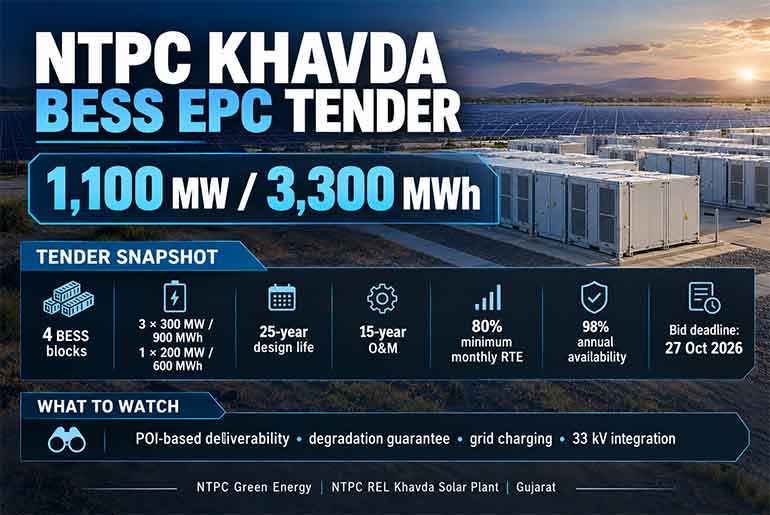
NTPC Green Energy Limited (NGEL) has issued a Khavda BESS EPC Tender for developing a 1,100 MW/3,300 MWh interstate transmission system (ISTS)-connected Battery Energy Storage System (BESS) at NTPC Renewable Energy Limited’s Khavda Solar Plant in Gujarat.
The fresh tender, issued on September 23, 2026, replaces NGEL’s earlier tender for the same 3,300 MWh project and introduces a revised capacity-degradation schedule for the BESS. Bids under the new Khavda BESS EPC Tender are due by October 27, 2026, at 3:00 PM, with techno-commercial bids scheduled to open at 3:30 PM the same day.
The procurement will follow a single-stage, two-envelope bidding process, comprising a techno-commercial bid and a price bid, followed by a reverse auction. The detailed bidding documents are scheduled to be available from October 1, 2026 through the designated tender platforms.
Four Blocks, 1,100 MW And 3,300 MWh
The Khavda BESS EPC Tender will be executed as a single EPC package comprising four independently evaluable blocks at PSS-1, NTPC REL Khavda, Gujarat.
| Block | Power Capacity | Energy Capacity |
|---|---|---|
| Block 1 | 300 MW | 900 MWh |
| Block 2 | 300 MW | 900 MWh |
| Block 3 | 300 MW | 900 MWh |
| Block 4 | 200 MW | 600 MWh |
| Total | 1,100 MW | 3,300 MWh |
Each BESS block will be connected at the 33 kV level of the designated solar plant. Importantly, the capacity specified in the new tender is the deliverable AC capacity to be demonstrated at the Point of Interconnection (POI) at COD, rather than simply the battery’s internal nameplate capacity.
The bidder therefore has to account for auxiliary consumption, transmission-line losses, transformer losses and other losses while sizing the BESS.
25-Year BESS Design Life
NGEL has specified a 25-year design life for the BESS system, including the batteries, based on a daily single-cycle operation. The September tender also changes the battery requirement from the earlier tender. Instead of specifying a minimum number of cycles, the fresh document requires the batteries offered to be rated for a minimum 25 years of operation with a single-cycle-per-day application.
This requirement effectively places the emphasis on long-duration asset performance over the full operating life rather than simply meeting an upfront energy-capacity requirement.
New Degradation Schedule
One of the more significant technical provisions in the fresh Khavda BESS EPC Tender is the degradation schedule that the bidder must guarantee. The tender requires the BESS to begin at 100% of its awarded dispatchable capacity at COD, with minimum dispatchable energy specified progressively through Year 15:
– Year 1: 98%
– Year 2: 96%
– Year 3: 94%
– Year 4: 92%
– Year 5: 90%
– Year 6: 88%
– Year 7: 86%
– Year 8: 84%
– Year 9: 82%
– Year 10: 80%
– Year 11: 78%
– Year 12: 76%
– Year 13: 74%
– Year 14: 72%
– Year 15: 70%
The schedule is expressed as a percentage of the capacity at the beginning of life/COD, or the awarded capacity. That means the EPC bidder has to design its battery system, augmentation strategy and performance guarantees around a 70% minimum dispatchable-energy level at the end of Year 15, as specified in the tender.
15-Year O&M Is Part Of The EPC Scope
The contract does not end with construction and commissioning. NGEL has included comprehensive operation and maintenance for 15 years in the bidder’s scope. This includes the associated warranty and annual maintenance/service-level arrangements required to maintain BESS performance.
The technical scope therefore combines:
- EPC execution
- Commissioning
- Performance testing
- Long-term O&M
- Warranty obligations
- Annual maintenance/service-level requirements
- Capacity-performance obligations
The Salient Technical Features document also confirms that the BESS must be integrated with the existing 33 kV system, the designated solar plant and the grid.
80% RTE And 98% Availability
The technical requirements also set operating-performance benchmarks. The minimum monthly round-trip efficiency is 80%, including auxiliary consumption, measured at the termination point/Point of Coupling.
At the same time, the bidder must maintain 98% annual system availability.
The BESS must also be capable of meeting its deliverable capacity at the POI while providing the required reactive-power compensation.
For an EPC contractor, this means that battery performance cannot be considered independently from the power-conversion system, auxiliary systems, transformers, grid interface and controls.
Transformer And Transmission Losses Must Be Accounted For
The tender specifically directs the BESS supplier to account for losses between the termination point and the POI while determining the required nameplate capacity.
The specified loss assumptions include:
- Power transformer losses: 1%
- Transmission-line losses: 0.25%
The bidder must incorporate these losses, together with auxiliary consumption and other relevant losses, into the BESS sizing so that the contracted deliverable capacity is achieved at the POI. This is particularly important because the contracted 1,100 MW/3,300 MWh figure is tied to deliverable AC capacity, rather than being merely an installed battery figure.
Stored Energy To Meet Auxiliary Consumption
Another notable requirement is the treatment of auxiliary consumption. The bidder must design the system so that during both discharging and standby hours, the BESS plant’s auxiliary consumption is met using stored energy. The auxiliary system and BESS capacity therefore have to be sized for the entire contract period.
This requirement brings auxiliary loads directly into the system’s energy-sizing and long-term performance considerations.
EMS Must Support Grid Charging
The EPC scope extends beyond the battery containers and PCS. The bidder is responsible for configuring the Energy Management System (EMS) to operate the BESS in different modes according to grid requirements and to integrate its operation with the designated solar plant and plant scheduling requirements. The EMS scope specifically includes operation of the BESS with charging from the grid, with provision for future integration with the solar plant.
The project therefore involves a broader grid-integrated storage architecture rather than a standalone battery installation operating independently of the renewable plant.
What The EPC Contractor Has To Supply
The Salient Technical Features document lists a broad equipment and systems package.
The BESS is expected to include:
– Battery containers and battery racks
– Battery Management System (BMS)
– Energy Management System (EMS)
– SCADA
– Power Conversion System (PCS)
– Inverter-duty transformers
– Protection systems
– Power evacuation system up to the owner’s 33 kV pooling switchgear
– Cables
– Communication systems
– HT and LT systems
– Auxiliary power system
– Monitoring and control systems
– Fire-fighting systems
– Remote control and monitoring systems
– Other equipment and services required for reliable BESS operation and maintenance.
The turnkey scope covers design, engineering, supply, transportation, unloading, storage, installation, testing and commissioning.
33 kV Integration And Grid Compliance
The contractor will also be responsible for integrating each BESS block with the designated solar plant. The scope includes required bus-extension work and modifications needed to integrate the BESS into the 33 kV switchgear of the designated solar plant. The bidder must also undertake the grid-compliance study for the complete designated solar + BESS + power-evacuation system.
Power-quality compliance up to the grid interconnection point at the ISTS switchyard is also part of the EPC scope.
Fire Safety And Standards
NGEL has specified that the BESS should comply with the latest applicable guidelines of CEA, CERC and the relevant Load Despatch Centre. The BMS, EMS and fire-safety systems must comply with applicable Indian and/or IEC/IEEE standards and statutory guidelines. The tender specifically requires fire safety of the battery and container to follow applicable Indian and/or international standards.
Contractor To Bear Attributable DSM Charges
The EPC contractor also has a commercial responsibility linked to BESS scheduling. According to the tender, Deviation Settlement Mechanism (DSM) charges attributable to the bidder in connection with metering and scheduling of the BESS will have to be paid by the bidder during the contract period. This adds an operational-performance element to the contract beyond simply constructing and maintaining the storage system.
NGEL To Provide Bonded Warehouse
The fresh tender contains an important logistics provision that has received less attention in the early coverage.
NGEL will provide an earmarked, demarcated and licensed Private Bonded Warehouse at the BESS project site under the applicable provisions of Section 58 of the Customs Act, 1962 and the MOOWR framework.
The facility will serve as a designated shipping/receipt location for eligible imported BESS raw materials and components.
The successful contractor remains responsible for customs documentation, compliance and other obligations connected with imported materials and the use of the MOOWR facility. The bidder must also factor applicable benefits from the facility into its quoted price.
For a project involving 1,100 MW/3,300 MWh of storage equipment, this provision could have a direct bearing on the contractor’s import logistics and pricing assumptions.
Emergency Supply And Auxiliary Systems
The bidder must provide for emergency supply requirements during grid failure while the BESS is in operation. The auxiliary supply system from the 33 kV termination point/Point of Coupling is also within the bidder’s scope, including the auxiliary supply required for battery containers during commissioning.
The contractor must consequently account for auxiliary infrastructure from construction through long-term operation rather than treating it as an owner-supplied facility.
Bidding Process And Timeline
The current Khavda BESS EPC Tender follows a domestic competitive bidding route.
Tender: NGEL-CS-5779-004(BESS1R)-9
Issuing entity: NTPC Green Energy Limited
Project: 1,100 MW/3,300 MWh ISTS-connected BESS
Location: NTPC REL Khavda Solar Plant, Gujarat
Issue date: September 23, 2026
Bidding documents available from: October 1, 2026
Bid submission deadline: October 27, 2026, 3:00 PM
Techno-commercial bid opening: October 27, 2026, 3:30 PM
Process: Single-stage, two-envelope bidding followed by reverse auction.
| Capacity | 1,100 MW / 3,300 MWh BESS |
| Location | Khavda, Gujarat |
| Last Date | 27/10/2026 |
 Electrify your feed! Click here to join our Whatsapp group and to get the latest updates, expert insights, and innovations driving India’s energy storage revolution.