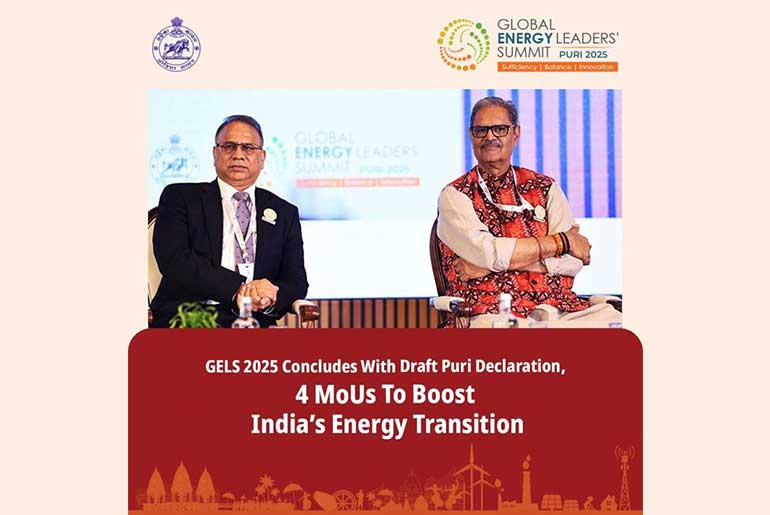
The Odisha government has successfully concluded the Global Energy Leaders’ Summit (GELS) 2025 in Puri, held from December 5–7. Bringing together national and international energy leaders, senior policymakers, researchers, and innovators, the summit aimed to outline India’s long-term energy vision under the central theme “Powering India: Sufficiency, Balance, Innovation.” The three-day gathering set the stage for major advancements in renewable energy, grid resilience, and sustainable technology adoption across the country.
GELS 2025 witnessed participation from 15 Indian states and more than 30 global energy experts, marking it as one of India’s most collaborative and future-oriented energy platforms. The event was structured around multi-sector dialogues and high-level sessions, enabling state governments, energy companies, and technology leaders to jointly address India’s evolving power needs.
A key highlight was the release of the Puri Declaration, a forward-looking policy statement outlining India’s commitment to accelerate clean energy capacity, strengthen interstate grid connectivity, and scale emerging technologies such as battery energy storage systems (BESS), hydrogen, nuclear power, and offshore wind. The declaration also emphasizes the role of artificial intelligence and machine learning in modernizing India’s power grid.
During the summit, Odisha signed four major Memoranda of Understanding (MoUs) with leading energy organizations. These agreements focus on developing renewable energy zones, integrating advanced storage solutions, supporting grid digitization projects, and promoting skill development for energy transition jobs. The MoUs are expected to boost Odisha’s clean energy investment pipeline while positioning the state as a rising hub for power innovation.
The sessions at GELS 2025 covered a diverse set of themes, including
- Artificial Intelligence in Power Systems: Experts demonstrated how AI-driven forecasting, predictive maintenance, and automated grid control can significantly reduce outages and distribution losses.
- Grid Security & Resilience: With rising renewable penetration, leaders discussed cyber-resilience, decentralized monitoring systems, and multi-layered protections for India’s transmission infrastructure.
- Nuclear Power for Base Load Stability: Policymakers emphasized nuclear energy’s expanding role in India’s 2050 energy strategy, highlighting safety advancements and upcoming small modular reactor (SMR) deployments.
- Energy Storage & Battery Innovation: Specialists presented India’s progress in BESS deployment, pumped hydro projects, and next-generation battery manufacturing.
- State-Level Energy Transformation: States such as Odisha, Karnataka, Maharashtra, and Tamil Nadu showcased their renewable and storage pipeline, with a collective emphasis on green manufacturing and decentralized energy solutions.
According to official data released during the summit, India added 31.25 GW of non-fossil energy capacity in FY 2025–26 (till October 2025)—the highest annual addition ever recorded. This demonstrates strong momentum toward the national goal of achieving 500 GW of non-fossil capacity by 2030.
Odisha’s leadership at GELS 2025 received wide appreciation, with analysts highlighting the state’s increasing investment in offshore wind studies, tidal energy exploration, and pumped hydro potential. Puri’s selection as the summit venue also reinforced the state’s commitment to sustainability, cultural heritage tourism, and green event management.
With its emphasis on sufficiency, balance, and innovation, GELS 2025 is expected to influence India’s energy policy directions for the coming decade—strengthening collaboration among states, accelerating clean technology adoption, and setting clear goals for a resilient, AI-enabled, and low-carbon power sector.
 Electrify your feed! Click here to join our Whatsapp group and to get the latest updates, expert insights, and innovations driving India’s energy storage revolution.