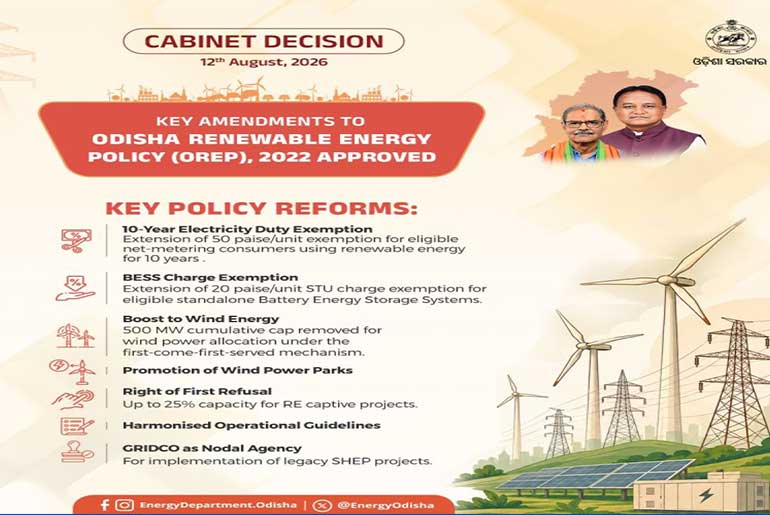
The Odisha Cabinet has approved a set of amendments to the Odisha Renewable Energy Policy (OREP), 2022, introducing changes aimed at accelerating renewable energy deployment, improving the investment environment and supporting the development of wind power and battery energy storage systems (BESS) in the state.
The amendments, announced through the Odisha government’s Cabinet Decision dated August 12, 2026, cover electricity-duty incentives for renewable-energy consumers, transmission-related relief for standalone BESS, wind project allocation, wind power parks, captive renewable-energy projects and implementation of legacy small hydro projects.
The move comes against the backdrop of Odisha’s existing OREP 2022 framework, which was formulated to create an enabling environment for renewable-energy development across technologies and to attract both private and public investment into the state’s clean-energy sector. The policy covers solar, wind, hydro, biomass, waste-to-energy, green hydrogen and green ammonia, among other technologies.
Key changes approved by the Odisha Cabinet
10-year Electricity Duty exemption:
The Cabinet has approved an extension of the 50 paise per unit Electricity Duty exemption for eligible net-metering consumers using electricity from renewable-energy projects established in Odisha. The exemption will be available for 10 years from commissioning, according to the Cabinet decision.
This is an important incentive for consumers adopting renewable generation because it reduces the effective cost of renewable electricity consumption over the operating period of eligible projects.
BESS gets 20 paise per unit STU charge exemption:
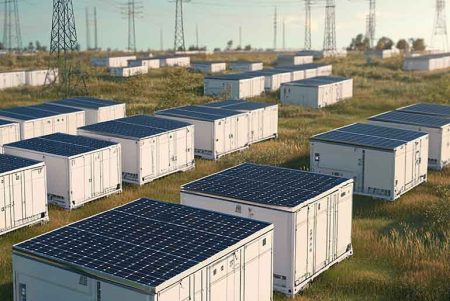
The amendment extends a 20 paise per unit exemption on State Transmission Utility (STU) charges for eligible standalone Battery Energy Storage Systems commissioned in Odisha.
The incentive is subject to the specified condition that the input energy is sourced from renewable-energy projects and the output is used to meet the state’s electricity demand.
The move is particularly significant as storage becomes increasingly important for integrating variable renewable generation and improving grid flexibility.
500 MW wind allocation cap removed:
One of the more consequential changes is the removal of the existing 500 MW cumulative cap for allocation of wind power projects under the first-come-first-served mechanism.
The change could provide additional room for wind developers to bring projects into the state, subject to applicable project-allocation and regulatory requirements.
Notably, Odisha’s earlier OREP framework already provided for wind projects to be allotted on a first-come-first-served basis, while the state amended the policy in February 2025 amid implementation requirements and wind-potential considerations.
Push for Wind Power Parks:
The amended framework also provides for the promotion of Wind Power Parks, potentially creating a more organised approach to developing larger-scale wind capacity and associated infrastructure.
Right of First Refusal for captive renewable projects:
The Cabinet has approved a provision for Right of First Refusal (RoFR) of up to 25% of capacity for renewable-energy captive projects.
This could provide greater flexibility to eligible captive consumers and project stakeholders in securing renewable-energy capacity for their requirements.
Operational guidelines to be harmonised:
The amendments also seek to harmonise operational guidelines, with the objective of reducing procedural friction and improving the implementation of renewable-energy projects.
GRIDCO designated for legacy SHEP implementation:
The Cabinet has further designated GRIDCO as the Nodal Agency for implementation of legacy Small Hydro Electric Power (SHEP) projects.
GRIDCO already has a central role in Odisha’s renewable-energy framework. The state designated GRIDCO as the nodal agency for implementation of OREP 2022 in December 2022, and GRIDCO’s current policy portal continues to list OREP 2022 and its amendments among the state’s renewable-energy policy documents.
What the amendments mean for Odisha’s renewable-energy sector
Taken together, the changes target several areas that are increasingly important to renewable-energy investors: project allocation, transmission costs, energy storage, captive consumption, wind development and implementation mechanisms.
The BESS incentive is particularly relevant because Odisha’s original OREP 2022 already recognised energy storage as part of the state’s renewable-energy framework. The policy provides technology-agnostic measures alongside technology-specific provisions and includes energy-storage projects among the areas covered by the policy.
The wind-related changes could also be significant. Removing the 500 MW cumulative allocation ceiling potentially widens the pipeline for wind development, while the proposed Wind Power Park approach could support larger, more coordinated projects.
For investors, however, the practical impact will depend on the detailed notifications, implementation guidelines and procedures that follow the Cabinet approval. The Cabinet decision establishes the policy direction; the corresponding operational and regulatory instruments will determine how developers and consumers can actually access the revised provisions.
Overall, the amendments represent a substantial attempt to rework the implementation architecture of OREP 2022 around Odisha’s evolving renewable-energy requirements, with greater emphasis on wind, storage, captive renewable generation and smoother project execution.
 Electrify your feed! Click here to join our Whatsapp group and to get the latest updates, expert insights, and innovations driving India’s energy storage revolution.