

As electric mobility gains momentum in India, the next phase of sustainable transport will depend on more than vehicle adoption. Battery technology, swapping networks, charging infrastructure and intelligent energy management will determine how reliably the transition moves forward.
The future of sustainable transport is often measured by the number of electric vehicles on the road. Yet, behind every electric two-wheeler, three-wheeler, car or bus lies a much larger system that determines whether the vehicle can operate efficiently, affordably and reliably.
For a delivery rider, the difference between an electric and conventional vehicle is not simply the technology under the seat. It is also the time required to recharge, the availability of a replacement battery, the reliability of the battery pack and the cost of keeping the vehicle operational. For a fleet operator, the equation extends to charging infrastructure, electricity costs, vehicle utilisation and the ability to manage energy demand.
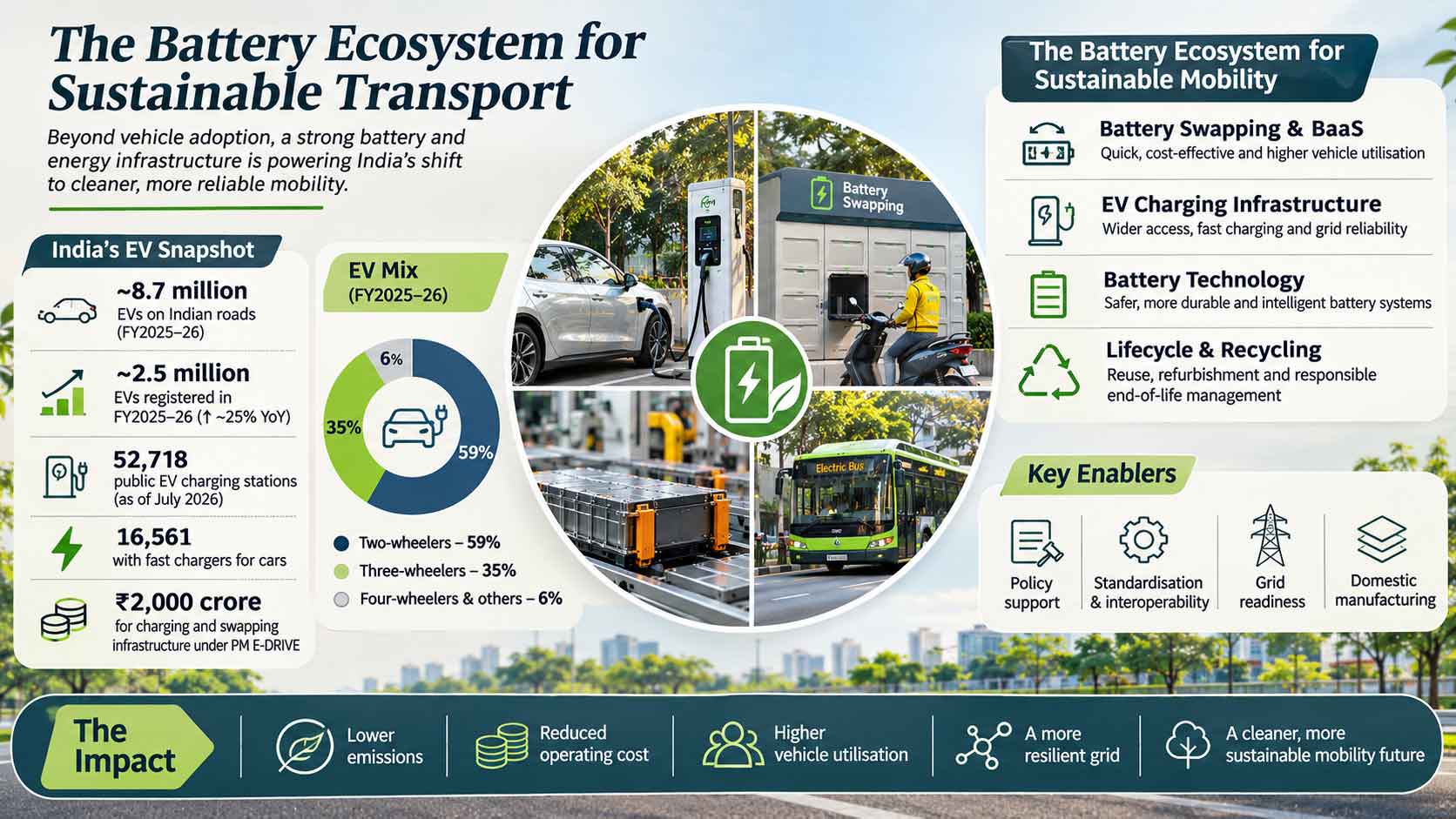
These everyday considerations are becoming increasingly important as India’s electric mobility ecosystem expands. The country recorded 52,718 public EV charging stations as of July 2026, including 16,561 equipped with fast chargers for cars, according to the Ministry of Heavy Industries. The government has also earmarked ₹2,000 crore under the PM E-DRIVE scheme for public EV charging infrastructure, including battery-swapping and battery-charging stations.
The numbers indicate that infrastructure development is progressing, but the larger challenge is to create an ecosystem in which vehicles, batteries, charging networks and electricity distribution systems work together. This is where the battery and energy infrastructure behind sustainable transport becomes central to India’s mobility ambitions.
Battery Swapping: Making Every Minute Count
In commercial electric mobility, time has a direct economic value. Delivery riders, e-commerce fleets, electric three-wheelers and other high-utilisation vehicles cannot afford long interruptions while their batteries recharge. A vehicle waiting at a charging point is a vehicle that is not earning.
Battery swapping offers an alternative by allowing a depleted battery to be exchanged for a charged one within minutes. Instead of waiting for the battery to recharge, the driver can return to the road with a replacement pack. The model is particularly relevant for electric two- and three-wheelers, where daily utilisation and operating costs influence the economics of ownership.
Battery-as-a-Service (BaaS) further changes the ownership equation by separating the battery from the vehicle. Under this model, the battery can be owned and managed by a third-party provider, while the vehicle user pays for access to energy. This can reduce the initial cost of purchasing an electric vehicle and make battery management a specialised service.
Tejasav Khattar, SVP, Engineering, Data and Platforms, Battery Smart, highlights the importance of combining energy accessibility with technology-led operations.
“The future of sustainable transportation will be shaped not just by the adoption of electric vehicles, but by how efficiently, intelligently and reliably we manage the energy that powers them. For commercial electric mobility to scale, sustainability must go hand in hand with affordability and operational efficiency. Battery swapping is emerging as one of the solutions supporting this transition, particularly for commercial two- and three-wheelers, where vehicle utilisation and time on the road directly influence driver earnings. Separating battery ownership from vehicle ownership can also help reduce the upfront cost of EV adoption, while swapping enables drivers to access energy in just a few minutes.
Technology is central to making this ecosystem reliable and scalable. Intelligent Battery Management Systems, IoT-enabled monitoring and technology-led network operations enable continuous tracking of battery health and performance, supporting better safety management, battery utilisation and operational efficiency. However, building a robust battery-swapping ecosystem requires more than deploying battery stations. It calls for OEM collaboration, standardised safety practices, effective battery lifecycle management and networks designed around demand. As India advances its sustainable mobility ambitions, the convergence of battery intelligence and accessible energy solutions will be key to making commercial electric mobility more efficient, reliable and economically viable at scale.”
The economics of swapping become clearer when viewed from the driver’s perspective. Muthu Subramanian, GM & MD, Yuma Energy, points to lost working time as one of the barriers affecting electric vehicle adoption among commercial users.
“Ask a delivery rider in Bengaluru what keeps him from going electric and the answer is rarely the vehicle price. It is the hour lost at a charger, because an hour offline is earnings gone.
That is the real adoption barrier in two- and three-wheelers: time, not technology. Battery swapping removes it. A depleted pack is exchanged for a charged one in minutes, so the vehicle spends its day earning instead of waiting. Utilisation rises and downtime falls.
Battery-as-a-Service strengthens the case by separating the battery from the vehicle. Upfront cost drops, the rider pays for energy as a service, and the operator ensures vehicle uptime. Smart battery management tracks pack health, charge cycles and temperature, so batteries last longer and the network sees where demand is building.
Scaling needs policy support. Swap networks are capital-heavy and depend on utilisation that takes time to build. GST is the immediate lever: swappable batteries should be taxed on par with the vehicles they power, and swapping services treated like EV charging. Clear, consistent tax treatment reduces capital needed and enables faster adoption.”
The two perspectives underline that swapping is not simply a faster way to recharge. Its long-term viability depends on station utilisation, battery standardisation, network density, safety practices and a commercially workable operating model.
India has also taken steps to establish a policy framework for this segment. The Ministry of Power issued the Guidelines for Installation and Operation of Battery Swapping and Battery Charging Stations on 10 January 2025. The guidelines aim to promote battery swapping and BaaS, while supporting the development of a wider network of battery charging and swapping stations. They also provide for coordination between state-level agencies, DISCOMs and other stakeholders to facilitate implementation.
Charging Infrastructure: From Availability to Reliability
While swapping can serve high-utilisation vehicle segments, conventional charging infrastructure remains essential for electric cars, buses, commercial vehicles and a growing range of other applications.
India’s public charging network is expanding, but the next challenge is to ensure that charging facilities are available where vehicles need them. Charging access along highways, at commercial hubs, in residential areas and around freight corridors will influence how confidently consumers and fleet operators adopt electric mobility.
The distinction between the number of installed chargers and the reliability of the network is equally important. A charging station must have an adequate electricity connection, suitable equipment, dependable uptime and a payment system that allows users to access charging without unnecessary complexity.
High-capacity DC fast chargers can reduce vehicle turnaround time, particularly for commercial operations. However, their deployment also creates additional demands on local electricity infrastructure. High-power charging hubs may require transformer upgrades, stronger grid connections and careful management of peak electricity demand.
Raman Bhatia, Managing Director, Servotech Renewable Power System Ltd., points to the need to combine charging infrastructure with intelligent energy management.
“India’s transition toward sustainable transportation has reached a stage where long-term momentum depends less on vehicle adoption and more on the reliability, speed, and accessibility of EV charging infrastructure. Expanding public charging networks beyond metro centres onto national highways, commercial hubs, and freight corridors is essential to eliminating range anxiety for daily commuters and fleet operators alike.
Making electric mobility truly viable requires deploying high-efficiency DC fast-charging solutions capable of delivering rapid turnaround times without compromising grid stability. Simultaneously, improving charging accessibility through standardised interoperability and transparent payment systems ensures seamless user experience across networks.
However, building a dependable charging ecosystem comes with critical on-ground challenges—most notably upstream DISCOM grid-connection bottlenecks, transformer upgrade delays for high-capacity hubs, and erratic peak load surges. Overcoming these hurdles requires intelligent energy management. Pairing high-efficiency DC fast chargers with solar generation and behind-the-meter Battery Energy Storage Systems (BESS) allows charging operators to shave peak grid demand, maintain high charger uptime during voltage fluctuations, and power electric vehicles with genuinely clean energy. When charging infrastructure becomes both grid-resilient and commercially sustainable, India’s e-mobility transition accelerates naturally.”
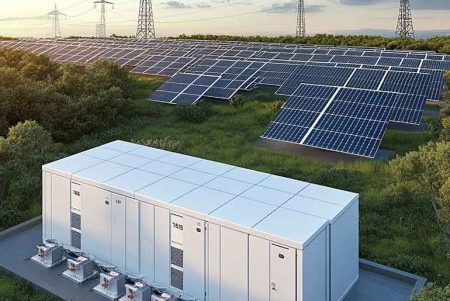
The integration of renewable energy and battery storage at charging facilities offers another opportunity. Behind-the-meter BESS can store electricity and discharge it during periods of high demand, helping operators manage peak loads and improve energy resilience. When combined with solar generation and appropriate energy management systems, storage can also support greater use of renewable electricity.
However, these benefits depend on project design, battery sizing, electricity tariffs and local grid conditions. Storage is not a universal substitute for stronger distribution infrastructure; it is one of the tools available to make charging networks more flexible.
The government’s PM E-DRIVE programme provides a policy push in this direction. Of its total ₹10,900 crore outlay, ₹2,000 crore has been earmarked for public EV charging infrastructure, including charging and battery-swapping facilities.
The Battery Question: Safety, Performance and Lifecycle
The reliability of an electric vehicle ultimately depends on the battery powering it. Battery performance influences driving range, charging time, operating costs and the overall ownership experience. For commercial vehicles, where packs may undergo frequent charging and discharging cycles, durability and consistent performance are especially important.
Battery Management Systems (BMS) play a central role in this process. They monitor parameters such as voltage, current and temperature, helping maintain battery operation within defined safety limits. Intelligent monitoring can also provide information about battery health, charge cycles and performance, supporting maintenance decisions and better asset utilisation.
As the market expands, battery manufacturers and technology providers will need to address more than energy density. Thermal management, product quality, safety validation, service support and lifecycle performance will all influence the long-term credibility of electric mobility.
Samrath S Kochar, Founder and CEO, Trontek, highlights the importance of dependable battery technology in building a commercially viable mobility ecosystem.
“The future of sustainable transportation will depend not just on the adoption of electric vehicles, but on the strength of the battery technology and energy infrastructure supporting them. In high-utilisation segments such as electric two- and three-wheelers, battery reliability, lifecycle performance and reduced downtime directly influence the economics of vehicle ownership and commercial viability.
Advancements in lithium battery technology, intelligent Battery Management Systems and real-time battery monitoring are playing a critical role in enhancing safety, optimising performance and improving asset utilisation. However, scaling electric mobility requires more than technological advancement. It calls for affordable battery solutions, reliable charging infrastructure, robust service networks and consistent quality standards.
India has a significant opportunity to build a globally competitive electric mobility ecosystem through investments in indigenous battery manufacturing, technology development and infrastructure. The next phase of EV growth will be driven by the ability to deliver battery solutions that are not only technologically advanced but also dependable, commercially viable and accessible at scale.”
The battery’s role in sustainable transport does not end when it is removed from a vehicle. As electric vehicle batteries reach the end of their first useful life, reuse, refurbishment and recycling become important parts of the wider mobility ecosystem.
India’s Battery Waste Management Rules, 2022, establish an Extended Producer Responsibility (EPR) framework under which producers are responsible for the collection and recycling or refurbishment of waste batteries. The rules cover EV batteries alongside other battery categories. They also provide for the use of recovered materials in new battery manufacturing, supporting the development of a circular battery economy.
This lifecycle approach is essential to ensuring that the environmental benefits of electric mobility extend beyond the point of use. Better battery tracking, responsible collection networks, recycling capacity and the recovery of valuable materials will become increasingly important as the number of EVs on Indian roads grows.
Building the Complete Sustainable Mobility Ecosystem
India’s sustainable transport transition is entering a phase in which the supporting infrastructure will matter as much as the vehicles themselves. Battery swapping can improve utilisation in commercial two- and three-wheelers. Public charging networks can extend the reach of electric mobility. BESS and renewable energy can help charging operators manage electricity demand, while intelligent battery monitoring can improve safety and asset performance.
None of these developments can progress in isolation. Vehicle manufacturers, battery companies, charging operators, swapping service providers, DISCOMs and policymakers must work together to address gaps in standards, infrastructure, financing and technology.
The next phase will also require greater attention to domestic battery manufacturing, reliable service networks and end-of-life management. Sustainable mobility cannot be measured only by the number of electric vehicles sold or the charging stations installed. It must also be assessed through how efficiently those vehicles operate, how responsibly their batteries are managed and how much of the energy ecosystem can be made cleaner and more resilient.
Ultimately, the success of electric mobility will depend on what happens beyond the vehicle. The battery systems, energy networks and infrastructure powering every journey will determine whether India’s transition to sustainable transport can deliver lasting environmental and economic value.
 Electrify your feed! Click here to join our Whatsapp group and to get the latest updates, expert insights, and innovations driving India’s energy storage revolution.