The battery industry is on the cusp of a revolutionary transformation, and at the center of this shift is an emerging technology known as quantum dot batteries. This represents not just a futuristic-sounding concept but a powerful solution to many of the limitations plaguing current battery technologies, including slow charge cycles, limited energy density, and challenges in miniaturization.
As consumer devices become more compact and electric vehicles (EVs) demand faster charging with longer ranges, the race to develop high-efficiency energy storage has never been more intense. Quantum dot batteries are gaining momentum in research labs and early-stage development, promising a future where storage is smarter, smaller, and significantly more powerful.
What Are Quantum Dots?
Quantum dots are small-scale semiconductor particles usually between 2 to 10 nanometers in size. Their small scale allows them to represent quantum mechanical properties, and most specifically quantum confinement. This means that when their size and composition are altered, they have discrete tuneable energy levels, making them highly adaptable to a range of applications such as optoelectronics, solar panels, displays, and now batteries!
Quantum dots can absorb light and emit light extremely effectively, so when they are used in battery architecture, they improve the electron transport pathways in the battery application, and in turn improve the overall rate of charge-discharge and performance of the battery to a greater extent.
How Do Quantum Dot Batteries Work?
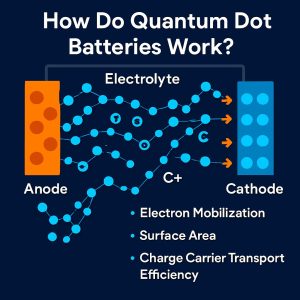
Quantum dot batteries utilize quantum dots either in the anode, cathode, or in the electrolyte to increase charge carrier mobility, conductivity, and chemical stability. The role of the quantum dots will depend on the battery chemistry (lithium-ion, sodium-ion, zinc-air, etc.):
- Electron Mobilization: quantum dots can add additional conduction pathways to enhance the transport of the electron.
- Surface Area: The nano-size of quantum dots provides significant active surface area to allow ions to interact with numerous active sites.
- Charge Carrier Transport Efficiency: they assist in decreasing the internal resistance and stabilizing the charge carriers over cycles.
Overall, quantum dots are nanoscale particles that act as microscopic highways to enhance the speed and efficiency of the electrons that flow when compared to conventional materials.
Key Advantages of Quantum Dot Batteries
1. Quicker Charging and Discharge
Quantum dot batteries can cut charging time due to their superior electron mobility, which is important for consumer electronics and electric vehicles.
2. Increased Energy Density
Quantum dots can store a greater amount of energy in a smaller volume (essentially addressing the front-of-the-napkin battery calculation—size versus capacity).
3. Longer Cycle Life
Quantum dot materials have high chemical stability and lower levels of electrode degradation relative to conventional batteries, resulting in longer cycle life.
4. Improved Safety
The enhanced thermal stability of these nanomaterials markedly decreases the chances of overheating and thermal runaway, which are common issues for lithium-ion batteries.
5. Alternative Form Factors
Quantum dot batteries can be manufactured as flexible and ultra-thin batteries, suitable for wearable, medical implant and microdevice applications.
Uses for Quantum Dot Batteries By Industry
- Consumer Electronics
Better smartphones, laptops and wearables could all benefit from smaller, faster-charging batteries. The possibilities include a phone that can fully charge in less than 10 minutes, and a smartwatch that can go for a week on a single charge. - Electric Vehicles
The EV market could also be one of the biggest beneficiaries of quantum dot batteries. A faster charging time and longer ranges would help to alleviate the feeling of “range anxiety”, while also making electric cars more appealing for the average consumer. - Medical Devices
Their size, along with their flexibility, also make quantum dot batteries safe to use in medical implants, such as pacemakers, or diagnostic sensors, while also providing long-lasting power in very small packages. - Grid Storage
The potential to use quantum dot batteries, due to their longer life span and efficiencies, could lead to greater use in renewable energy storage systems and small power grids that utilize solar or wind, to store energy and stabilize the grid.
Current Research and Breakthroughs
Researchers at institutions like MIT, Stanford University, and Korea Advanced Institute of Science and Technology (KAIST) have made significant strides in quantum dot battery development.
- MIT: Demonstrated the use of cadmium selenide quantum dots in lithium-ion batteries, increasing charge rates by 30%.
- KAIST: Developed a prototype sodium-ion battery using graphene quantum dots, showing remarkable energy density and low-cost scalability.
- Stanford: Created a hybrid battery that combines quantum dots with polymer electrolytes for improved thermal resistance and safety.
Private companies like QuantumScape and Nexeon are exploring quantum dot materials as part of their next-generation battery research, although much of the data remains proprietary.
Challenges to Overcome
Despite their promise, quantum dot batteries face hurdles that must be addressed before mass commercialization:
- Toxicity of Materials: Some quantum dots (e.g., cadmium-based) are toxic and environmentally hazardous. Safer alternatives like carbon or silicon-based quantum dots are being researched.
- Scalability: Manufacturing quantum dots consistently and cost-effectively on a large scale remains a significant challenge.
- Stability Under Cycling: Maintaining structural integrity over many charge-discharge cycles is still under study.
- Cost: The high production cost of quantum dots and integration into battery systems currently limits their commercial appeal.
The Road Ahead
While the battery industry continues to focus on alternative chemistries such as sodium-ion batteries, quantum dot batteries are, conceptually, an innovative, exciting, and viable path. Novel nanomaterials and scalable synthesis processes with hybrid architectures may fast-track a most exciting lab outcome into the
real world.
Material Scientists, Battery Engineers and Nanotechnology companies will have to collaborate to translate this promising research into fruition. Continuing government funding, support for industry investments and policies that incentivize sustainable innovation will also contribute to the outcome being realized.
In summary, quantum dot batteries will be potential changers for what energy storage systems are capable of, with the key factor being the systems relative ability to create efficiencies, miniaturisation, and fast charging performance as the platform for not just the next generation of battery technologies but the next generation of technologies which need them – whether that is a wiser electric vehicle to allow longer range, more intelligent medical implants or both, the future of batteries could be quantum.
 Electrify your feed! Click here to join our Whatsapp group and to get the latest updates, expert insights, and innovations driving India’s energy storage revolution.