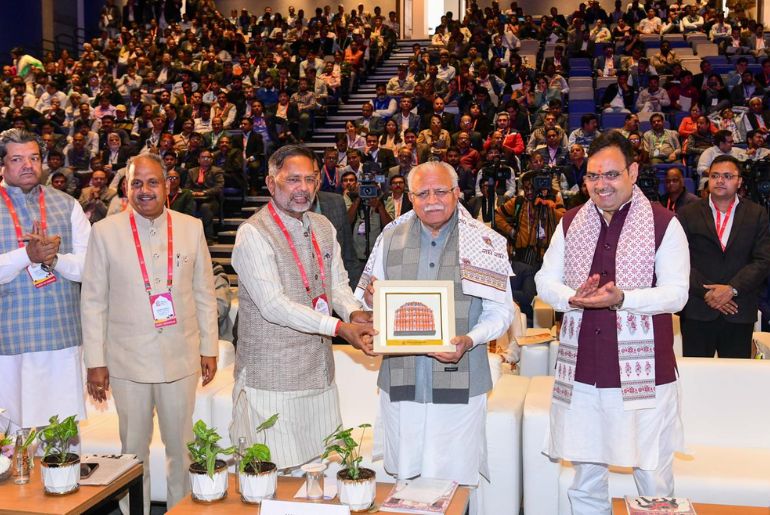
Rajasthan is set to become the backbone of India’s renewable energy network, with Union Power Minister Manohar Lal Khattar announcing at the Pravasi Rajasthani Divas held at JECC, Sitapura, Jaipur, that the state will host India’s future “energy super-highway.” He revealed that a 115-GW central transmission network under the Central Transmission System is being developed solely in Rajasthan and that work has commenced on a 1,600-kilometre undersea power cable to supply electricity from India to Dubai and the UAE, a Rs 40,000 crore project enabling India to export green energy to West Asian nations. The state’s 141 GW solar and 283 GW wind capacity, combined with its geographic advantage of early sunrise, makes it ideally positioned to power India and supply surplus electricity to Western countries, transforming Rajasthan into a global green energy hub.
Speaking at a special session on Battery Energy Storage Systems (BESS) during the event, Khattar emphasized Rajasthan’s immense renewable potential, noting that “although the sun sets in Rajasthan geographically, the future of global green energy will shine from this region.” He added that India is creating a “sun-to-sun” global energy cycle, developing electricity from solar, wind, water, and nuclear sources. Highlighting India’s rapid energy progress, he said the country has achieved 45% carbon emission reduction and 50% renewable energy share, five years ahead of schedule.
Chief Minister Bhajan Lal Sharma highlighted that 23,386 hectares have been allotted for renewable parks generating around 10,202 MW, and an additional 51,808 hectares for solar parks with 26,784 MW capacity.
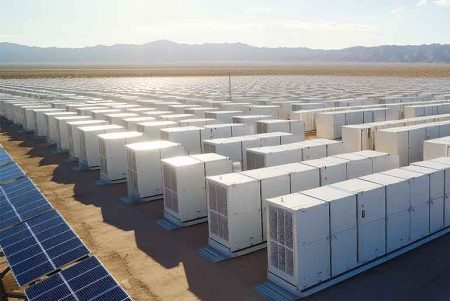
Principal Secretary (Energy) Ajitabh Sharma noted that India has entered a “decisive decade” for clean energy, as renewable capacity is expanding faster than the national grid can absorb. He explained that BESS functions like a giant power bank, storing electricity when available and releasing it as needed, stabilizing frequency and voltage, easing transmission pressure, and supporting peak-hour demand without relying on thermal plants. However, he added that adoption remains slow due to fragmented execution, outdated procurement, unclear market for storage services, high upfront costs, import dependence, and lack of standards for battery life and degradation. He stressed the need for a system-led national storage strategy encouraging new business models, revenue pathways, domestic manufacturing, and strong technical modelling.
Khattar highlighted India’s remarkable energy transformation over the past decade, from a 5% power deficit in 2014 to becoming power-surplus and exporting electricity. Last year, India met a peak demand of 250 GW, with the 2024–25 demand expected to reach 267 GW. The country has already achieved 505 GW renewable capacity, surpassing the 2030 green energy target of 500 GW.
Addressing transmission and storage challenges, Khattar said the Central Government has accelerated new transmission lines to ensure power from Rajasthan reaches other states. The Supreme Court has finalized hearings regarding the Great Indian Bustard habitat, with solutions for transmission lines to be implemented under certain conditions. To complement solar energy, India is developing large-scale storage systems, including the 1,680 MW pumped storage project near Hyderabad.
On reforms, the minister highlighted RDSS scheme measures to reduce transmission and distribution losses, which have dropped from 28% to 16%, and the installation of 4.7 crore smart meters, including 1.9 crore prepaid meters, initially rolled out in government departments to build public trust. Khattar emphasized the goal of ensuring 24×7 electricity supply for every citizen.
Reiterating Rajasthan’s strategic position, Manohar Lal Khattar, said, “A 115-GW central transmission network being built in Rajasthan clearly shows that the country’s energy super-highway will emerge from here,” establishing the state as India’s central hub for renewable energy and global green power exports.
 Electrify your feed! Click here to join our Whatsapp group and to get the latest updates, expert insights, and innovations driving India’s energy storage revolution.