REC Power Development and Consultancy Ltd. (RECPDCL), a wholly owned subsidiary of REC Ltd., has handed over the project-specific Luhri Power Transmission Limited special purpose vehicle (SPV) to Terralight Solar Energy Tinwari Private Limited, marking a key step toward strengthening power evacuation infrastructure for hydropower projects in Himachal Pradesh.
The SPV was handed over to the successful bidder on August 21, 2026, for development of the transmission system required to evacuate power from the Sunni Dam Hydroelectric Power Project (HEP) and Luhri Stage-I HEP.
The transmission system will be developed on a Build, Own, Operate and Transfer (BOOT) basis and is designed to support the integration of hydropower capacity into the wider electricity grid.
₹839.55 Crore Transmission Infrastructure
The project has an estimated investment of ₹839.55 crore and is scheduled for commissioning by October 15, 2029. The timeline is aligned with the expected commissioning schedule of the associated Sunni Dam and Luhri Stage-I hydro projects.
The planned infrastructure includes the establishment of a 400/220 kV GIS Nange Pooling Station in Himachal Pradesh, along with a 400 kV Nange Pooling Station–Koldam double-circuit transmission line spanning approximately 50 kilometres.
Additional associated transmission works will also be developed as part of the project.
The infrastructure is expected to provide the necessary transmission capacity to evacuate electricity generated by the upcoming hydro projects and deliver it to the regional power network.
SPV Handed Over to Successful Bidder
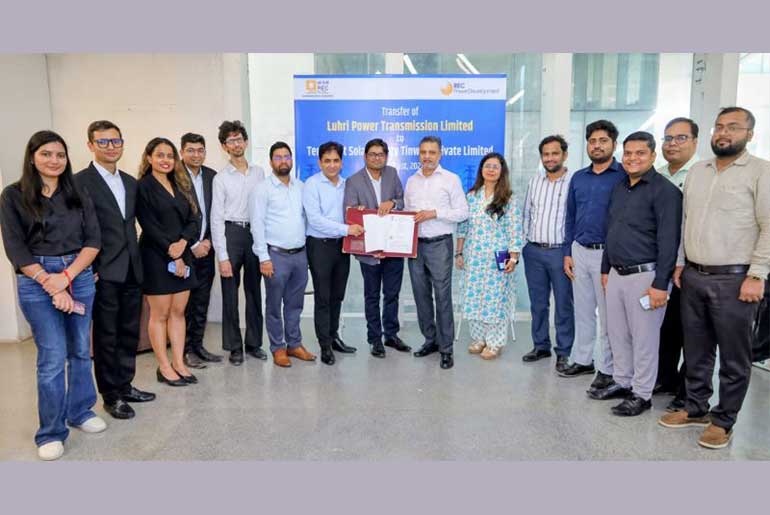
The SPV handover was carried out by Rajkumar Sonkar, HoD (CS), RECPDCL, to Nitin Mahajan, General Manager (Bidding), Terralight Solar Energy Tinwari Private Limited.
Senior officials from RECPDCL, Terralight Solar Energy Tinwari and the Central Transmission Utility of India Ltd. were also present during the handover.
The project-specific SPV structure enables the successful bidder to take forward development and operation of the transmission infrastructure under the BOOT model.
Supporting Renewable and Grid Integration
Hydropower is expected to remain an important component of India’s clean-energy mix because of its ability to provide relatively flexible generation and complement variable renewable sources such as solar and wind.
Transmission infrastructure will be critical as India adds more renewable and hydro capacity to the grid. Adequate evacuation systems can help prevent generation assets from being constrained due to insufficient network capacity.
The Luhri transmission project is therefore expected to play an important role in integrating power from the Sunni Dam and Luhri Stage-I projects while strengthening the transmission network in Himachal Pradesh.
For the broader battery and energy-storage sector, stronger transmission infrastructure is also important. A more robust grid can support the integration of renewable generation and future battery energy storage systems, enabling electricity to be moved efficiently between generation centres and demand hubs.
With commissioning targeted for 2029, the ₹839.55 crore project represents a significant investment in the transmission infrastructure needed to support India’s expanding clean-energy capacity.
 Electrify your feed! Click here to join our Whatsapp group and to get the latest updates, expert insights, and innovations driving India’s energy storage revolution.