Battery materials sit at the heart of every electric vehicle and energy storage system, yet the real debate shaping the industry today is not simply recycled versus virgin inputs. The decisive question is whether battery materials—regardless of origin—can meet the strict performance, safety, and reliability benchmarks demanded by modern cells. As EV manufacturing scales globally and in India, qualification standards for battery materials are emerging as the true gatekeepers of sustainability, cost control, and industrial resilience.
The real question is not recycled vs virgin—it’s qualification
In industry discussions, recycled and virgin battery materials are often positioned as opposing choices. In practice, cell manufacturers care far less about origin and far more about consistency. Battery materials must perform predictably across thousands of cycles, tolerate fast charging, and remain stable under thermal stress. A recycled lithium salt that meets these criteria is more valuable than a virgin input that fails to do so.
As EV batteries move toward higher energy density and faster charging, tolerances are tightening. What once passed as “acceptable” impurity levels in battery materials can now translate into accelerated degradation, impedance growth, or safety risks. This is why qualification—not recovery volume—is becoming the defining benchmark.
What “performance benchmarking” actually means for battery materials
Performance benchmarking of battery materials goes far beyond basic chemical composition. It is a multi-layered process that evaluates how materials behave during cell manufacturing and throughout the battery’s operating life.
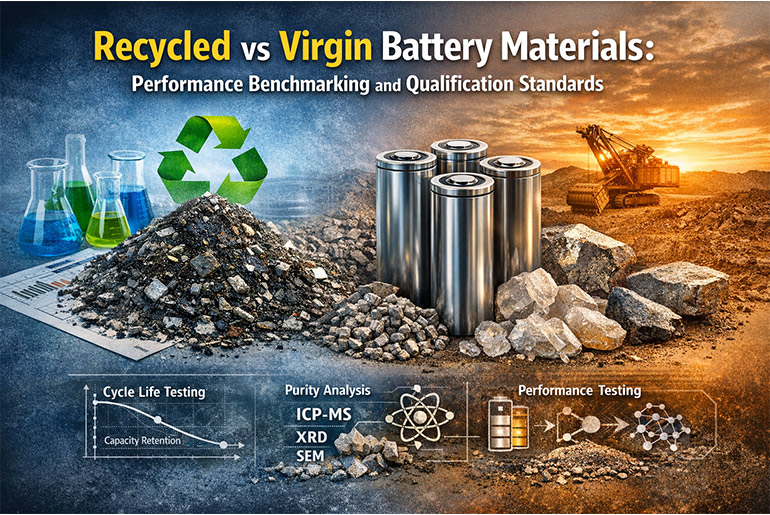
At the material level, benchmarking typically includes impurity profiling using techniques such as ICP-MS to identify trace metals that may catalyse side reactions. Moisture content, loss on ignition, particle size distribution, tap density, and surface area are assessed because they directly influence slurry rheology, coating uniformity, and electrode density.
At the electrochemical level, battery materials are tested for coulombic efficiency, impedance evolution, and voltage hysteresis. Even minor deviations can result in lithium plating during fast charging or uneven ageing across cells. At the pack level, these effects compound into reduced warranty life and increased safety risk.
For manufacturers, benchmarking battery materials is not a one-time test but an ongoing validation process tied to process control and supplier consistency.
Virgin vs recycled battery materials: where differences really show up
Virgin battery materials benefit from controlled extraction and refining routes, which historically delivered uniformity. However, mining variability, water chemistry, and refining shortcuts can still introduce impurities. Recycled battery materials, on the other hand, begin with heterogeneous feedstocks—end-of-life cells, production scrap, and mixed chemistries.
The real differences appear in three areas: impurity spectrum, morphology, and batch-to-batch stability.
Trace impurities such as iron, copper, sodium, calcium, chlorine, or sulphur—even at parts-per-million levels—can increase self-discharge, accelerate electrolyte decomposition, or raise thermal runaway susceptibility. Morphology matters equally. Particle shape and crystallinity influence lithium diffusion paths, while residual binders or cross-contamination from black mass can degrade performance if not fully removed.
This does not mean recycled battery materials are inherently inferior. Advanced hydrometallurgical and direct recycling routes can deliver battery-grade outputs that match virgin benchmarks. But lower-grade recovery processes often produce materials that look acceptable on paper yet fail during long-term cycling.
Battery material qualification is based on a tiered testing toolkit. Chemical purity is confirmed via ICP-MS and titration to measure concentration. Structural integrity is validated via XRD (phase purity and lattice parameters), while SEM-EDS provides information regarding particle morphology and elemental distribution.
Electrochemical testing includes half-cell evaluation, dQ/dV analysis (which provides insight on parasitic reactions) and EIS (to monitor resistance growth). However, the Cycle-life testing completed using fastest charges also reveals risks of lithium plating that could not be detected under standard conditions.
A quality engineer at a cell manufacturing facility recently shared a story in which an entire shipment of battery materials was rejected because of an observed impedance rise after only 50 cycles tested with fast charges. The chemical analysis showed that the chemistry met specifications on paper, but the testing showed a very different result when subjected to the physical testing method. By making that one decision, months of downstream failures were prevented.
Qualification standards map: global + India
Globally, qualification of battery materials is increasingly shaped by regulation. The EU Battery Regulation (EU 2023/1542) introduces recycled content targets and traceability requirements that implicitly demand battery-grade quality. Materials that cannot re-enter cell manufacturing at full specification will not help manufacturers meet compliance.
International safety frameworks such as UN 38.3 govern transport, while UNECE R100 and R136 set safety expectations for traction batteries. These standards do not specify material chemistry, but they indirectly raise the bar for battery materials by linking performance consistency to safety outcomes.
The Battery Waste Management Rules, 2022 for India has placed Extended Producer Responsibility (EPR) at the center of the ecosystem. The rules mainly focus on collection and recycling of used batteries; however, over the long term, they will also have an impact on quality. As it becomes easier to trace recycled content used in OEMs’ products, OEMs will require assurance that the recycled battery materials will meet their performance standards.
standards referenced by Indian authorities such as the AIS-156 Standard regarding battery safety, reinforce the connection between the quality of materials and the reliability of systems as a whole; and compliance success will be based on qualification rather than volume of recycled material.
India context: recycling growth, EPR pressure, supply security
India’s EV battery demand is growing at over 30 percent annually, while domestic access to lithium, nickel, and cobalt remains limited. This makes battery materials a strategic vulnerability. Recycling offers a domestic pathway, but only if recovered materials meet cell-grade standards.
Indian recyclers are rapidly expanding capacity, yet variability in feedstock and process maturity remains a challenge. For cell manufacturers scaling gigafactory operations, inconsistent battery materials can disrupt yields and delay ramp-up. As EPR frameworks mature, the market will naturally favour recyclers who can deliver qualified outputs rather than bulk recovery.
Two emerging use cases illustrate this shift. In one, a cell maker qualifies recycled lithium carbonate for LFP cathodes after extended cycling validation. In another, an OEM assesses recycled graphite against virgin benchmarks to stabilise anode supply during import disruptions. In both cases, success hinges on rigorous benchmarking.
What good looks like: a practical qualification playbook
For manufacturers and recyclers alike, a practical qualification approach for battery materials includes:
- Defined impurity thresholds linked to chemistry and use case
- Batch-level consistency checks, not just average values
- Morphology control aligned with electrode design
- Moisture and contamination management across logistics
- Electrochemical validation under fast-charge conditions
- Long-term cycle testing beyond minimum standards
- Supplier process audits and traceability
- Alignment with AIS, UN, and OEM internal standards
- Continuous feedback loops between cell performance and material specs
- Clear rejection protocols to prevent spec drift
This playbook transforms recycling from a compliance activity into a manufacturing asset.
Conclusion: How India Can Win in Quality vs. Volume on Battery Materials
The future of electric vehicle manufacturing will be determined by the reliability of electric vehicle batteries to perform rather than just the quantity of batteries that are manufactured. Central to this equation will be the materials used to make the electric vehicle batteries. Battery materials that are either made from recycled materials or made from raw virgin materials will both be successful/have the potential to fail based on your qualifications/disciplines of the individual who performs the qualifications/disciplines on both types of the battery material used to produce the electric vehicle batteries.
For India to take advantage of this opportunity, India must focus on creating/recyclable battery materials that meet quality control standards and will be manufactured to perform at established performance benchmarks. In doing so, India will have an opportunity to create a robust, sustainable, competitive battery ecosystem from cradle to grave. Sustainability, supply security, and industrial growth converge only when battery materials are trusted at the cell level. That is where the real transition begins.
 Electrify your feed! Click here to join our Whatsapp group and to get the latest updates, expert insights, and innovations driving India’s energy storage revolution.