Battery swapping is having a remarkable impact on how the fleets of electric vehicles are powered and managed as they make deliveries in a rapidly changing last-mile environment. As battery swapping services can shorten down-time from charging, decrease down-time in which vehicles sit, and significantly reduce energy consumption, this innovative and scalable solution allows electric delivery fleets to operate more efficiently by providing a fast energy refresh via an exchange of batteries. Battery swapping is fueling the evolution towards clean, sustainable mobility—enabling logistics companies to meet emissions goals by reducing costs and improving overall urban efficiency.
What Is Battery Swapping?
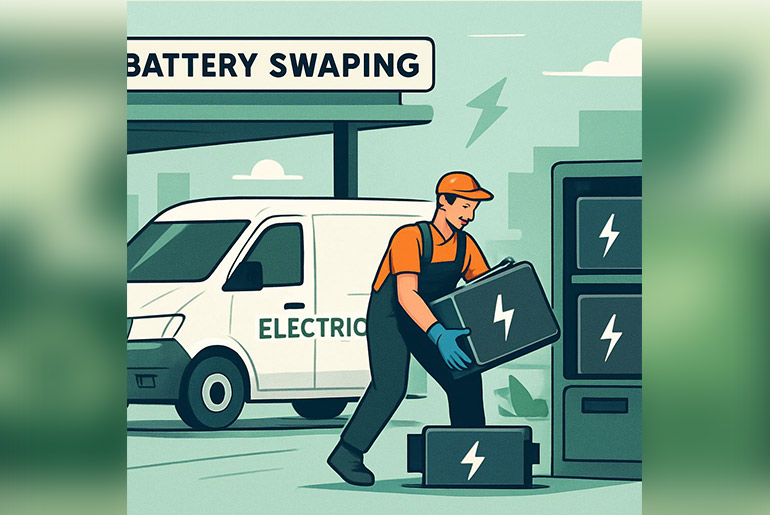
Battery swapping is the process of exchanging a depleted battery for a fully charged one in minutes—far quicker than conventional charging. Instead of waiting at a charger, delivery drivers can drive into a swap station, leave with a fresh battery, and continue operations almost immediately.
For last‑mile delivery fleets, where every minute counts, battery swapping minimizes vehicle downtime and maximizes fleet productivity.
Why Swapping Makes Sense for Fleets
Lightning-fast turnaround
Swapping a battery often takes under five minutes—faster than fueling a petrol vehicle. Companies such as Ample guarantee a full swap in under five minutes, while CATL’s stations in China advertise 100‑second changes.
Lower upfront costs
Through swapping, fleets have the option to avoid spending upfront on expensive batteries. They subscribe to the service, which is typically known as battery-as-a-service (BaaS). ACEEE has indicated this has the potential to reduce expenses related to vehicles by as much as 50%- and therefore, reduces the cost of electrification.
Infrastructure that is flexible and scalable
Swapping is easier because swapping stations do not require fast chargers (which require massive amounts of power), and they require much less upfront infrastructure than gas stations or high-powered charging stations. This means they are scalable and can be deployed significantly faster- which is ideal for building out urban delivery networks.
Grid-friendly charging
Swapping stations reduce demand on the grid, in that they take battery packs and charge them en masse with low demand, low-cost electricity at off-peak times. As more cities adopt renewable electricity, this will help cities grid reliability and energy efficiency.
Uninterrupted delivery service
Routinely, drivers using fast DC chargers can spend many hours per week waiting for power. With battery swapping, fleets stay on the move — no extra breaks, no service interruption .
Who’s Leading the Charge?
Several companies are pioneering swapping for last‑mile delivery:
- Ample: Based in San Francisco, Ample uses modular, vehicle‑agnostic battery packs and robotic swap stations that work with leading delivery trucks like Mitsubishi Fuso eCanter.
- Mitsubishi Fuso + Ample + Yamato: In Tokyo, a 150‑truck pilot with 14 swap stations delivers full charges in under five minutes. It’s funded through Tokyo’s New‑Energy grant.
- CATL: China’s battery giant plans 1,000 swap stations in 2025, ultimately boosting fleet adoption. These swaps take roughly 100 seconds.
- Nio: Originally focused on consumer vehicles, Nio has over 2,300 swap stations globally — proof that swapping can reach scale.
- Sun Mobility, Battery Smart, Gogoro, Oyika, Selex Motors: These firms operate worldwide, especially in Asia, focusing on two‑ and three‑wheeler fleets. Battery Smart alone supports Zepto with 1,000+ stations in India.
Battery Swapping in Action: India
India is rapidly adopting swapping across cities:
- Battery Smart enables Zepto’s deliveries via swift swaps across 30+ cities. A swap only takes two minutes.
- Sun Mobility supports Amazon, Swiggy, and Zomato with 600+ stations covering e‑bikes, auto‑rickshaws, and e‑loaders.
- Gogoro–Zypp pilots in Delhi—Gogoro powers 6 swap stations and 100 scooters, planning expansion to 30 cities.
- India’s Battery Swapping Policy draft promotes standards and BaaS models for urban EVs.
These examples highlight how battery swapping is thriving in India’s last‑mile delivery sector.
Challenges to Scaling Battery Swapping
Despite its benefits, battery swapping also presents obstacles:
Standardization issues
Battery packs vary between vehicle models, complicating universal swap station use. Companies like CATL and Gogoro are creating standard platforms to solve this.
High initial investment
While cheaper than fast chargers, setting up swap stations still requires capital. Plus, operators must stock extra batteries, which are expensive.
Battery lifecycle and logistics
Stations need smart inventory management to rotate batteries, ensure quality, and manage reuse and recycling—especially for commercial fleets that cycle batteries heavily.
OEM collaboration
Swapping requires vehicle designs compatible with removable batteries. Ample works with unaffected OEMs, but widespread OEM support is crucial.
Why Now? The Business Case for Battery Swapping
Surging e‑commerce growth
Last‑mile delivery demand is driving pressure to evolve. Fleets need faster electrification; battery swapping offers a practical solution without charging delays.
Government incentives
Tokyo’s grant, China’s CATL roll‑out, and India’s national policy all drive battery swapping infrastructure investment.
Shift in ownership models
BaaS means fleets don’t own batteries. They pay for energy and access only—cutting upfront costs and streamlining operations.
Complement to charging infrastructure
Battery swapping isn’t replacing chargers—it’s supplementing them. It fills critical gaps for high‑utilization fleet scenarios where charging stations alone may be insufficient .
Implementing Battery Swapping: A Fleet Playbook
Step 1: Assess your fleet profile
Evaluate delivery distances, utilization, vehicle types (two‑three‑wheeler, vans, trucks). Fleets with high daily range or constant use benefit the most.
Step 2: Choose the right partner
Work with established battery swapping providers:
- Ample for heavy trucks/vans
- Battery Smart or Sun Mobility for two‑/three‑wheelers
- CATL or Nio for scalable commercial roll‑outs
Step 3: Plan infrastructure strategically
Deploy stations near depots, along key routes, or hubs. Draw on government incentives and public‑private opportunities (e.g., municipal-owned land).
Step 4: Align with OEMs
Invest in vehicles compatible with battery swapping, or supported by swapping partners’ modular designs. This ensures battery fit and easier scalability.
Step 5: Design BaaS subscription
Adopt a battery‑as‑a‑service model, shifting capital expenditure to operational expense. Establish tariff, maintenance, and battery‑swap terms upfront.
Step 6: Streamline operations
Digitally track battery condition—swap counts, cycles, temperature. Plan proactive maintenance or replacement based on real‑time data.
Case Study: Tokyo Pilot
In Tokyo, the synergistic effort between Mitsubishi Fuso, Ample, Mitsubishi Motors, Yamato Transport, and the city government shows real-world success:
- 150 EV trucks and vans with 14 swap stations
- Swaps under five minutes, no charge downtime
- Quick station setup (one week max)
- Supports Tokyo’s 2030 greenhouse‑gas goal of 46% reduction
This collaboration exemplifies how battery swapping powers efficient, city‑wide fleet electrification.
Future Prospects
Standardisation momentum: CATL is co‑developing ten EV models with swappable packs; China plans 10,000 stations by 2030.
Policy support: India’s national swapping policy and Tokyo’s pilot show governments backing battery swapping for clean, efficient delivery.
Global expansion: Companies like Selex in Vietnam, Oyika in SE Asia, Sun Mobility in India are shaping multi‑city delivery networks.
Tech evolution: Robotics, battery modularity, and IoT monitoring enhance the swapping model for fleets.
Strategic Takeaways
- Battery swapping dramatically cuts downtime and boosts delivery efficiency.
- BaaS and modular batteries help reduce capital costs and complexity.
- To succeed, fleets must collaborate across infrastructure, OEMs, and policy makers.
- The wave of global pilots—from Tokyo to Delhi—proves swapping is ready for scale.
Conclusion: Utilize Battery Swapping to Accelerate Electrification
A critical step toward clean logistics is adoption of swapping models in last-mile delivery fleets. Swapping is becoming the foundation of electric fleets because it is faster than rapid charging, cheaper than battery ownership, and has been proven internationally from Delhi to Tokyo.
Swapping is not just an option for delivery companies wanting to save costs, increase uptime, and meet sustainability objectives, but it’s the smart, long-term fleet strategy choice.
 Electrify your feed! Click here to join our Whatsapp group and to get the latest updates, expert insights, and innovations driving India’s energy storage revolution.