
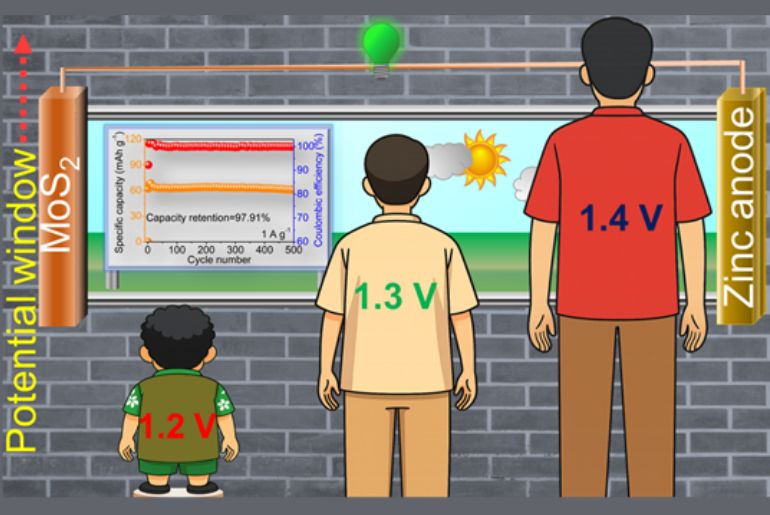
Researchers have made a big step forward in the field of sustainable energy storage by creating a new cathode material that makes aqueous zinc-ion batteries (AZIBs) work better and last longer.
Aqueous zinc-ion batteries are a safe, cheap, and eco-friendly way to store renewable energy from solar and wind sources. They use water-based electrolytes. Using zinc metal directly as the anode gives it a lot of theoretical capacity and is easy to find. But making a high-performance cathode material has been a big problem that has kept these batteries from being commercially viable.
Novel Cathode Material Developed at CeNS
Scientists at the Centre for Nano and Soft Matter Sciences (CeNS), Bengaluru an autonomous institute under the Department of Science and Technology (DST) have synthesised a sulfur vacancy-induced 1T-phase Molybdenum Disulfide (1T-MoS₂) as a high-efficiency cathode material.
The research team, comprising Mr. Ganesh Mahendra, Dr. Rahuldeb Roy, and Dr. Ashutosh Kumar Singh, used a controlled hydrothermal process to create sulfur-deficient 1T-phase MoS₂ nanoflakes. This advanced cathode material has a high surface area and superior electrical conductivity, enabling faster electrochemical reactions and improved charge storage.
Optimized Performance Window
A major part of the research was finding the best electrochemical potential window, which is the stable range of operating voltage for the battery. The group decided that the best range was “0.2 to 1.3 Volts (vs. Zn²⁺/Zn).” This optimization was very important for making the cathode material work better.
The developed battery demonstrated exceptional cyclic stability, retaining 97.91% of its initial capacity after 500 charge-discharge cycles at a current density of 1 A g⁻¹. It also achieved a Coulombic efficiency of 99.7%, indicating highly reversible zinc-ion movement with minimal side reactions.
To demonstrate real-world potential, the researchers used the battery to power a commercial LCD timer using a coin-cell prototype. The findings, published in the journal Energy & Fuels by the American Chemical Society (ACS), provide a detailed roadmap for designing advanced cathode material systems.
This breakthrough cathode material could help develop affordable, safe, and efficient batteries capable of storing large amounts of renewable energy for grid-scale applications.
 Electrify your feed! Click here to join our Whatsapp group and to get the latest updates, expert insights, and innovations driving India’s energy storage revolution.