
In the rapidly advancing world of energy storage, precision is everything. Lithium-ion and solid-state batteries—cornerstones of the EV and clean energy revolution—demand manufacturing conditions that leave no room for error. Even the smallest trace of moisture can compromise performance, shorten lifespan, or trigger safety hazards in these highly sensitive energy systems. As global demand surges for safer, more efficient, and more sustainable batteries, environmental control technologies are emerging as an indispensable part of the equation.
At the forefront of this transformation stands Bry-Air (Asia) Private Limited, a pioneer in dehumidification and environmental control solutions. With its state-of-the-art Dry Rooms, ultra-low dew point (LDP) dehumidifiers, and advanced solvent recovery systems, the company has established itself as a critical enabler of next-generation battery manufacturing. By combining sustainability with technological excellence, Bry-Air is helping manufacturers overcome challenges of energy efficiency, safety, and environmental compliance, while also preparing for the ultra-dry demands of solid-state technologies.
In an exclusive interaction, Shweta Kumari, Sub-Editor at The Battery Magazine, engaged with Dr. Vijay Chaudhry, CEO of Bry-Air (Asia) Private Limited, who shed light on how the company’s innovations in dehumidification, energy optimization, and NMP recovery are shaping the future of lithium-ion and solid-state battery production. From mitigating moisture risks to enabling sustainable practices, Dr. Chaudhry offered valuable insights into the role of Bry-Air’s technologies in driving the battery industry forward.
Let’s delve into the conversation to learn more.
1. Your company’s Dry Rooms and low dew point dehumidification are critical for lithium ion—and especially solid state Li ion—battery production. Could you explain how Bry Air’s technologies mitigate moisture-related risks during battery manufacturing?
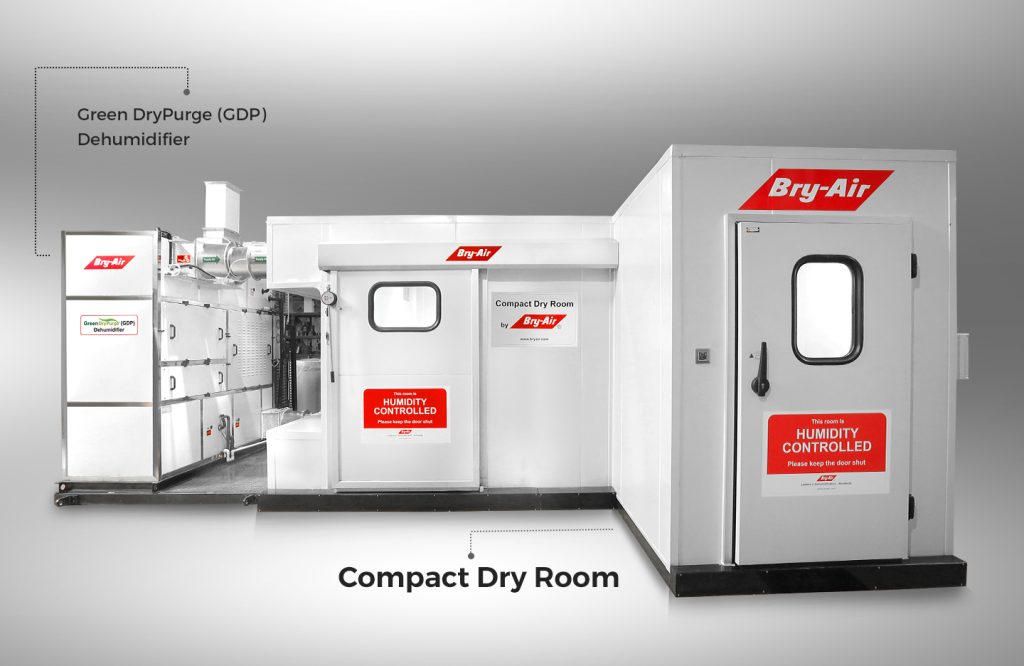
The various components of a Li-ion battery are hygroscopic in nature, making it mandatory to manufacture the batteries in highly controlled environmental conditions. Additionally, with the advent of solid-state Li-ion batteries comprising sulfides, which tend to degenerate in the presence of moisture, it is essential to perform manufacturing in Dry Rooms. Dry Rooms are basically sealed and controlled environment for maintaining ultra-low humidity levels by employing a precision dehumidifier that is plugged into the room. It is critical for mitigating moisture-related defects in battery components, such as lithium salts and electrolytes.
Along with this, the Low Dew Point (LDP) Dehumidifier provides an ideal solution for dealing with the moisture menace in the Dry Rooms. Tailored specifically for Li-ion battery manufacturing, LDP comes with technology to monitor moisture levels within the range of -40°C to -80°C supply air dew point in a Dry Room.
2. Operating Dry Rooms accounts for roughly 43% of a battery plant’s energy usage. How does Bry Air’s Low Dew Point (LDP) technology enhance energy efficiency and cost effectiveness in these environments?
During the time of battery manufacturing, Dry Rooms account for 43% of total energy consumption, majorly to power the dehumidifiers. To address the issue, our Super Low Dew Point (LDP) dehumidifiers play a crucial role in minimizing the energy costs by driving the energy efficiency of the Dry Rooms. Well equipped with high-performance rotors, it adds to the productivity of the Dry Rooms where it is responsible for achieving ideal manufacturing conditions with a dew point of -80°C. Along with this, it supplies air of < -70°C Dew Point for driving the stability and optimal performance of solid electrolyte.
3. Bry Air’s dehumidifiers achieve ultra low dew points (e.g., −80 °C). How do such capabilities impact the performance and longevity of batteries using moisture-sensitive components like solid electrolytes?
The ability of Bry-Air dehumidifiers to achieve ultra-low dew points comes to the aid in boosting the performance, safety, and longevity of the batteries. A dew point of −80 °C comes in handy for protecting the moisture-sensitive components of solid-state Li-ion batteries. It prevents decomposition of the solid electrolyte, thereby enhancing the battery lifespan in the process. By eliminating moisture, the desiccant dehumidifiers reduce the instances of explosion or fire accidents in EVs.
4. Your N Methyl 2 Pyrrolidone (NMP) recovery solutions reportedly reclaim up to 99.9% of solvent. How has this technology improved environmental compliance, manufacturing costs, and worker safety in battery production?
The NMP recovery is a pioneering technology from the house of Bry-Air that provides sustainable solutions for Li-ion battery manufacturing. Basically N-Methyl-2-Pyrrolidone (NMP) is a vital element that acts as a solvent for the electrode coating process. However, it is extremely expensive, due to which procurement of NMP remains a major issue in the industry. Along with this, consisting of toxic gases and substances, the material is life-threatening for the occupants, making them vulnerable to cancer. Furthermore, it even gives rise to air pollution, severely having a negative impact on the environment. Thereby, to counter its side effects, it is mandatory to recover 99.9% NMP to avoid releasing it directly into air as per the government guidelines.
Here the NMP Recovery System comes to the rescue, where it promotes capturing and recycling of NMP which effectively solves the problem of acquiring the material, saving them the exorbitant cost of buying NMP. At the same time, by extracting the toxic gas at the source, it significantly contributes to improving the air quality and even minimizes the exposure of occupants to the harmful gas. Thereby, the system readily conforms to environmental stewardship by reducing the carbon footprint at the time of battery manufacturing.
5. As the battery industry transitions toward solid state technologies that demand even drier conditions, how is Bry Air innovating to support evolving manufacturing requirements?
With Bry-Air leading the frontier in environmental control innovation, it is proficient at maintaining ideal environmental conditions for battery manufacturing. In the wake of sophisticated battery chemistries making strong inroads in the market with solid-state formulations, we at Bry-Air have aced the game with the state-of-the-art dehumidification systems. They achieve ultra-low dew point levels, meeting the stringent humidity and contamination control demands that guarantee the quality, performance, and safety of products. Taking for instance, our technologies – Green DryPurge® and advanced adsorption rotors, which are specifically engineered for Dry Rooms, align with the larger purpose of sustainability with their energy-efficient solutions as well. Staying committed to innovation, our solutions incorporate sensor-based automation, aimed at driving real-time monitoring and limiting manual intervention. As a result, Bry-Air is focused on delivering high-performing, future-ready environmental systems for facilitating battery manufacturing in terms of the most demanding applications.
 Electrify your feed! Click here to join our Whatsapp group and to get the latest updates, expert insights, and innovations driving India’s energy storage revolution.