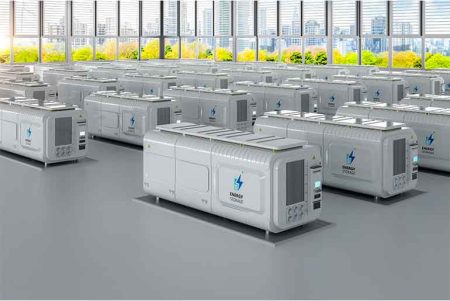


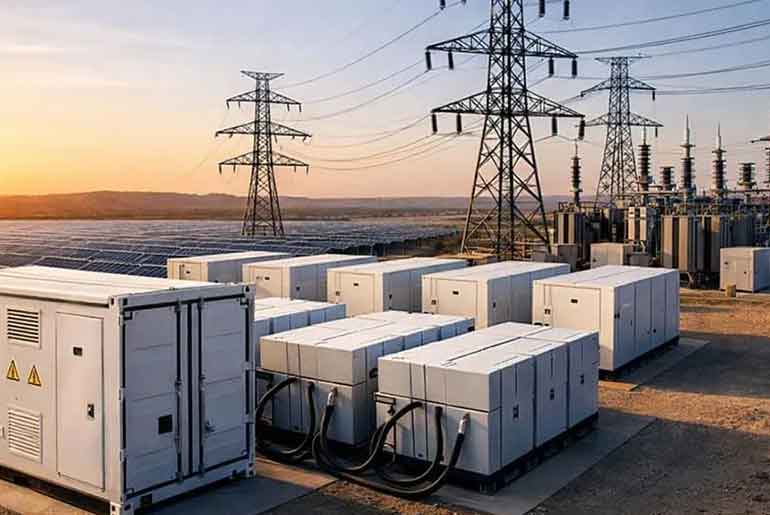
India’s BESS sector is now entering a pivotal phase, with the government introducing fresh support for large-scale battery storage projects and actively promoting the use of indigenously manufactured components. The Union Cabinet has approved a ₹14,500 crore Viability Gap Funding (VGF) scheme for 92 GWh of energy storage capacity, which is expected to create new opportunities for Indian BESS manufacturers, battery suppliers and energy storage project developers.
One of the key features of the scheme is the mandatory 40% Domestic Content Requirement (DCR) for all BESS projects which are going to be supported under the scheme. This is intended to boost local manufacturing, reduce import dependence and build a more robust supply chain for India’s burgeoning battery storage industry.
India Plans 92 GWh of New Energy Storage Capacity
Approved on 4th November 2026, the scheme will support the development of 92 GWh of grid scale energy storage over the period FY2026-27 to FY2030-31. The government has committed ₹14,500 crore in financial support to make these projects financially viable.
The planned capacity is 30 GWh of BESS, 60 GWh of pumped storage and 2 GWh of emerging storage. The projects are expected to attract an aggregate investment of ₹97,600 crore.
As per the government, the additional storage capacity will assist India in making inroads towards its estimated requirement of 411 GWh of energy storage by 2031-32.
The whole scheme is designed to deal with a major issue in the Indian renewables space. We generate solar power during the day, and we have a very significant demand for power in the evenings and at night. Battery storage is the answer to that. It enables you to store the surplus power generated during the day and then dispatch it when the demand is higher.
What does the 40% domestic content requirement mean?
The Domestic Content Requirement means that any battery storage project receiving support under the scheme must meet a minimum level of domestic content.
In simple terms at least 40% of the content required under the scheme must be from India (the domestic content requirement). The exact manner in which this will be measured and verified will be set out in the detailed implementation guidelines.
The primary objective is to get companies to source more of their components from Indian manufacturers rather than rely so heavily on imports.
For India’s battery industry this could translate into a greater demand for locally made battery components, equipment and storage systems and may well see companies looking to expand their manufacturing capacity and develop new capabilities.
However the requirement does not mean that every single component of the battery has to be made in India. The 40% requirement is a minimum domestic content requirement for projects that are funded under the scheme.
Opportunities for Indian Battery Manufacturers
India’s battery storage market is seeing increasing interest from manufacturers, project developers and renewable energy companies. The new scheme could go some way to further fuel that demand by incentivising storage projects to use local products.
Battery manufacturers may benefit from the increased opportunities to supply cells, battery packs and other components. There could be further business for those involved in battery management systems, power conversion equipment and energy storage integration as the projects develop.
For smaller players it could be an opportunity to get into the supply chain. For the more established players it could be an incentive to invest in further capacity and technology.
The requirement could also go on to support the development of a broader manufacturing ecosystem rather than just focussing on the battery assembly bit.
Can the policy reduce India’s import dependence?
India is very much reliant on imports for a number of battery materials and components, particularly in the lithium-ion battery space.
Encouraging domestic manufacturing via the new scheme could go some way to reducing this dependence over time. It would take more than just the assembly of the battery systems in the country to achieve that.
India will also need to build up its own domestic capability in battery materials, components, cell manufacturing and recycling.
The new domestic content requirement can facilitate this process by creating demand for locally produced goods. As volumes increase the companies will have the opportunity to improve their production efficiency and build up their supply chains.
At the same time domestic manufacturers will need to keep their prices, product quality and reliability up to scratch in order to meet the requirements of the large scale energy storage projects.
What does this mean for India’s energy storage market?
The ₹14,500 cr scheme is not just about funding energy storage projects. It’s also a policy initiative to build up a robust domestic battery industry.
By tying the financial support for BESS projects to domestic content requirements the Government is linking the deployment of storage with the growth of the manufacturing base.
For battery makers and energy storage developers the coming years could see more project opportunities, more partnerships and greater demand for Indian made components.
The real impact will be down to how quickly the projects get awarded, how the domestic content requirement is actually implemented and whether the Indian manufacturers can meet the growing demand of the industry.
Conclusion
India’s new energy storage scheme could well be a significant step in enabling both the deployment of batteries and the development of domestic manufacturing. The 40% domestic content requirement provides Indian companies with a real opportunity to get more involved in the burgeoning BESS market.
As the amount of renewable energy capacity grows, battery storage is going to be increasingly important for maintaining a reliable supply of electricity. A combination of strengthening domestic manufacturing and deployment of storage will go a long way to help India build a more resilient and self-reliant energy storage capability.
 Electrify your feed! Click here to join our Whatsapp group and to get the latest updates, expert insights, and innovations driving India’s energy storage revolution.