

India’s solar bill of materials (BOM) market could more than double from approximately US$3.6 billion (₹34,200 crore) in September 2026 to US$7.8 billion (₹74,100 crore) by March 2028, provided domestic manufacturing capacity is commissioned on time and demand certainty improves, according to a new study by the Council on Energy, Environment and Water (CEEW).
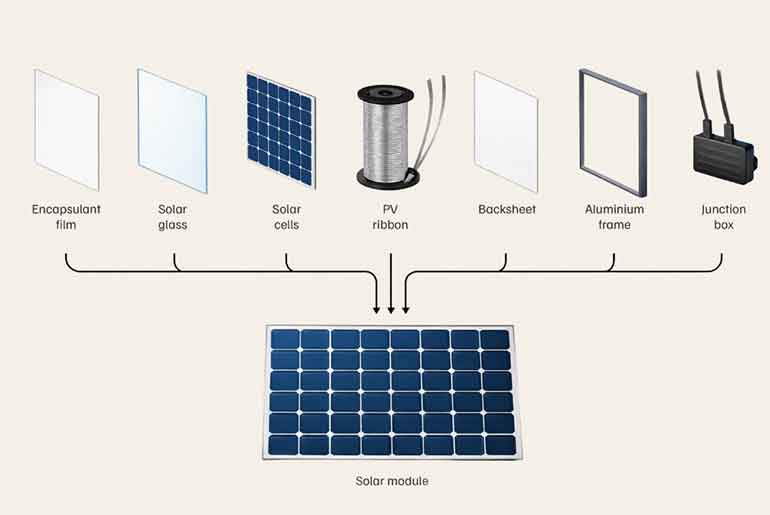
The study highlights opportunities for India to expand domestic manufacturing of solar module components, including solar glass, aluminium frames, copper ribbons, encapsulants, backsheets and junction boxes. These components constitute the bill of materials required for solar modules, excluding solar cells.
The findings were released at the Bharat Renewable Energy Summit & Expo 2026 in New Delhi, alongside a second CEEW study examining opportunities to localise battery electrolyte manufacturing in India.
India’s solar module manufacturing capacity reached 228.5 GW in September 2026, prompting manufacturers of associated components to expand their production capabilities. According to CEEW, India has the industrial foundation to manufacture most solar BOM components domestically, but timely commissioning of facilities, sustained demand and standardised testing infrastructure will be essential to translate capacity into market adoption.
Domestic Solar Component Manufacturing Could Meet Demand
Company announcements indicate that India could achieve self-reliance in most solar module components by March 2028 if planned manufacturing facilities are commissioned as scheduled.
Domestic annual manufacturing capacities for solar BOM components in September 2026 ranged from 20 GW for solar glass to 153 GW for junction boxes.
If planned expansions are completed on schedule, domestic manufacturing capacity for aluminium frames, copper ribbons and encapsulants could meet India’s estimated annual solar module demand of approximately 67 GW by March 2027. Solar glass capacity is expected to meet this demand by March 2028, while junction box manufacturing capacity already exceeds estimated requirements.
Backsheets remain an exception, as manufacturers have not announced new capacity expansions amid the increasing adoption of glass-glass solar modules.
The study highlights that module manufacturers are willing to shift towards domestic components if Indian suppliers can match imported products in cost and performance. However, domestic production must expand alongside solar deployment to ensure adequate supply.
Rising Imports Highlight Domestic Manufacturing Opportunities
India’s dependence on imported solar components has increased significantly in recent years.
Between FY2021 and FY2026, solar glass imports grew at an annual rate of 63%, increasing from US$129 million to US$1.48 billion. Aluminium frame imports grew by 88% annually, while junction box imports increased by 92%.
During FY2026, China accounted for 66% of India’s solar glass imports and 70% of aluminium frame imports. Vietnam and Thailand supplied 34% and 31% of encapsulant imports, respectively.
CEEW said strengthening domestic manufacturing could reduce solar module producers’ exposure to international price fluctuations and trade policy changes.
China withdrew its value-added tax rebate on photovoltaic exports in April 2026, while India’s anti-dumping duties on solar glass, frames and EVA encapsulants remain in force until 2029. These measures increase the landed cost of imported components and could improve the competitiveness of domestic manufacturers.
However, the study cautions that delays in commissioning domestic manufacturing facilities could increase solar module production costs.
Need for Advanced Manufacturing and Standardised Testing
CEEW identified opportunities for Indian manufacturers to expand into advanced solar component technologies, including multi-busbar and reflective ribbons that improve module efficiency, low-temperature ribbons for heterojunction cells and composite frames.
The study also highlights continued dependence on imported raw materials and the absence of uniform testing standards across the industry. Manufacturers currently follow their own testing practices, creating challenges in establishing consistent quality benchmarks.
Additionally, none of the six solar BOM components has a dedicated Harmonised System customs classification. Imports are recorded under multiple customs codes, making trade data estimation difficult and complicating the enforcement of anti-dumping duties.
Rishabh Jain, Fellow at CEEW, said India has demonstrated its ability to manufacture solar modules at scale, with the next challenge being the domestic production of components at comparable scale and quality.
He added that committed investments and sustained local demand could help India emerge as an alternative global supply chain for solar bill of materials.
India Has Existing Capabilities for Battery Electrolyte Manufacturing
The second CEEW study, Localising Battery Electrolyte Manufacturing in India: Capabilities, Constraints, and Policy Support, highlights opportunities to establish domestic battery electrolyte production using India’s existing chemical industry capabilities.
Electrolyte accounts for approximately 5% of the total cost of a battery cell and plays a critical role in cell performance and safety.
Indian companies have announced approximately 150 GWh of domestic battery cell manufacturing capacity. According to CEEW’s analysis, India would require between 60,000 and 90,000 tonnes of electrolyte annually to support battery manufacturing.
The study finds that India’s chemical industry already possesses much of the capability required to manufacture battery electrolytes. The primary gaps include battery-grade purity standards, testing infrastructure and specialised equipment rather than manufacturing technology.
Domestic Electrolyte Testing Infrastructure Required
CEEW highlighted the limited availability of accredited domestic laboratories for testing battery-grade electrolyte.
Currently, Indian producers send samples to laboratories in South Korea, Japan and Germany for testing and certification. This process increases approval timelines, laboratory expenses and courier costs.
The study estimates that establishing a domestic battery electrolyte testing laboratory would require approximately US$1.6 million (₹15 crore).
Dr Akanksha Tyagi, Senior Programme Lead at CEEW, said India’s chemical industry and research institutions possess capabilities in raw materials, machinery, processes and skilled talent that could support commercial electrolyte manufacturing.
She highlighted the opportunity for India to strengthen its position in the global battery electrolyte supply chain by leveraging these existing capabilities.
CEEW Recommends Standards and Demand Support for Domestic Manufacturing
CEEW has proposed several policy measures to strengthen domestic solar component manufacturing and battery electrolyte production.
For the solar sector, the study recommends introducing dedicated customs codes for each component variant before the Union Budget 2027–28. It also calls for uniform testing standards through the Ministry of New and Renewable Energy (MNRE), Bureau of Indian Standards (BIS) and industry stakeholders.
The study recommends bringing all six solar BOM components under the Approved List of Models and Manufacturers (ALMM), with listings by January 2028 and implementation from January 2029. It also proposes extending the Domestic Content Requirement to these components from January 2028.
For battery manufacturing, CEEW recommends establishing domestic testing laboratories whose certificates are recognised internationally, alongside local sourcing requirements that gradually progress from voluntary to partial and full implementation.
The study also proposes an Approved List of Battery Component Manufacturers, milestone-linked capital subsidies for battery cell components and joint ventures that enable Indian companies to co-own technologies they develop.
Both studies were supported by the New Energy Industrial Strategy (NEIS) Center.
The Council on Energy, Environment and Water (CEEW) is an independent climate and energy policy research institution headquartered in New Delhi. The organisation conducts research and analysis to support public policy, transform markets, advance technology and promote sustainable development.
 Electrify your feed! Click here to join our Whatsapp group and to get the latest updates, expert insights, and innovations driving India’s energy storage revolution.