If you follow the global energy industry even casually, one phrase likely dominates your feed: Solid-State Batteries (SSB). They are frequently heralded as the “holy grail”—the definitive end-point of battery evolution. Safer, denser, and supposedly invincible, they represent the peak of our technological ambition.
But for those operating on the ground—managing grids, drafting policy, and deploying capital—a more grounded question remains: Is the industry building that future today, or is it still preparing the mechanical and economic floor for it?
While the headlines belong to the “breakthroughs” of tomorrow, the heavy lifting of the global energy transition is being done by the “workhorses” of today. In the world of Battery Energy Storage Systems (BESS), the conversation has shifted. We are no longer just asking, “What is the most advanced battery?” We are asking, “What is the most bankable?”
The Reality of a Shifting Grid
The sun doesn’t always shine, and the wind doesn’t always blow. This “intermittency” is the greatest hurdle for India’s target of 500 GW of non-fossil fuel capacity by 2030. To solve this, we don’t just need a “fancy” battery; we need a massive, reliable, and affordable one.
This is where the distinction between “Innovation” and “Execution” becomes critical. While solid-state technology offers a tantalizing promise—higher energy density and a non-flammable solid electrolyte—the timeline for its arrival at a utility scale is a subject of intense debate.
The “Tsinghua Warning”: A Global Reality Check
In mid-March 2026, a crucial perspective emerged from China, the world’s undisputed battery superpower. Ouyang Minggao, a lead academician at Tsinghua University, provided what is called as a “Strategic Synchronization” update.
Despite China holding a dominant 44% of global solid-state patents, Ouyang cautioned that a mass-market rush before 2027–2030 could be premature. This wasn’t a dismissal of the technology; it was a reality check on engineering. Moving from a lab-scale coin cell to a 500 MWh grid-scale container involves overcoming “interface resistance” and manufacturing costs that currently remain prohibitive for the mass market.
The 15,000-Cycle Powerhouse: LFP’s New Era
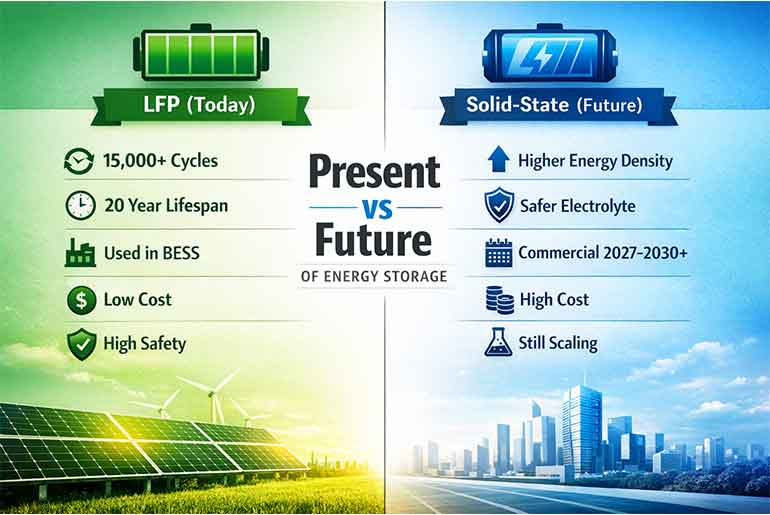
While we wait for the solid-state “sprint,” the Lithium Iron Phosphate (LFP) “marathon” has reached a new gear. We are now seeing LFP chemistries capable of 15,000 charge cycles.
For a B2B operator, this is a game-changer. A 15,000-cycle life translates to nearly 20 years of operational service. When a battery’s lifespan matches the 25-year lifespan of a solar farm, the economics of renewable energy become unbeatable. LFP is no longer the “budget” choice; it has become the “Standard of Reliability.” In India’s tropical climate, LFP’s thermal stability isn’t just a feature—it’s a requirement. This is why our current BESS infrastructure is almost entirely built on this “proven” foundation.
India’s Two-Track Strategy: Bridging the Gap
India is not standing on the sidelines of this tech evolution. Our industry leaders are playing a sophisticated “Two-Track” game: deploying what works now, while investing in what comes next.
- Reliance New Energy: At the Jamnagar complex, Reliance is building a multi-chemistry ecosystem. By acquiring companies like Faradion (Sodium-Ion) and Lithium Werks (LFP), they are securing the “now.” Simultaneously, their global R&D partnerships ensure they are at the table when solid-state reaches commercial maturity.
- Ola Electric: Through their “Bharat Cell” initiative and the Battery Innovation Centre (BIC), Ola is filing hundreds of patents. They are currently scaling up high-density cells for the 2-wheeler market, but their prototypes are already testing the boundaries of solid-state architectures.
- The Academic Backbone: At IIT Madras and ARCI Hyderabad, researchers are working on indigenous solid electrolytes. They aren’t just trying to copy global tech; they are trying to find “India-specific” materials that can reduce our reliance on imported minerals.
From Breakthrough to Bankability
The most significant shift observed this year is the move toward Execution-Driven Thinking. Earlier, the focus for policymakers was: “What is the most advanced technology?” Today, the focus is: “What can be deployed at scale, safely, and profitably?”
For a grid operator in Rajasthan or a DISCOM in Maharashtra, a “breakthrough” in a lab is meaningless if it cannot be insured, financed, and maintained for two decades. This is why the “transition” is a bridge, not a jump. We are using the proven safety and supply chain of LFP to build the infrastructure that will one day house the solid-state cells of the future.
Where Does Solid State Fit?
So, does solid-state have a future? Absolutely. But its entry point will likely be a “top-down” approach. We will see solid-state first in premium EVs, aerospace, and defense applications where energy density is worth a premium price. Over time, as manufacturing scales and costs drop—likely post-2030—it may begin to compete with LFP in the stationary storage market.
The Final Take: A Symphony of Chemistries
The battery industry is moving away from a “winner-takes-all” mentality. The future isn’t about one technology killing another; it’s about a symphony of chemistries working in harmony.
LFP provides the Stability and the Scale we need today.
Sodium-Ion offers the Sustainability for low-cost mobility.
Solid-State offers the Aspiration and Performance for tomorrow.
Real progress is rarely a sudden explosion of new tech. It is the steady, disciplined application of what is already proven, layered with the restless ambition of what is next.
Real progress is rarely a sudden explosion of new tech. It is the steady, disciplined application of what is already proven, layered with the restless ambition of what is next. Solid-state may define the next decade, but the global energy transition is currently being powered by technologies that are already dependable, scalable, and remarkably resilient. The coming years will not decide a single winner; they will define how well the industry balanced its grandest ambitions with its immediate realities.
 Electrify your feed! Click here to join our Whatsapp group and to get the latest updates, expert insights, and innovations driving India’s energy storage revolution.