Look at the Indian energy horizon today, and you’ll see a landscape that would have been unrecognizable just a few years ago. For the longest time, whenever we talked about Battery Energy Storage (BESS), the room would go quiet for one reason: the price tag. The industry was locked in a frantic loop of “who’s going to foot the bill?”
But through a relentless push of government funding and bold manufacturing incentives, that question has finally been put to bed. We’ve moved past the era of tentative pilots and “what if” scenarios. As we step into 2026, the training wheels are officially off. The storage revolution is no longer a futuristic experiment—it’s grown up, it’s grounded, and it’s ready to do the heavy lifting for the national grid.
The focus has moved from the “if” and the “how much” to the “how well.” With the Central Electricity Authority (CEA) recently notifying the comprehensive Technical Standards for Construction of BESS Regulations, the “rules of the game” have been codified. For developers, EPC contractors, and investors, these guidelines represent the transition from a regulatory Wild West to a structured, standardized infrastructure asset class.
The Historical Context: From Pilots to Powerhouses
To understand the weight of the 2026 guidelines, one must look back at the trajectory of the last five years. India’s journey began with small-scale pilot projects, often treated as auxiliary additions to solar parks. These early installations were frequently governed by a patchwork of international standards—primarily from the IEC and UL—which, while robust, were not always tailored to the unique thermal and environmental stresses of the Indian subcontinent.
As the National Electricity Plan (NEP) ramped up targets toward 500 GW of non-fossil fuel capacity, the grid’s vulnerability became clear. The sheer intermittency of massive solar and wind injections required storage that wasn’t just available, but reliable. The earlier “incentive-driven” phase succeeded in bringing costs down, but it left a vacuum in terms of uniform safety and performance benchmarks. The 2026 CEA guidelines are the definitive response to that vacuum, synthesizing international best practices with local grid requirements.
The Pillars of Compliance: Safety First
Perhaps the most critical chapter of the new regulations concerns fire safety. In the global BESS landscape, high-profile thermal runaway incidents have occasionally dampened investor confidence. The CEA’s 2026 standards address this head-on by mandating a multi-layered safety architecture.
The regulations now require every BESS installation to move beyond simple smoke detection. Modern projects must integrate:
- Gas Detection Systems: Specifically designed to identify “off-gassing” at the cell level before a thermal event occurs.
- Active and Passive Suppression: A combination of physical barriers (fire-rated enclosures) and automated suppression agents that can isolate a single failing module to prevent the “domino effect” across a container.
- Explosion Relief: Mandatory venting designs that ensure, in the worst-case scenario, pressure is released safely away from personnel and critical infrastructure.
This means that safety is no longer an optional “add-on” to lower insurance premiums; it is a fundamental requirement for grid connectivity.
Interoperability: The Grid’s New Language
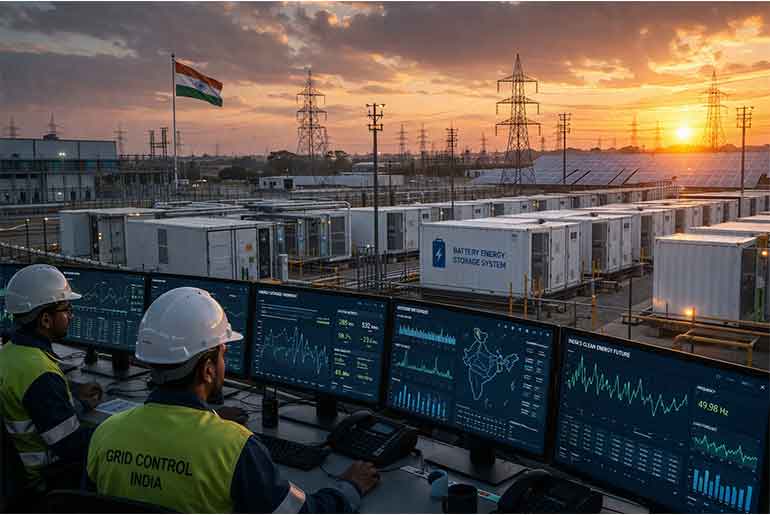
In the past, BESS projects often operated as “black boxes.” A developer would buy a proprietary system that spoke a specific language, making it difficult for the National Load Despatch Centre (NLDC) to gain granular control over the asset. The 2026 guidelines effectively dismantle these silos by mandating strict interoperability and communication standards.
The new rules require BESS units to be “grid-aware.” This involves standardized protocols for Energy Management Systems (EMS) to communicate with the grid in real-time. Whether it is Frequency Regulation, Voltage Support, or Black Start capabilities, the CEA now dictates exactly how a battery must respond to a grid signal. This standardization is intended to turn a thousand disparate battery projects into a single, cohesive “virtual power plant” that the national grid can rely on during peak demand shifts.
In the early days of BESS in India, “performance” was often a handshake agreement or a glossy brochure claim. You bought a battery, installed it, and hoped the Round-Trip Efficiency (RTE) stayed somewhere near the promise. But in 2026, the era of “take our word for it” is dead.
The new CEA framework has turned the spotlight on the actual guts of these systems. It’s no longer enough to just show up to the grid; you have to prove you’re performing through grueling, standardized testing cycles. Think of it as a mandatory fitness test that never ends.
Perhaps the biggest game-changer is the mandate for State of Health (SOH) monitoring. For the first time, battery health is being measured by a universal yardstick rather than proprietary manufacturer metrics. This is massive for the “bankability” of a project.
By forcing this data into the open, the government has essentially created a “Carfax” for industrial batteries. Investors and lenders no longer have to squint at spreadsheets and wonder about degradation—they can look at a verified data trail and know exactly how much life is left in the cells. It’s this move—from mystery to transparency—that is finally giving investors the confidence to treat these giant batteries as reliable, long-term assets rather than risky bets.
While the language of the CEA is technical, the impact is deeply human and economic. For the site engineer, these guidelines mean a safer working environment. For the investor, they mean a reduced risk of stranded assets. For the Indian consumer, they represent a more stable electricity bill, as the grid becomes less reliant on expensive, high-carbon “peaker” plants.
For years, global energy giants and tech pioneers looked at India’s storage market and saw a massive opportunity blurred by “fuzzy” rules. It was a high-stakes arena where the goalposts felt like they were written in pencil, making it hard for sophisticated players to go all-in. But in 2026, the fog has lifted. The CEA hasn’t just clarified the rules; they’ve handed out a high-definition blueprint that serves as a massive green light for the world’s most advanced engineering firms.
This newfound clarity is doing something even more exciting: it’s triggering a “chemistry-agnostic” explosion. While Lithium-ion has been the undisputed king, the new standards focus on how a battery performs rather than what is inside it. This opens the floor for the underdogs. Whether it’s Sodium-ion—leveraging India’s own salt reserves—or Flow batteries designed to pull ten-hour shifts for the grid, the door is now wide open. As long as a technology can survive the CEA’s rigorous “performance envelope,” it has a seat at the table. We’re finally moving away from a one-size-fits-all era and into a diverse ecosystem where the best engineering, not just the most famous chemistry, wins the day.
Conclusion: The Road Ahead
The “Battery Standard” Era is not just about compliance; it is about confidence. By moving from a model of subsidizing growth to a model of regulating quality, India is signaling to the world that its energy transition is on solid ground.
For those looking to bid on the upcoming 43 GWh tranches of VGF-supported projects, the message is clear: the lowest bid is no longer the only winning factor. The ability to demonstrate a “compliant-by-design” philosophy—integrating advanced fire suppression, seamless grid communication, and transparent performance tracking—will be the true hallmark of a successful developer in 2026.
As the industry digests these 1,000-page manuals and technical annexures, the underlying theme remains simple: Storage is no longer a luxury for the Indian grid; it is the backbone. And with the new CEA guidelines, that backbone just became much stronger.
 Electrify your feed! Click here to join our Whatsapp group and to get the latest updates, expert insights, and innovations driving India’s energy storage revolution.