Solid-state batteries are often described as the next generation of battery technology. Scientists, car manufacturers, and technology companies believe these batteries could solve many problems associated with current lithium-ion batteries. They promise longer driving range for electric vehicles, faster charging, improved safety, and longer battery life.
Because of these advantages, solid-state batteries are receiving enormous global investment from companies such as Toyota, BMW, Samsung, and many research institutions. However, while the technology is promising, many experts still question how soon these batteries will reach mass adoption.
This article discusses the most recent advancements, provides a straightforward explanation of solid-state battery technology, and assesses whether widespread adoption is actually imminent.
What Are Solid-State Batteries?
Lithium-ion batteries are currently used in the majority of electric cars and electronics. During charging and discharging, these batteries’ liquid electrolyte permits lithium ions to flow between the battery’s electrodes.
Solid-state batteries work in a similar way, but instead of using a liquid electrolyte, they use a solid electrolyte made from materials such as ceramics, polymers, or sulfides. This structural change improves performance and safety.
According to researchers, compared to liquid electrolytes used in traditional lithium-ion batteries, solid electrolytes are more thermally stable and non-flammable, greatly lowering the risk of battery fires.
Because of this design, solid-state batteries can also use lithium-metal anodes, which store more energy than the graphite anodes used in current batteries.
Why Solid-State Batteries Are Important
1. Higher Energy Density
Higher energy density is one of solid-state batteries’ main benefits. The quantity of energy stored in a battery in relation to its weight is known as energy density.
Advanced solid-state batteries could reach around 450–500 watt-hours per kilogram (Wh/kg), significantly higher than many lithium-ion batteries used today.
Higher energy density means:
- Longer driving range for electric vehicles
- Smaller battery packs
- Lighter devices and vehicles
Some prototype batteries already claim extremely long ranges.
As an illustration of the potential of next-generation battery technologies, a prototype semi-solid-state battery created by Chinese researchers reportedly achieved a driving range of over 620 miles (1,000 km) during testing.
2. Faster Charging
Compared to modern lithium-ion batteries, solid-state batteries may charge considerably more quickly.
Some experiments show that electric cars with these batteries might be able to charge up to 80% in about ten minutes.
One of the main issues with the adoption of electric vehicles long charging times compared to petrol refueling may be resolved by fast charging.
3. Improved Safety
Lithium-ion batteries contain liquid electrolytes that can catch fire if damaged or overheated.
Solid-state batteries reduce this risk because their electrolytes are solid and non-flammable, which improves overall safety.
This safety improvement is particularly important for:
- Electric vehicles
- Airplanes and aerospace systems
- Consumer electronics
4. Longer Lifespan
Solid-state batteries are also expected to last longer than lithium-ion batteries.
Studies indicate that advanced solid-state designs could attain more than 5,000 charge cycles, in contrast to approximately 1,000 to 2,000 cycles for numerous lithium-ion batteries.
A longer lifespan means:
- Lower maintenance costs
- Reduced battery replacement
- More sustainable energy storage systems
The Global Race to Develop Solid-State Batteries
Many large companies and governments are investing billions of dollars to develop this technology.
Automotive Industry
Car manufacturers see solid-state batteries as a way to make electric vehicles more competitive with gasoline cars.
Several companies currently working on solid-state battery technology include:
- Toyota
- Nissan
- BMW
- Volkswagen
- Hyundai
- Ford
Toyota is one of the most active companies in this field. The company has been researching solid-state batteries since 2006 and holds more than 1,000 patents related to the technology.
Reports from the industry and the company say that Toyota plans to release electric cars with solid-state batteries around 2027–2028.
To support this goal, Japan’s energy company Idemitsu Kosan is building a lithium sulfide production plant, which will supply materials needed for solid electrolytes.
Battery Technology Companies
In addition to automakers, many specialized battery companies are also developing solid-state batteries.
These include:
- QuantumScape
- Solid Power
- ProLogium
- Samsung SDI
These companies focus on improving battery materials, manufacturing techniques, and performance.
Research Institutions
Researchers and universities all over the world are looking into solid-state batteries.
But scientists stress that there are still big technical problems that need to be solved before the technology can be used by a lot of people.
Major Challenges to Mass Adoption
Despite the promising benefits, several important challenges remain.
1. Manufacturing Complexity
Producing solid-state batteries at large scale is extremely difficult.
The materials used for solid electrolytes must maintain excellent contact between battery components, which is harder than with liquid electrolytes.
Manufacturing processes must also be redesigned, which increases development time and costs.
2. High Production Costs
Currently, solid-state batteries are much more expensive than conventional lithium-ion batteries.
Some estimates say that these batteries could cost almost three times as much as current battery technologies because they use complicated materials and manufacturing methods.
Reducing these costs is essential before the technology can reach mass markets.
3. Technical Limitations
Researchers are still working to solve several technical issues, including:
- Lithium dendrite formation (which can cause short circuits)
- Resistance between solid materials
- Performance problems at different temperatures
Scientists say solving these issues is critical before large-scale commercialization becomes possible.
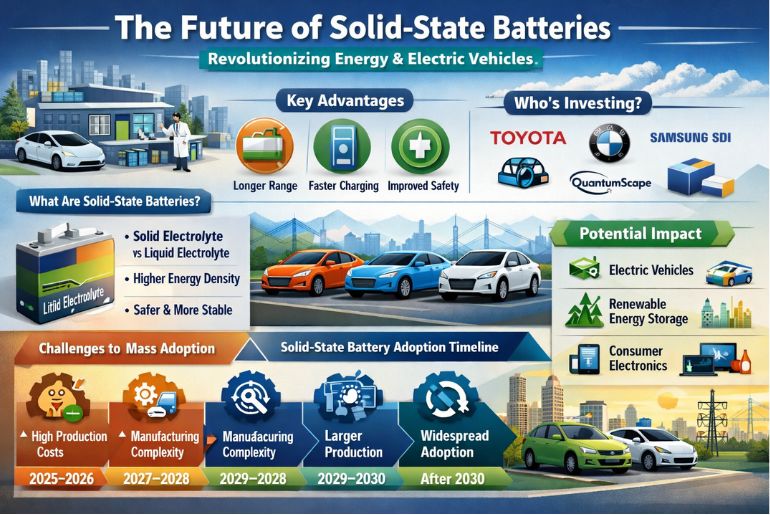
Timeline for Solid-State Battery Adoption
Although headlines often suggest that solid-state batteries are arriving soon, experts expect adoption to happen gradually.
Current projections suggest the following timeline:
2025–2026
- Prototype vehicles and pilot manufacturing lines
- Continued testing by automakers
2027–2028
- First commercial electric vehicles with solid-state batteries
- Limited production, mainly in premium vehicles
2029–2030
- Larger production volumes
- Potential cost reductions
After 2030
- Possible widespread adoption across the automotive industry
A look at the industry shows that widespread use could start by the end of the decade, when costs go down and production gets better.
Potential Impact on the Energy Industry
If solid-state batteries reach mass production, they could transform several industries.
Electric Vehicles
Solid-state batteries could remove three major barriers to EV adoption:
- Limited driving range
- Long charging times
- Safety concerns
This would make electric vehicles more attractive to consumers.
Renewable Energy Storage
Renewable energy systems like solar and wind require efficient energy storage. Solid-state batteries could improve grid-scale storage systems, helping stabilize electricity supply.
Consumer Electronics
Smartphones, laptops, and wearable devices could benefit from:
- Smaller batteries
- Longer battery life
- Improved safety
Solid-state batteries are one of the most exciting new technologies in the field of energy. They have a lot of benefits over regular lithium-ion batteries, such as more energy density, faster charging, better safety, and a longer lifespan.
Toyota and other big car companies are putting a lot of money into the technology, and new research breakthroughs show that it is making a lot of progress. Some car companies want to make the first cars with solid-state batteries in the next few years.
However, important challenges still remain, including high production costs, manufacturing difficulties, and unresolved technical issues.
So, while solid-state batteries are getting closer to being real, they probably won’t be widely used until the late 2020s or early 2030s.
In short, solid-state batteries are no longer just a fantasy, but they are still moving from the lab to real-world products. If researchers can get past the problems they are having now, these batteries could change the way electric cars, renewable energy storage, and consumer electronics work in the next few decades.
 Electrify your feed! Click here to join our Whatsapp group and to get the latest updates, expert insights, and innovations driving India’s energy storage revolution.