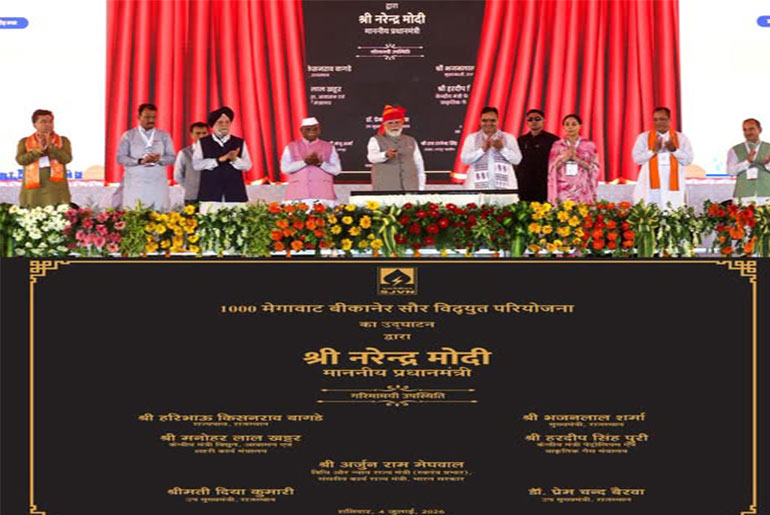
Prime Minister Shri Narendra Modi inaugurated SJVN’s 1,000 MW Bikaner Solar Power Project from Pachpadra, Rajasthan, marking a major step forward in India’s renewable energy journey. The project strengthens the country’s commitment to expanding clean energy capacity and achieving its long-term sustainability goals.
The inauguration ceremony was attended by several dignitaries, including Rajasthan Governor Shri Haribhau Kisanrao Bagde, Chief Minister Shri Bhajan Lal Sharma, Union Minister for Power and Housing & Urban Affairs Shri Manohar Lal, Union Minister for Petroleum and Natural Gas Shri Hardeep Singh Puri, Union Minister of State (Independent Charge) for Law & Justice and Minister of State for Parliamentary Affairs Shri Arjun Ram Meghwal, Deputy Chief Ministers Smt. Diya Kumari and Dr. Prem Chand Bairwa, as well as other senior government officials.
The event was also virtually joined by SJVN Limited’s senior leadership including Chairman & Managing Director Shri Bhupender Gupta, Director (Personnel) Shri Ajay Kumar Sharma, Director (Finance) Shri Parthajit De, Director (Projects) Shri Rajesh Kumar Chandel, Chief Vigilance Officer Shri Pankaj Porwal, CEO of SJVN Green Energy Limited (SGEL) Shri Prashant Sharma and other senior officials.
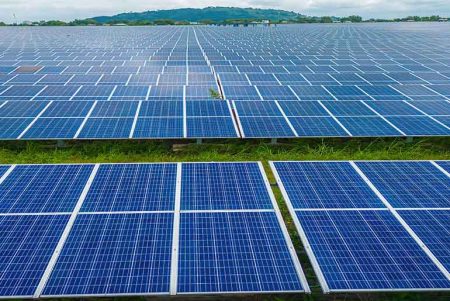
The 1000 MW Bikaner Solar Power Project has been developed by SJVN through its renewable energy subsidiary SJVN Green Energy Limited (SGEL) in Bikaner, Rajasthan. Built with an investment of approximately ₹5,492 crore across nearly 5,000 acres, the project is India’s largest single-location EPC solar project under the Domestic Content Requirement (DCR) category.
The project emphasizes India’s growing renewable energy infrastructure and supports the Government of India’s Make in India and Atmanirbhar Bharat initiatives by promoting domestic solar manufacturing capabilities.
The solar project is scheduled to produce around 2,454.84 million units (MU) of electricity in its first year of operation and approximately 56,482.14 MU of clean energy over its 25-year operational life.
The electricity produced from the project will be supplied to Rajasthan, Uttarakhand and Jammu & Kashmir. Rajasthan will receive 500 MW of power, while Jammu & Kashmir and Uttarakhand will receive 300 MW and 200 MW respectively, helping strengthen clean energy availability across these regions.
The project is also expected to reduce nearly 2.79 billion kilograms of carbon emissions during its operational life, contributing to India’s climate action commitments and environmental sustainability targets.
One of the key highlights of the project is its extensive use of domestically manufactured solar equipment. It has deployed nearly 24.22 lakh Domestic Content Requirement (DCR) solar modules and around 175 crore indigenous solar cells, reinforcing the Government of India’s push to strengthen the domestic renewable energy manufacturing ecosystem.
Beyond clean power generation, the project has also delivered significant socio-economic benefits to the region. During the construction and commissioning phases, it created over 2,000 direct and indirect employment opportunities while driving the development of key infrastructure, including roads, transmission networks, and other supporting facilities across the Bikaner region.
SJVN, a Navratna Central Public Sector Enterprise under the administrative control of the Ministry of Power, Government of India, currently has an installed power generation capacity of 4,196.5 MW and operates two transmission lines with a combined network length of 123 kilometres.
The commissioning of the 1,000 MW Bikaner Solar Power Project marks a significant addition to SJVN’s renewable energy portfolio, further advancing India’s clean energy transition and contributing to the country’s long-term goal of achieving a sustainable, reliable, and energy-secure future.
 Electrify your feed! Click here to join our Whatsapp group and to get the latest updates, expert insights, and innovations driving India’s energy storage revolution.