
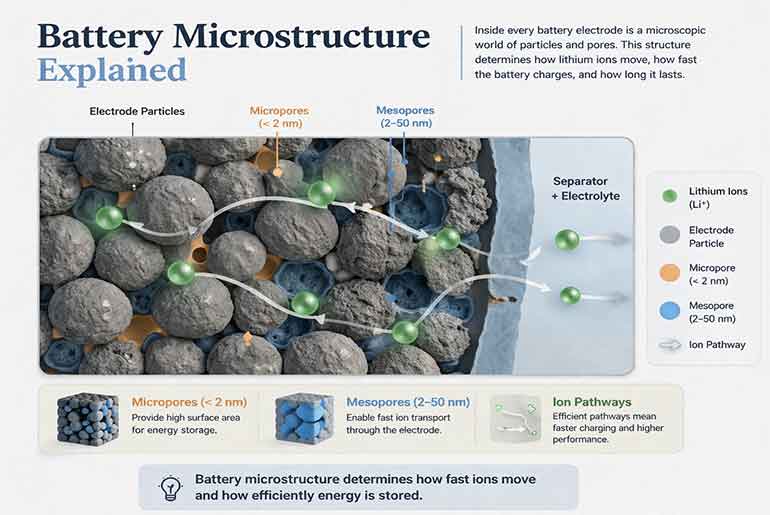
When you look at an electric vehicle or even your smartphone, you probably think about battery capacity, charging time, or brand. But the real story is hidden from your eyes. Inside every battery, there is a microscopic world of particles, pores, and pathways. This hidden structure—known as battery microstructure—is quietly deciding how your battery performs.
It controls how fast your device charges, how long it lasts, and how safe it remains.
Today, the battery industry is no longer just asking what materials are used. It is asking how those materials are arranged.
And that is where everything is changing.
Understanding Battery Microstructure: The Real Engine of Performance
You might imagine a battery as a solid block. In reality, it is more like a sponge.
It is made up of tiny particles with empty spaces between them. These spaces, called pores, allow lithium ions to move during charging and discharging.
- If the pores are too small, ion movement slows down
- If they are well-sized, energy flows smoothly
This delicate design is what defines a good battery microstructure.
Companies like Micromeritics Instrument Corporation help scientists measure this invisible world. Their tools analyse surface area and porosity using advanced techniques like BET analysis.
If you cannot measure the structure, you cannot control the performance.
Why Surface Area and Porosity Matter to You
Let’s make this practical.
A typical graphite anode has a surface area of about 2.5 m² per gram
Most high-performance batteries maintain 18% to 35% porosity
What does this mean for you?
- More surface area → better energy storage
- Balanced porosity → faster charging
- Too much porosity → weaker battery structure
Even a 15% increase in surface area can improve charging speed by nearly 25%, but it can also reduce stability.
So, designing the right battery microstructure is always a balancing act.
Particle Size: The Detail That Changes Everything
Another important factor in battery microstructure is particle size.
If particles are uneven:
- Some parts of the battery work harder
- Others remain underused
This leads to faster wear and shorter battery life.
That is why companies like Malvern Panalytical and Anton Paar focus on precise particle measurement.
When particles are uniform, the battery performs smoothly.When they are not, problems begin early.
The Testing Process: What Your Battery Goes Through
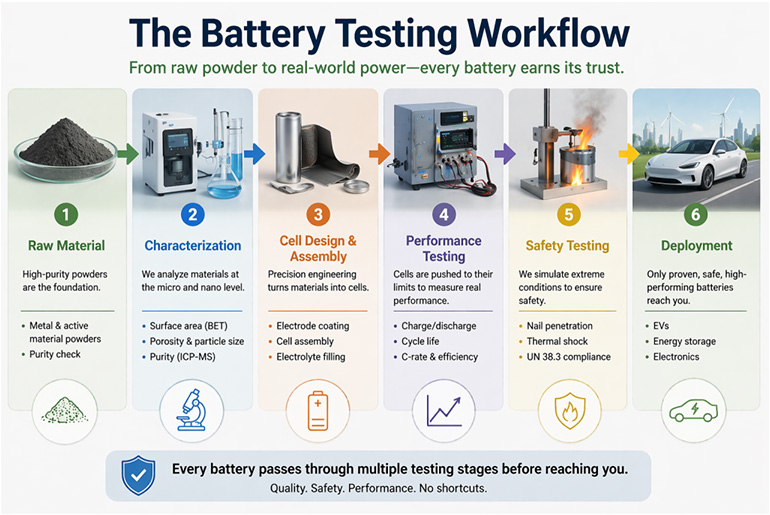
Before a battery reaches you, it goes through intense testing.
1. Raw Material Testing
At this stage, purity is critical.Even 10 ppm of iron impurity can damage battery performance and increase safety risks.
2. Performance Testing
Here, batteries are tested for:
- Charging efficiency
- Charging speed
This ensures your battery works reliably in daily use.
3.Safety Testing
This is where things get extreme.
Under global standards like UN 38.3:
- Batteries are pierced with nails
- Exposed to high temperatures
- Overcharged deliberately
Temperatures can rise above 600°C during failure tests.
All this is done to make sure your battery stays safe in real life.
Market Forecast: Why Battery Microstructure is Now Critical
Now, look at the bigger picture.The importance of battery microstructure is growing because the market is expanding rapidly.
- The global battery materials market is expected to reach $79.1 billion by 2026
- The International Energy Agency estimates demand will grow nearly 10 times by 2030
This creates a major challenge.
When production increases, even small flaws in battery microstructure can lead to large-scale failures.
That is why companies are investing heavily in:
- Material characterization
- Advanced testing
- Quality control systems
In fact, recent industry data shows that better microstructure analysis can reduce battery failures by up to 27%.
The Companies Working Behind the Scenes
You usually hear about battery manufacturers.But there are other companies working silently behind them.
- Material Characterization Experts
- Micromeritics Instrument Corporation
- HORIBA
- Testing & Certification Leaders
- SGS
- UL Solutions
These companies ensure that battery microstructure is properly tested and understood.
A Serious Time for India: Battery Manufacturing Investment
India has begun investing heavily in battery manufacturing with initiatives such as the PLI Government program to help with this effort.
How can India be successful in these efforts beyond just manufacturing batteries?
By developing:
- NPV of battery testing facilities
- Robust R&D facilities that support battery innovation
Experts/engineers who have a high level of understanding of battery micro-structure
Without this, scaling production will always carry risk.
The Future: From Testing to Prediction
The future of batteries is moving beyond testing.
New technologies like:
- AI-based analysis
- X-ray imaging
- Digital modelling
are helping predict battery behaviour before failure happens.
This means you will soon use batteries that are not just tested—but intelligently designed from the inside.
Conclusion: The Power You Cannot See
The next time you charge your phone or drive an electric vehicle, remember this:
The real strength of your battery is not what you see on the outside. It lies inside—in its structure.
- In its pores.
- In its particles.
- In its precision.
The future of energy will not be decided by size or scale alone.
It will be decided by how well we understand and control battery microstructure.
Because in the end, the smallest details create the biggest impact.
 Electrify your feed! Click here to join our Whatsapp group and to get the latest updates, expert insights, and innovations driving India’s energy storage revolution.