India’s energy transition is entering a new chapter—one where renewable generation alone is no longer enough. As solar and wind capacity continue to expand at an unprecedented pace, the industry’s focus is rapidly shifting toward grid stability, energy storage, intelligent power management, and round-the-clock clean energy delivery. The future of renewable energy will be defined not merely by how much power is generated, but by how effectively it is stored, managed, and delivered when it is needed most. At the heart of this transformation stands Sungrow India, a company that has evolved beyond being an inverter manufacturer to become a comprehensive provider of intelligent energy solutions. From advanced energy storage systems and grid-forming technologies to AI-ready power infrastructure and hybrid renewable solutions, Sungrow is helping shape the next generation of clean energy ecosystems.
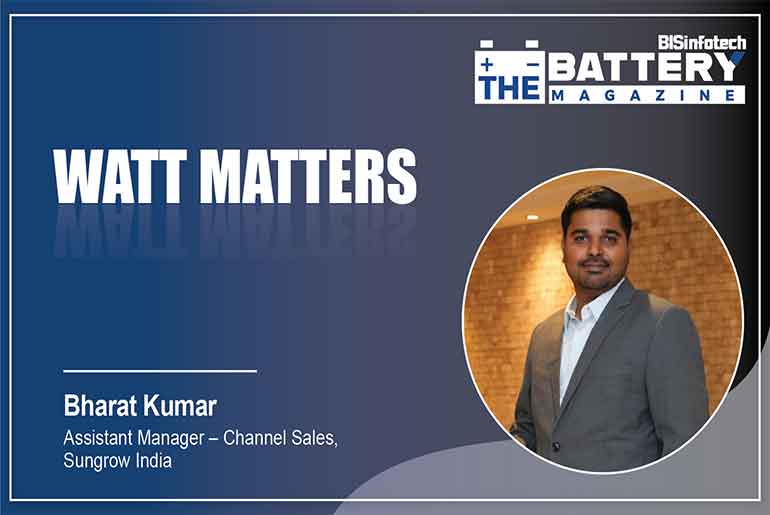
Against the backdrop of RenewX Chennai’s landmark 10th-anniversary edition, Bharat Kumar, Assistant Manager – Channel Sales, Sungrow India, shared valuable insights into the technologies and trends redefining India’s renewable energy landscape. During an engaging conversation with Shweta Kumari, Sub-Editor of The Battery Magazine, he discussed the growing role of energy storage, the promise of grid-forming systems, the evolution of liquid-cooled BESS solutions, and the increasing convergence of solar, storage, and digital infrastructure.
As India accelerates toward a more resilient and dispatchable clean energy future, Sungrow’s vision offers a compelling glimpse into the technologies that will power the next phase of the country’s energy transition. Let’s delve deeper into the conversation.
RenewX Chennai is a hub for South India’s clean energy sector. How has your experience been at this 10th-anniversary edition, and what specific opportunities do you see in the Tamil Nadu and South Indian markets this year?
This 10th-anniversary edition of RenewX Chennai has been especially significant because it reflects how rapidly South India has evolved into one of the most dynamic clean energy ecosystems in the country. The scale of participation, the quality of conversations, and the strong presence of developers, manufacturers, utilities, and policymakers all indicate that the market is entering a more mature and investment-ready phase.
Tamil Nadu continues to be a cornerstone of India’s renewable energy story. It already has a strong installed base in wind energy and is now seeing accelerated momentum in solar, hybrid projects, energy storage, green hydrogen, and industrial decarbonization. What stands out this year is the growing emphasis on integrated clean energy solutions rather than standalone generation assets.
Sungrow recently showcased the “PowerMatrix” system and the “Matrix Inverter” globally. For the visitors here in Chennai, which specific products or solutions were the “stars” of your booth, and how do they cater to the Indian climate?
At the Chennai showcase, the key highlights of our booth were the SC255CS_2H and SC510CS_4H energy storage solutions, along with our latest inverter portfolio designed for diverse market applications in India. These products are specifically engineered considering Indian climatic conditions, grid requirements, and the growing demand for reliable and efficient renewable energy solutions.
Our showcased inverter range included:
- SGRS-L2 – Residential segment
- SGRT-P2 – Residential segment
- SGCX-P2 – Commercial & Industrial segment
- SGCX Series – Commercial & Industrial segment
- SGHX-20 Series – Utility-scale sector
With robust design, high efficiency, and dependable performance even under high ambient temperatures, these solutions are well suited for India’s rapidly expanding solar and energy storage market.
When it comes to “Grid-Forming” technology—which you’ve emphasized this year—how is Sungrow helping Indian IPPs (Independent Power Producers) manage grid stability as more renewables come online?
Sungrow is actively focusing on Grid-Forming technology and aims to further strengthen and implement this capability by the end of this year. With advanced Grid-Forming solutions, we will be able to support Indian IPPs in enhancing grid stability, especially as renewable energy penetration continues to increase across the country. This technology will help maintain stable voltage and frequency, ensuring reliable integration of renewable power into the grid.
Safety is a non-negotiable in BESS (Battery Energy Storage Systems). Could you explain the “PowerTitan 3.0” architecture and why consumers should trust Sungrow’s liquid-cooling technology over conventional cooling methods?
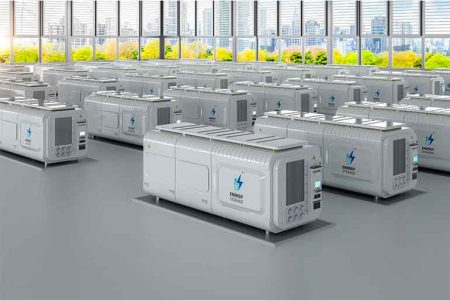
The PowerTitan 3.0 architecture is built with an advanced liquid-cooling architecture designed to ensure higher safety & improved overall system efficiency. The architecture integrates battery modules, power conversion systems and safety protection into a compact and optimized design, enabling better energy management and reliable system operation.
Compared to conventional air-cooling methods, liquid cooling maintains a more uniform temperature across battery cells, which helps enhance battery performance and extend the overall product life cycle. This also improves charging and discharging efficiency while ensuring stable operation even under demanding environmental conditions.
In addition, advanced architecture minimizes energy losses making the system more reliable and efficient for long-term operation. With these advantages, Sun grow’s liquid-cooled BESS solutions provide customers with a safer, more durable, and high-performance energy storage system.
What sets your C&I (Commercial & Industrial) solutions, like the PowerStack ST255CS, apart from the competition in terms of “Levelized Cost of Storage” (LCOS) and ease of installation?
What differentiates the Power Stack ST255CS most is that it’s designed to reduce total lifecycle cost — not just upfront CAPEX — while also minimizing deployment complexity for EPCs and facility operators.
On the LCOS (Levelized Cost of Storage) side, the biggest advantages are:
- High round-trip efficiency (>90%) combined with PCS efficiency above 98.5%, which means less energy lost during charge/discharge cycles.
- AI-driven liquid cooling and thermal balancing reduce auxiliary power consumption by roughly 33–40%, lowering ongoing operating costs and improving usable energy throughput over the system’s life.
- The use of 314Ah LFP cells improves cycle life and thermal stability, supporting a projected design lifetime of up to 20 years. Longer operational life directly improves LCOS because the asset delivers more energy over time before replacement is needed.
- The system is optimized for applications like peak shaving, demand charge reduction, PV self-consumption, backup power, EV charging support, and energy arbitrage, helping customers maximize revenue streams from one platform.
From an installation and deployment perspective, the system focuses heavily on reducing labor, commissioning time, and BOS (balance-of-system) costs:
- It uses an all-in-one architecture integrating the PCS, EMS, BMS, batteries, cooling, and safety systems into a single cabinet. That reduces external integration work compared with multi-vendor architectures.
- The cabinets support side-by-side, back-to-back, and face-to-face layouts, which improves land-use efficiency and makes installation easier in space-constrained industrial sites.
- The modular parallel design allows scaling from a single 257 kWh unit up to multi-MWh deployments without redesigning the entire architecture.
- Integrated monitoring through iSolarCloud simplifies O&M and remote diagnostics, reducing truck rolls and maintenance overhead.
Compared with many competing C&I BESS offerings that still require separate PCS skids, external HVAC integration, or longer on-site commissioning workflows, the ST255CS is positioned as a more “plug-and-deploy” system aimed at lowering both EPC effort and operational expense over the asset lifecycle.
We are seeing a massive shift toward “PV-BESS-Hydrogen” integration. Is Sungrow seeing a demand for these “all-in-one” hybrid solutions in India, and how are you preparing for this trend?
Sungrow is witnessing a strong market shift toward integrated PV and BESS solutions in India. Currently, the demand for PV + BESS systems is significantly higher compared to hydrogen-based applications, especially in the residential and distributed energy sectors. To address this growing trend, Sungrow is preparing to launch its hybrid inverter solutions by the end of this year.
These hybrid inverters are designed to integrate solar PV and battery energy storage systems, enabling improved energy management, backup power support, and higher energy. The solution will be particularly beneficial for the residential segment, where reliable and efficient hybrid energy systems are seeing rapid adoption in the Indian market.
With the rise of AI Data Centers requiring massive power, Sungrow has introduced “Grid-to-Chip” power solutions. How does this technology bridge the gap between renewable generation and the high-density loads of modern digital infrastructure?
Here’s how the approach bridges the gap between intermittent renewable energy and the extreme demands of AI infrastructure:
1. Connecting renewable generation directly into the data-center power chain
Sungrow combines utility-scale solar PV, battery energy storage systems (BESS), and advanced power electronics so renewable energy can feed AI campuses more reliably. Instead of renewables being “external” to the data center, they become part of the operational power architecture.
2. Using grid-forming energy storage as a stabilizing buffer
AI data centers create highly dynamic loads — power demand can spike or fluctuate rapidly as GPU clusters ramp up. Sun grow’s grid-forming BESS acts like a “shock absorber” between the grid and computing hardware by providing:
- voltage support,
- frequency regulation,
- disturbance damping,
- fault ride-through capability,
- ultra-fast response to load changes
This allows renewable-heavy grids to support sensitive AI compute without instability.
3. Reducing conversion losses from “grid to chip”
Traditional data-center power systems involve many AC/DC conversion stages, each adding inefficiency and failure risk. Sungrow is developing:
- high-efficiency solid-state transformers (SSTs),
- 800V DC architectures,
- advanced power conversion systems,
- rack-level and onboard power delivery.
These technologies shorten the electrical path from the grid to AI chips, improving efficiency and enabling higher rack power density.
4. Enabling scalable “gigawatt-class” AI campuses
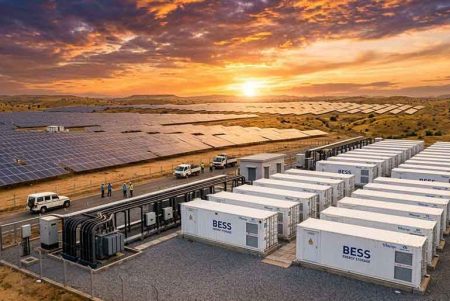
AI infrastructure is evolving from megawatt-scale facilities to gigawatt-scale compute campuses. Sun grow’s modular storage systems such as Power Titan 3.0 are designed for rapid deployment and high-density operation, helping developers bring large renewable-backed AI campuses online faster.
For a developer looking at the crowded Indian market, why is Sungrow the “bankable” choice for 2026, and what are you most excited to achieve in the Indian energy landscape by the end of this year?
For developers navigating India’s intensely competitive solar market in 2026, Sungrow stands out as a “bankable” choice because it combines three things that financiers and EPCs care about most: proven scale, local manufacturing strength, and long-term technical reliability.
A major differentiator is Sun grow’s deep commitment to India’s domestic ecosystem. The company has built a 10 GW manufacturing facility in India under the “Make in India” initiative, enabling faster delivery, localized support, and reduced supply-chain risk for developers.
What makes Sungrow especially attractive for utility-scale developers is that bankability today is no longer just about inverter efficiency — it’s about whether lenders and investors trust the technology provider to remain stable, serviceable, and innovation-led for the next 20–25 years. Sungrow has consistently emphasized its BloombergNEF-recognized bankability and strong global R&D footprint, while also tailoring solutions for India’s harsh operating environments such as Rajasthan and other high-temperature zones.
The company’s continued wins with major Indian IPPs and developers also reinforce that confidence. Recent agreements with players like Hero Future Energies, Avaada, Juniper Green Energy, Tata Power Solar, and SJVN demonstrate that large developers continue to trust Sungrow for mission-critical projects.
Another reason developers view Sungrow as “bankable” is the shift beyond pure solar into integrated energy storage and grid stability. India’s next renewable phase will be defined not only by generation capacity, but by dispatchability and hybrid infrastructure. Sungrow’s push into liquid-cooled BESS solutions and utility-scale storage positions it well for India’s evolving energy transition.
From a market perception standpoint, industry discussions and user communities also frequently associate Sungrow with strong engineering quality, intelligent monitoring, and utility-scale project experience, even though some discussions note that localized after-sales support can vary regionally.
By the end of 2026, one of the most exciting possibilities for Sungrow in India is likely the acceleration of grid-scale storage adoption and hybrid renewable infrastructure. India is moving rapidly toward 24/7 renewable power, RTC projects, and storage-backed solar parks. If Sungrow can continue expanding localized manufacturing, strengthen service networks, and deepen partnerships with India’s top IPPs, it could become not just an inverter supplier, but a core infrastructure partner in India’s clean-energy transformation.
 Electrify your feed! Click here to join our Whatsapp group and to get the latest updates, expert insights, and innovations driving India’s energy storage revolution.