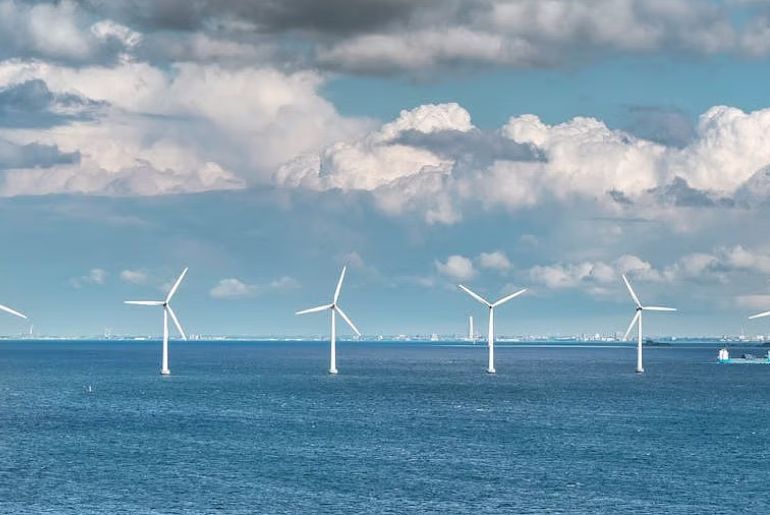
Toda Construction announced that its consortium has commenced commercial operations at the Goto Offshore Wind Farm in Nagasaki Prefecture, marking Japan’s first-ever commercial floating offshore wind project. Officially certified under Japan’s Marine Renewable Energy Sea-Area Utilisation Act, the 16.8 MW facility positions Japan among the first nations to advance floating wind from pilot projects to full-scale commercial deployment.
Located off Goto City, the wind farm comprises eight 2.1 MW Hitachi turbines mounted on hybrid spar-type floating foundations designed for deepwater conditions common along Japan’s steep coastal geography where fixed-bottom installations are impractical. Toda Corporation highlighted that this represents the world’s first commercial application of hybrid spar-type floater technology, featuring a steel upper section and concrete lower section, demonstrating Japan’s growing engineering capabilities in offshore wind.
The project was developed by a consortium of six Japanese industrial and energy companies- Toda Corporation, ENEOS Renewable Energy Corporation, Osaka Gas, INPEX, Kansai Electric Power, and Chubu Electric Power which established a special-purpose company in 2021 after securing the site in a government tender. Offshore construction began in October 2022, with the first floating foundation transported from Fukue Port to the site offshore Kabashima.
Many local companies participated in the construction and are expected to support the wind farm’s operations and maintenance (O&M). In line with the principle of local energy production for local consumption, the electricity generated will be supplied preferentially to local retail electricity providers at a price of JPY 36 per kWh (EUR 0.20/kWh) until the scheduled end-of-life in December 2043.
The Goto Floating Wind Farm supports Japan’s ambitious offshore wind targets of 10 GW by 2030 and 45 GW by 2040, including 15 GW from floating installations, and represents a key step toward the country’s 2050 carbon-neutral target. Despite cost pressures and occasional developer withdrawals, floating wind remains central to Japan’s renewable energy strategy due to its adaptability to deepwater conditions.
The successful commissioning of the Goto project demonstrates the consortium’s technical expertise, disciplined execution, and ability to deliver complex renewable energy infrastructure, paving the way for further large-scale floating wind development in Japan.
 Electrify your feed! Click here to join our Whatsapp group and to get the latest updates, expert insights, and innovations driving India’s energy storage revolution.