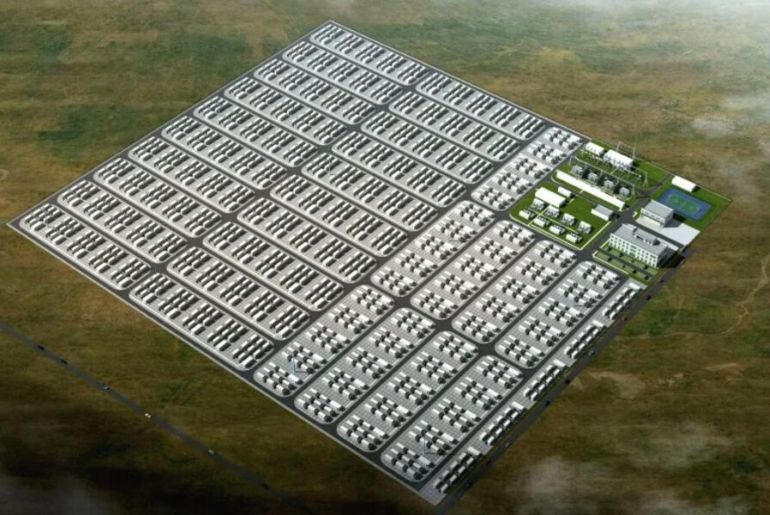
A 300 MW / 1,200 MWh battery energy storage system (BESS) in Ordos City, Inner Mongolia, has officially entered commercial operation after completing rigorous performance validation testing. The project is described as one of the world’s largest single-site grid-forming hybrid energy storage power plants.
The facility, located in the Kubuqi Desert, forms part of a larger 3 GW / 12.8 GWh energy storage rollout in the region, known as the Gushanliang energy storage power station. The site covers approximately 73 hectares and is backed by an investment of 11.2 billion yuan (USD 1.58 billion).
Hybrid Technology and Grid-Forming Capability
The project uses lithium iron phosphate (LFP) batteries for quick response and vanadium flow battery (VFB) systems for longer-lasting energy stability. This hybrid setup lets you switch between grid-forming, grid-following, and islanded modes easily.
Sineng Electric supplied 1.25 MW central power conversion system (PCS) units equipped with advanced grid-forming technology. These systems provide millisecond-level power support, virtual inertia, oscillation damping and black-start capability during grid disturbances.
The hybrid setup is coordinated by AI-driven energy management software that optimises dispatch schedules, improves system efficiency and enhances lifecycle performance under varying grid conditions. Performance validation was conducted through a “three-charge/three-discharge” testing process before commercial launch.
Development and Regional Impact
The Ordos Gushanliang project was jointly developed by Hunan Corun New Energy Co. (CORUN) and members of a large-scale energy storage innovation consortium, including Zhejiang Xingchen New Energy Technology Co. (SNE). In a December 30, 2025 update on WeChat, Hunan Corun New Energy stated that the project was in testing, with Xingchen New Energy and “other members of the large-scale energy storage ecosystem innovation consortium” involved.
The facility will connect to the 500 kV Gushanliang substation and supply electricity to industrial and residential users in Ordos and western Inner Mongolia. It will also support integration with the broader northern China power grid.
The project highlights the scale at which Chinese developers are deploying grid-forming energy storage technology, compared to other markets where similar projects remain in pilot stages or face regulatory barriers.
 Electrify your feed! Click here to join our Whatsapp group and to get the latest updates, expert insights, and innovations driving India’s energy storage revolution.