India’s logistics and freight sector operates on a brutal equation: uptime equals revenue. A truck parked for hours is not just idle—it is losing money, disrupting supply chains, and eroding margins. As electrification pushes deeper into transport, this reality exposes a growing mismatch between passenger EV solutions and the demands of heavy-duty trucking and buses. Technologies that work well for cars begin to strain when applied to vehicles that run long distances, carry heavy loads, and operate almost continuously. This is where a lesser-known but increasingly discussed technology enters the conversation. The Aluminum-Air battery for heavy-duty EVs does not attempt to compete with lithium-ion on familiar terms. Instead, it questions the very assumption that electric vehicles must be recharged. What if, instead of waiting for electrons to flow back into a battery, energy could be refueled—much like diesel—by replacing a consumable metal?
The Limits of Lithium-Ion in Heavy-Duty Applications
Lithium-ion batteries have earned their dominance in passenger vehicles through efficiency, falling costs, and an expanding charging ecosystem. However, heavy-duty transport places a very different set of demands on energy storage. Long-haul trucks and intercity buses require long range under load, rapid turnaround times, and predictable operational costs. Charging for several hours—even with fast chargers—creates bottlenecks that logistics operators simply cannot afford.
The introduction of lithium-ion to meet these needs brings about even greater challenges. As battery packs increase in size and weight exponentially, with rapid charging placing extreme stress on the electric grid, the need for complex thermal management will continue to grow. In addition, regular high-power charging will continue to accelerate degradation, ultimately impacting the durability of these batteries and increasing lifetime costs. These are not theoretical problems but rather structural limitations that are dictated by both physical constraints and infrastructure constraints.
As a result, the Aluminum-Air battery technology is being investigated specifically for heavy-duty EVs, with the understanding that it is not intended to replace lithium-ion for all applications; rather, it is expected to provide solutions to the primary pain points faced by long-haul and high-utilization vehicles.
Understanding Aluminum-Air Batteries
An Aluminum-Air battery is a type of metal-air electrochemical system that generates electricity by oxidizing aluminum using oxygen from ambient air. Aluminum acts as the anode, oxygen as the cathode reactant, and an electrolyte facilitates the reaction. As aluminum oxidizes, electricity is produced, along with heat and aluminum hydroxide as a byproduct.
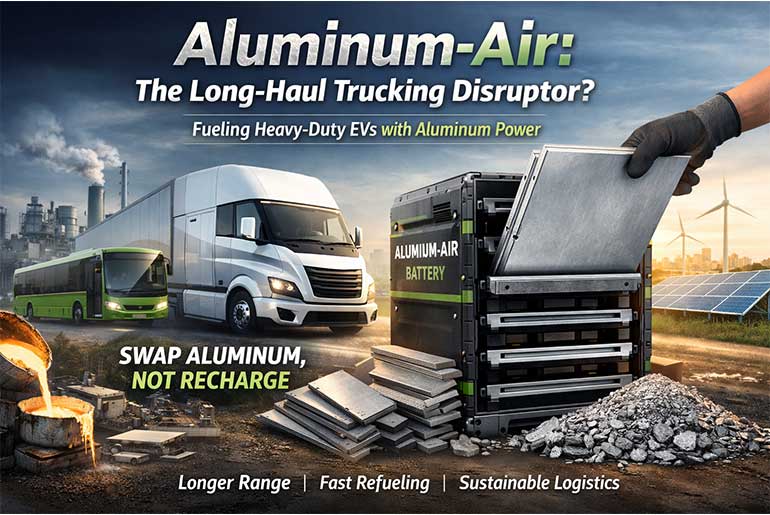
What fundamentally differentiates this system is that it is not electrically rechargeable. Once the aluminum is consumed, the battery must be “recharged” by physically replacing the aluminum plates. This makes the Aluminum-Air battery for heavy-duty EVs less like a conventional battery and more like a fuel system embedded within an electric drivetrain.
This distinction is critical. It shifts the operational logic from charging infrastructure to refueling logistics—a model that fleet operators already understand deeply.
A Refuelable Metal Solution Rather Than a Wait-For-Charging Approach
“For logistic businesses, downtime costs them more than paying for fuel. The advantage that Aluminum-Air batteries can offer the logistics industry are the battery’s refuelable capabilities. This allows logistics operators to replace depleted plates of Aluminum for fresh ones in less than 10 minutes, instead of having their trucks parked for extended periods waiting to charge.
The concept of having refueling stations or “fast-fuel” to swap depleted Aluminum for fresh Aluminum mirror the operational structure of diesel fleets today where trucks can quickly refuel with diesel and return to service.
For the Indian logistics industry, where freight schedules are tight and routes are lengthy, having a system for quickly swapping out depleted plates will fit in with their current operational practices vs. waiting to charge batteries for extended periods.”
Why Aluminum Makes Strategic Sense for India
Material availability is a critical but often underappreciated factor in energy transitions. Lithium-ion batteries rely heavily on imported materials such as lithium, cobalt, and nickel—resources over which India has limited control. Aluminum, by contrast, is a material India knows well.
India is among the world’s leading producers of aluminum, with established mining, refining, fabrication, and recycling capabilities. This makes the Aluminum-Air battery for heavy-duty EVs particularly attractive from an energy security perspective. Instead of importing critical minerals, India could leverage domestic aluminum supply chains to power its transport sector.
Equally important is recyclability. Spent aluminum from Aluminum-Air systems can be recycled back into fresh plates, creating a relatively straightforward material loop. While recycling aluminum is energy-intensive, it is a mature industrial process compared to the complex recycling of lithium-ion batteries.
Energy Density and Vehicle Design Advantages
Energy density is one of the most compelling technical reasons for using Aluminum-Air systems. From a theoretical point of view, Aluminum-Air batteries have gravimetric energy densities that greatly exceed those of lithium-ion batteries. Therefore, this means that there would be a larger range for vehicles equipped with Aluminum-Air batteries, and they will not require an extremely large amount of weight to provide sufficient power for the vehicle.
For heavy-duty trucks, where payload capacity directly impacts revenue, this is a major advantage. A lighter energy storage system allows either more cargo or longer range—or both. In logistics economics, such gains can significantly alter cost structures and route planning.
This is a key reason why the Aluminum-Air battery for heavy-duty EVs is being studied specifically for buses, long-haul trucks, mining vehicles, and defense logistics rather than passenger cars.
The Real Challenges Holding Aluminum-Air Back
Despite its promise, Aluminum-Air technology is not without serious limitations. As a result of being non-rechargeable, it lacks regenerative braking capabilities, which are a major benefit of lithium-ion EVs in terms of improving overall system efficiency. This also adds to the reliance on an ongoing source of aluminum plates, which means the creation of proper logistics and recycling infrastructure.
There are other obstacles related to the complexity of the systems. Robust engineering solutions will be necessary to manage electrolytes; avoid corrosion; manage by-products; and maintain consistent performance due to the harsh environment present in India. The systems must also endure heat, dust, vibration, and variable loads for long times.
The actual cost of these systems is still unknown. Although aluminum is a plentiful resource, the total price of the entire system (including the infrastructure for refueling, maintenance, and recycling) will need to be compared with lithium-ion systems that are expected to continue dropping in price annually.
Hybrid Energy Architecture—Most Likely Path for Aluminum-Airs
The most probable pathway for utilizing the Aluminum-Air Battery with heavy-duty Electric Vehicles (EVs) is to view the Aluminum-Air battery as a component of a hybrid energy architecture versus a stand-alone source of energy. This hybrid system would utilize Aluminum-Air batteries for sustained energy delivery over extended periods and utilize smaller Lithium-Ion battery packs for peak power requirements (acceleration, regenerative braking) consumed in a short time.
By combining these battery types, the system can capitalize on each technology’s strengths while minimizing each type’s weaknesses. A smaller Lithium-ion pack can be sized smaller, therefore decreasing both cost and degradation. Conversely, an Aluminum-Air battery offers increased range and reduced fast-charging needs.
A Hybrid Battery Energy Architecture combination may be the most effective balance of performance versus cost versus operational flexibility for the commercial freight market and bus fleets in India.
Infrastructure: Shifting the Burden from Grid to Logistics
Heavy-duty fast charging places enormous strain on electrical infrastructure. Multi-megawatt chargers require grid upgrades, substations, and sophisticated load management. Aluminum-Air refueling infrastructure, by contrast, shifts the challenge away from the grid and toward industrial logistics.
Instead of power electronics and substations, refueling stations would focus on aluminum plate handling, mechanical swapping systems, electrolyte management, and recycling logistics. For a country with deep experience in industrial supply chains, this shift may be more manageable than widespread grid reinforcement.
Environmental and Lifecycle Considerations
From a tailpipe perspective, Aluminum-Air systems are zero-emission. However, their true environmental impact depends on how aluminum is produced and recycled. If aluminum smelting is powered by fossil fuels, emissions are simply shifted upstream. If paired with renewable energy and high recycling rates, the Aluminum-Air battery for heavy-duty EVs could deliver very low lifecycle emissions.
This makes policy alignment critical. Incentives for low-carbon aluminum production and recycling could significantly improve the sustainability profile of Aluminum-Air systems.
Is Aluminum-Air the Disruptor India Needs?
Aluminum-Air is unlikely to replace lithium-ion across all applications. Passenger cars, urban mobility, and short-range fleets will continue to favor rechargeable batteries. But for long-haul trucking and high-utilization buses, the assumptions that underpin lithium-ion begin to crack.
The Aluminum-Air battery for heavy-duty EVs challenges the idea that electrification must always rely on charging. By reintroducing the concept of refueling—this time with metal—it opens a different pathway for decarbonizing transport.
In a country like India, where logistics scale is massive and operational efficiency is paramount, that alternative deserves serious attention. The future of energy storage will not be singular. It will be plural, contextual, and application-specific.
And in that future, Aluminum-Air may not dominate—but it could quietly redefine what is possible for long-haul electric transport.
 Electrify your feed! Click here to join our Whatsapp group and to get the latest updates, expert insights, and innovations driving India’s energy storage revolution.