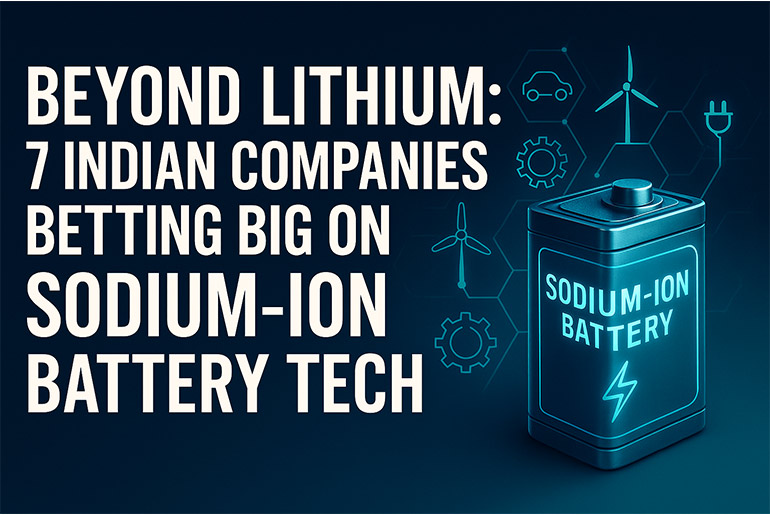
What if India could build safe, affordable batteries without depending so heavily on lithium imports? And what if the answer wasn’t a distant dream but a technology already taking shape inside Indian pilot plants, R&D labs and startup workshops? That technology is sodium-ion battery tech — a chemistry that has quietly moved from research papers to early commercial packs. In a world where lithium prices fluctuate and supply chains remain fragile, sodium-ion battery tech offers a simple but powerful advantage: sodium is abundant, cheap and widely available. And for a country like India, which needs millions of batteries for two-wheelers, telecom towers, backup storage and renewable integration, this shift could be transformational.
But none of this is possible without companies actually building the ecosystem. And right now, seven Indian players — from startups to industrial giants — are actively shaping the country’s sodium-ion story.
Before profiling them, let’s understand the market momentum behind this chemistry.
Why Sodium-Ion Battery Tech Matters Now
Sodium-ion battery tech works similarly to lithium-ion but replaces lithium with sodium, a far more abundant element. It still uses intercalation and similar cell architecture, which means existing Li-ion manufacturing lines can be adapted with lower cost and disruption.
The benefits are clear:
- Lower material cost (sodium is far cheaper than lithium)
- Higher safety (reduced thermal runaway risk)
- Good performance in cold and tropical temperatures
- Better suitability for stationary storage and short-range mobility
- Reduced import dependence
Multiple global research groups expect sodium-ion to be one of the fastest-growing battery chemistries by 2030.
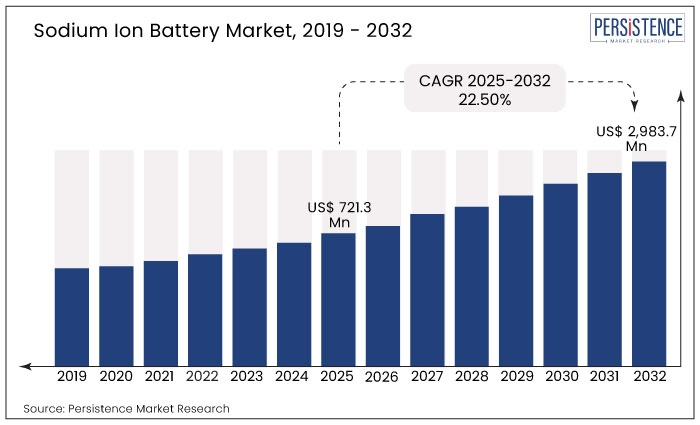
According to Persistence Market Research Company, the global sodium-ion battery market is projected to grow at a CAGR of around 22.5% between 2025 and 2032. This wide range reflects different adoption scenarios, but all forecasts point upward. Sodium-ion battery tech is still young — yet its curve is steep.
For India, the timing is perfect. The EV market is exploding, renewable capacity is scaling fast, and domestic manufacturing is a national priority. Sodium-ion doesn’t need to beat lithium-ion everywhere — it just needs to win where India needs reliable, cost-effective storage.
And that’s exactly where seven Indian companies come in.
1. Reliance New Energy (with Faradion)
When Reliance New Energy acquired UK-based Faradion, it instantly gave India one of the world’s strongest sodium-ion IP portfolios. Faradion has been a pioneer in this space for over a decade, and Reliance brings the one thing every new battery technology needs: scale.
This partnership is a major signal to global markets that India intends not just to adopt sodium-ion battery tech, but to mass-manufacture it. With Reliance’s investments in giga-scale infrastructure, sodium-ion could become an India-first success story.
2. Rechargion
Rechargion stands out as one of India’s first companies focused purely on sodium-ion cell manufacturing. They are setting up a pilot cell line, building demonstration packs and testing Indian-condition–specific chemistries.
What makes Rechargion important is that they are creating everything inside India — material sourcing, electrodes, cells, and packs. For your website’s readers, this represents the true “Made in India” sodium-ion battery tech journey.
3. Indi Energy
Indi Energy is another strong pillar in India’s sodium-ion ecosystem. The company works on:
- Hard-carbon anodes
- Sodium-ion electrolytes
- Prototype cells
- Materials commercialisation
Their “BioBlack” hard-carbon material is an example of how India can innovate at the materials level, not just assemble cells. A local materials base is critical for cost reduction, and Indi Energy helps fill that gap.
4. Cygni Energy
Cygni has already launched sodium-ion battery packs for two-wheelers and telecom/backup needs. They highlight why sodium-ion battery tech matches Indian realities:
- Hot tropical climate
- High cycle use
- Lower cost expectations
- Need for safer backup systems
For a market like two-wheelers, where extreme energy density isn’t mandatory, sodium-ion is promising — and Cygni is showing that commercialisation is already underway.
5. Exide Industries & Amara Raja
India’s two most prominent traditional battery manufacturers are moving toward a multi-chemistry strategy which includes sodium-ion.
Why that matters:
- They already have experience of manufacturing batteries.
- They have OEM networks.
- They can scale up quickly if sodium-ion battery technology becomes a widespread technology.
The idea of incumbents using a new chemistry signals maturity, not hype. For your article, it signals the potential of India’s industrial backbone.
6. Tata Group / Tata Chemicals
While not building sodium-ion cells directly, Tata Chemicals and other units of the Tata group play a critical role in the materials ecosystem: precursors, processing chemicals, and cell-grade inputs.
Every battery industry depends on upstream chemistry, and this is where India often relies on imports. With Tata deepening work in energy materials, India is preparing for a fully domestic sodium-ion supply chain.
7. Research Institutes & National Labs
IITs, national energy labs, and private research centres are actively working on improving sodium-ion battery tech, focusing on:
- Boosting cycle life
- Stabilising cathodes
- Creating India-specific hard carbon
- Testing tropical-temperature performance
These labs fill a crucial gap: sodium-ion needs chemistry innovation, not just manufacturing. India’s R&D ecosystem is making sure this tech fits our climate, cost structures and industrial needs.
What’s Actually Happening in the Market Right Now
Sodium-ion battery tech is moving through a predictable adoption curve:
- R&D and prototype validation (2016–2021)
- Pilot-scale production (2022–2025)
- Commercial pack deployment in targeted segments (2025–2030)
- Large-scale manufacturing when costs converge (post-2030)
India is currently in Stage 2 moving into Stage 3.
Where sodium-ion is likely to be used first:
- E-scooters and e-rickshaws
- Telecom tower backup
- Home and commercial energy storage
- Rural micro-grids
- Solar-plus-storage systems
These are high-volume, cost-sensitive segments where sodium-ion battery tech offers practical advantages.
Challenges to Be Honest About
- Energy density is lower than mainstream Li-ion (especially NMC)
- Heavy EVs may not adopt sodium-ion soon
- Supply chains are still being built
- Manufacturing still needs scaling to reduce costs
- But none of these are deal-breakers for its target applications.
India doesn’t need sodium-ion to power luxury cars — we need it to power the country.
Why This Is a Critical Technology for India’s Future
Sodium-ion battery tech can reshape India’s energy landscape in three ways:
1. Cost competitiveness:
- Cheaper materials → cheaper batteries → faster EV and solar adoption.
2. Supply-chain independence:
- Reducing lithium dependence and creating a fully domestic ecosystem.
3. Safety and reliability:
- Better thermal stability for India’s climate.
These seven companies are proving that sodium-ion is more than a buzzword — it’s a serious industrial opportunity.
The Road Ahead
India is at the perfect moment to lead globally in sodium-ion battery tech. Not by copying global trends, but by solving real Indian problems — affordable mobility, reliable backup, rural energy, and grid storage.
As these seven companies build the ecosystem step-by-step, sodium-ion battery tech is going from “interesting alternative” to “practical reality”. And if their momentum continues, India could become one of the world’s most important sodium-ion manufacturing hubs within the next decade.
 Electrify your feed! Click here to join our Whatsapp group and to get the latest updates, expert insights, and innovations driving India’s energy storage revolution.