India’s Battery Energy Storage System (BESS) market is moving rapidly from ambitious tenders to physical deployment. Gigawatt-hours are being announced, prices are becoming increasingly competitive and developers are looking for ever-lower costs. But beneath this acceleration sits a question the industry cannot afford to postpone: what happens when the numbers in a bid meet the realities of year seven in the field?
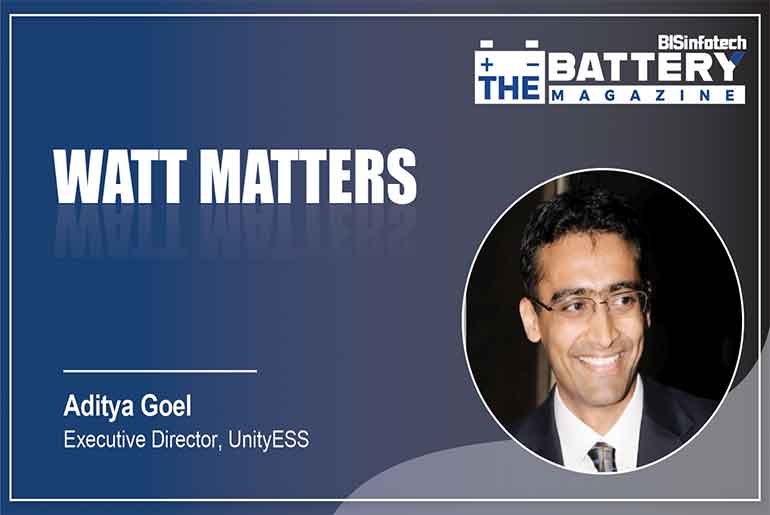
For Aditya Goel, Executive Director, UnityESS by Ornate Solar, the answer begins with evidence. In a candid and technically grounded conversation, Goel challenges the industry’s growing dependence on unverified assumptions around cycle life, round-trip efficiency, degradation and lifetime availability—figures that can look compelling in a tender document but carry very different consequences when billions are invested in assets expected to operate for 15–20 years.
Shweta Kumari, Sub-Editor, The Battery Magazine, engaged in a thought-provoking discussion with Goel to explore what genuine localisation means beyond the “Made in India” label, why traceability must extend from cell batches to firmware, and how BESS systems need to be engineered around India’s heat, humidity, dust, grid fluctuations and distinctly demanding operating patterns.
The conversation goes further—into BESS bankability, State of Health, residual value, policy sequencing, grid-code gaps, safety testing and the urgent need for standardised performance measurement. At its heart is a simple proposition: India can compete on price, but it cannot afford to compete by transferring unmeasured risk to the future.
Let’s delve into the interview to discover why the next phase of India’s BESS journey may be decided not by the lowest bid, but by the strongest evidence behind it.
India often frames the BESS challenge as a competition on price against Chinese technology. From your experience across battery manufacturing and now BESS, where does the real Chinese advantage actually lie—cell economics, supply-chain depth, power electronics, controls, manufacturing scale, or integration—and which of these can Indian OEMs realistically close within the next five years?
The advantage is not one thing. It is depth.
China’s real edge is in the material that makes the cell — in cathode and anode active material, separators, electrolyte, and the machinery that syntehsizes them. That layer, didn’t pop up out of nowhere. It took two decades to build, and it is the hardest to replicate.
Cell economics follow from that depth, not the other way around. Scale is the second lever. The largest Chinese cell plants run at volumes where yield improvement is continuous rather than occasional.
What we Indian OEMs can realistically close in five years is everything above the cell — system integration, thermal design, BMS and EMS logic, protection philosophy, commissioning discipline, and lifetime service.
That is where we chose to invest first. Over the last decade we have built a team of more than 168+ engineers whose work has been to learn, test, and fail on Li-Ion in Indian conditions — rather than bring in a finished system from elsewhere and hope it survives here.
A BESS is a 15 to 20 year asset. Whoever understands how it behaves in year seven, not year one, owns the relationship with the customer and the performance of the asset.
That knowledge is earned in the field. It is not a licensable technology, and it is available to Indian firms on exactly the same terms as anyone else.
The cells we will keep importing for now, but the competence is something we are not importing.
“Made in India” does not necessarily mean the battery system is technologically or materially indigenous. What level of component- and process-level traceability should a BESS OEM be able to demonstrate—from cell batch and BMS to PCS, thermal systems and software—and where do you believe today’s Indian BESS supply chain still lacks visibility?
“Made in India” is just a label, but Traceability is much more than that…it is a test.
We specify cell characteristics at the project level. Chemistry, format, C-rate, IR, and thermal envelope are selected against the site’s ambient profile, the duty cycle, and the application — before their manufacturing even begins. We do not choose them from a shell after they are produced.
That control is the precondition for traceability. A cell built to a defined specification can be audited against that specification.
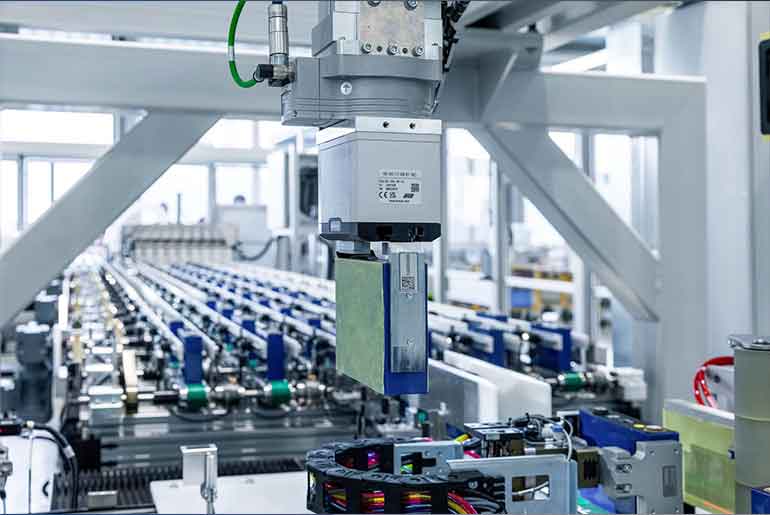
What a buyer should be able to demand is an unbroken chain. Cell batch and production lot. Module and pack serial. Rack and cluster mapping. BMS and BCU firmware version. PCS serial and firmware. Thermal unit, fire detection and suppression panel. And a factory acceptance test record tied to each of them.
Every one of those records should carry a number the buyer can physically match against the unit standing on their site.
Where the Indian supply chain still lacks visibility is one level below the component — the sub-assemblies inside the PCS, the sensors inside the thermal loop, and software.
Firmware provenance and version control receive almost no scrutiny in Indian procurement today. It is also the layer most likely to change silently across a 20-year life.
If an OEM cannot produce that chain at factory acceptance, the label means nothing.
BESS bids are increasingly evaluated through aggressive assumptions around cycle life, degradation, RTE and lifetime availability. You have previously questioned assumptions such as 12,000 cycles, 95% RTE and 2% annual degradation. What parameters should developers and procurers actually demand as field-validated evidence before accepting a BESS warranty or bankability model?
Ten thousand cycles is the honest number for the current generation of LFP. Not twelve thousand. Not fifteen.
It is worth looking at how fast this has actually moved. The first commercial LFP cells used in stationary storage delivered roughly 3,000 to 4,000 cycles at modest energy density. The 280 Ah prismatic generation that followed took that to around 6,000.
Today’s mainstream cells, 314 Ah and above, are rated near 10,000 cycles with a 20-year design life and materially higher volumetric energy density. That is why a 20-foot container has moved from about 2.5 MWh to more than 5 MWh in under five years without changing size (but definitely increasing in weight).
The next generation — cells above 587 Ah, are promising 12,000 cycles and higher density again. We expect them to first be tested in India rigorously. We do not accept it as a bid assumption before it is field-proven.
So what should developers demand from OEMs like us as evidence?
Testing cells at the rated C-rate and at the site’s real temperature band, not at laboratory conditions. Round-trip efficiency measured at the AC terminals with auxiliary consumption included, not DC-side efficiency quoted alone. Degradation curves drawn from operating fleets, not extrapolated from cell-level tests.
Optimism about this technology is fully justified. Optimism used as a financial model is not.
UnityESS positions itself as “Built for India.” Beyond ambient temperature, what does “Designed for India” actually mean at the engineering level? Which design decisions have you changed because of Indian grid behaviour, humidity, dust, heat, load profiles, power quality, site conditions or operating patterns that would not necessarily be required in a standard global BESS architecture?
Ambient temperature is the easy part. India’s harder variables are actually the ones that never appear on a global specification sheet.
Grid behaviour is the first. Indian industrial feeders see voltage and frequency excursions, harmonic distortion, and switching events at a frequency that a European or American design is not built to ride through. Protection settings tuned elsewhere will nuisance-trip a plant here, and a battery that trips is a battery that earns nothing.
Second is the operating pattern. A system built for a European or American market is often designed around one deep cycle a day. An Indian C&I asset runs multiple partial cycles in the same day — Time-of-Day arbitrage, demand-charge shaving, solar firming, and outage backup, frequently all four. That changes thermal design and cell selection, not just software.
Third is the environment as a whole system. Dust, monsoon humidity, coastal salt, and sites where the enclosure is the only protection the asset will receive for two decades.
Fourth is service reality. Spare availability, response time, and the assumption that a specialist engineer will not be standing on site when something goes wrong.
None of this can be gleaned from a specsheet. What we’ve experienced was learned by building, deploying, and correcting systems in Indian conditions over a decade, with our own engineering team doing the correcting.
“Designed for India” means the failure modes we engineered against are Indian failure modes.
Battery-as-a-Service can shift BESS from a high-CAPEX purchase to an OPEX model, but it also shifts degradation, performance and residual-value risk between the OEM, financier and customer. What has to change in India’s contracting and financing structure for BaaS to become genuinely bankable—and who should ultimately carry the battery’s performance risk?
We already operate across the full range — CAPEX, OPEX, Build-Own-Operate, and Build-Own-Operate-Transfer. So this is not a theoretical question for us.
The obstacle is not appetite. It is that Indian contracting has no standard way to price a battery’s condition.
Three things have to change.
First, State of Health must become a measured, contractual quantity — with an agreed test method, an agreed measurement point, and an agreed audit frequency. Not a number the OEM reports about itself.
Second, residual value needs a reference price. Until a second-life and recycling market puts an observable value on a cell at 70% State of Health, a financier is underwriting an asset with no defined exit.
Third, performance risk should sit with whoever controls the operating profile. If the OEM operates the asset and sets dispatch, the OEM carries degradation risk. If the customer dictates dispatch, that risk moves with the control. Most disputes in this industry come from contracts that blur the two.
Our position is straightforward. The party that can measure the risk should carry it, but the reward should be given to the same party that takes the risk. Risk without Reward is like one-person doing the heavy lifting, while the others watch and take credit. Today that is the OEM — and it should be, because it is the only structure that forces us to be honest about cycle life.
India has used PLI and domestic-content policies to build a local battery ecosystem. From an OEM’s perspective, where have these interventions genuinely changed manufacturing capability, and where have they mainly changed sourcing decisions? Does DCR create enough technological depth in BESS, or do we need policy to incentivise BMS, PCS, EMS, testing, thermal management and other system-level capabilities as well?
PLI is the right instrument, applied in the wrong order.
As per the Ministry of Heavy Industries, the ACC PLI scheme committed Rs. 18,100 crore towards 50 GWh of advanced chemistry cell manufacturing. That targets the single hardest link in the chain first.
We still import cells from China. So does every other Indian player in this industry, whatever the marketing says.
Look at how solar was actually localised. As per MNRE’s own policy sequence, India supported modules first, then moved backwards to wafers and cells. Assembly and integration were localised early, demand was created, and depth followed that demand.
BESS policy has begun at the opposite end. Cell manufacturing needs materials chemistry, precision equipment, and years of yield learning. Supporting it first, without a domestic integration base pulling volume through it, will not produce results in the short term.
The sequence should be reversed. Incentivise system integration, BMS, PCS, EMS, thermal management, and — most importantly — testing and certification infrastructure.
Those capabilities are achievable now. They create the demand signal, they retain value in India immediately, and they build the engineering base a domestic cell industry will eventually require.
Get the integration layer right, and cell plants become inevitable. Start at the cell, and we risk getting neither.
India is rapidly moving from BESS tenders to actual grid-scale deployment. Which technical gaps in India’s present grid-code, interconnection, performance-testing or ancillary-service framework worry you most—and what should be standardised now before hundreds of GWh of storage are connected to the grid?
The gap that worries us the most is measurement.
India has moved quickly on enablement. As per the Central Electricity Authority’s National Electricity Plan, the country will need roughly 47 GW and 236 GWh of battery storage by 2031-32, and CERC has opened both connectivity and ancillary services participation to storage.
What has not kept pace is a common, mandatory performance-testing protocol. There is no single national procedure defining how capacity, round-trip efficiency, and response time are verified at commissioning — and re-verified annually thereafter.
Second, interconnection requirements still vary by state. Ride-through, reactive power capability, and telemetry expectations differ between DISCOMs, so a serious OEM designs to the strictest and prices the difference into every project.
Third, availability and degradation reporting has no standard format. Without one, no regulator, off-taker, or lender can compare two assets on the same basis.
Fourth, energy accounting. How charging energy is metered, treated, and settled still differs across states — as does the treatment of banking, open access, and cross-subsidy for a storage asset. The same project can have two very different business cases on either side of a state border.
Fifth, safety testing. IEC 62933 and UL 9540A already exist, But we still are lagging on our local standards. Making system-level fire propagation testing mandatory before hundreds of GWh are connected is far cheaper than legislating it after the first serious incident.
Standardise measurement first. Almost everything else can follow from it.
India’s BESS market is moving from tender announcements to execution, but rapid scale can also encourage cost-driven procurement. If you had to identify one practice that the Indian BESS industry must stop doing now—because it could compromise long-term reliability, safety or bankability—what would it be? And what should replace it?
What we should start doing first, is awarding contracts on unverified paper.
The industry today accepts warranty and performance figures as bid inputs without demanding the test evidence behind them. Twelve thousand cycles, 95% round-trip efficiency, 2% annual degradation — quoted, tabulated, discounted into a financial model, and never once verified.
That is not merely a commercial risk. It is a reliability and safety risk that surfaces in year six, long after the tender team has moved on.
What should replace it is neither exotic nor expensive. Every bid should carry third-party test reports at rated conditions, a full traceability chain from cell batch to system, a defined commissioning test protocol, and annual performance verification with a stated remedy for shortfall.
Then let price decide. Price competition on verified specifications is healthy — it is how every mature industry works.
Price competition on unverified claims is not procurement. It is a transfer of risk onto whoever still owns the asset in year ten — usually the developer, sometimes the lender, and eventually the consumer.
None of this requires a new institution. CEA, BIS, and the certification bodies already have the mandate. What is missing is the requirement that evidence accompany the bid rather than follow it.
India is about to build a storage fleet that will outlive most of the people procuring it. We should be as rigorous about it now as we will wish we had been in 2035.
 Electrify your feed! Click here to join our Whatsapp group and to get the latest updates, expert insights, and innovations driving India’s energy storage revolution.