

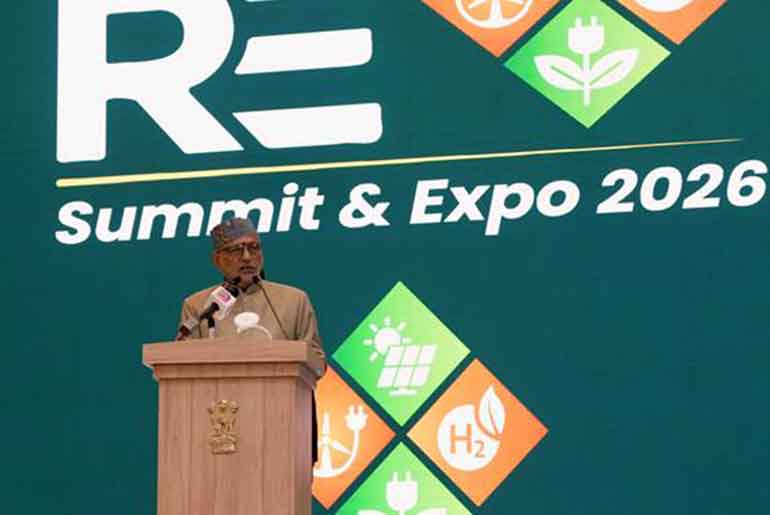
The Bharat Renewable Energy Summit & Expo (BRE Summit & Expo) 2026 concluded in New Delhi with participation from over 75,000 visitors representing 135 countries. Addressing the valedictory session, Vice-President of India C. P. Radhakrishnan highlighted India’s renewable energy progress and stated that environmental commitments are driving economic growth, energy access and sustainable development.
The Vice-President emphasised India’s achievements in renewable energy, its commitment to sustainability and the role of clean energy in empowering households, farmers and communities. He noted that the progress made over the past decade supports Prime Minister Narendra Modi’s vision of positioning environmental commitments as catalysts for economic growth, lower industrial costs, employment generation and reduced import dependence.
Calling for stronger industry-academia collaboration, the Vice-President said that research, innovation and entrepreneurship would be central to India’s future energy technologies.
Renewable Energy Sector Attracts ₹15 Lakh Crore Investment
Union Minister for New and Renewable Energy Pralhad Joshi stated that India’s renewable energy sector has attracted more than ₹15 lakh crore in investments over the past decade, including nearly ₹6 lakh crore in the last two years.
He described BRE Summit & Expo 2026 as India’s largest renewable energy event, bringing together international ministers, policymakers, investors, industry leaders and technology stakeholders.
The summit witnessed participation from:
- More than 75,000 visitors from 135 countries
- Over 32 international ministers
- More than eight partner countries and the European Union
- 14 partner States and Union Territories
- Six Chief Ministers and 10 State Energy Ministers
- Over 400 exhibitors
- More than 620 speakers
- 113 sessions
- Around 800 international delegates
The event also featured the 9th International Solar Alliance Assembly and the 4th International Conference on Green Hydrogen.
Cabinet Approves ₹14,500 Crore Energy Storage VGF Scheme
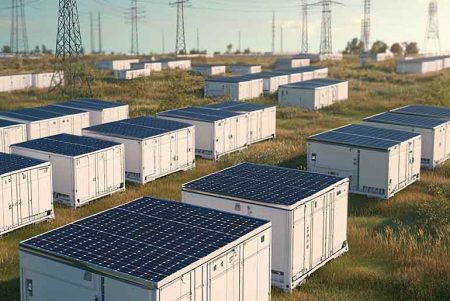
The Union Minister highlighted the Union Cabinet’s approval of a ₹14,500 crore Viability Gap Funding (VGF) scheme for developing 92 GWh of grid-scale energy storage capacity.
The approved storage capacity includes:
- 30 GWh: Battery Energy Storage Systems (BESS)
- 60 GWh: Pumped Storage Projects (PSPs)
- 2 GWh: New energy storage technologies
The Minister also highlighted the Next Terawatt Ministerial Plenary, which focused on integrated energy planning, resilient infrastructure, storage and financing, alongside the Watts Next forum that brought innovators together.
India Records Lowest Utility-Scale Solar Generation Costs
According to the Minister, India has achieved utility-scale solar generation costs of USD 30–35 per MWh, equivalent to approximately ₹2,840–₹3,313, which he described as the lowest globally.
Renewable energy has also helped India save more than USD 100 billion in fossil fuel imports, equivalent to approximately ₹9.46 lakh crore.
The Minister further stated that India auctioned 15 GW of hybrid renewable energy projects in 2025, taking the cumulative auctioned capacity to 64 GW. Both figures represent the highest volumes globally, according to his address.
Average tariffs achieved between 2023 and 2025 stood at approximately USD 45 per MWh, or ₹4,260, around 20% below the average cost of electricity from coal-fired power plants.
Solar Manufacturing Capacity Crosses 225 GW
Highlighting India’s growing manufacturing capabilities, Pralhad Joshi stated that solar module manufacturing capacity had crossed 225 GW, making India the world’s second-largest solar module manufacturer.
He also stated that distributed solar capacity for self-consumption is expected to exceed 100 GW by 2030.
These developments were also highlighted in the International Energy Agency’s report, India RE Market Report 2026: Analysis and Forecast to 2030, launched during the summit.
Summit Witnesses International Cooperation and Green Methanol MoUs
During the summit, the Union Minister held bilateral discussions with France, Denmark, the Canada Pension Plan Investment Board and several countries from the Global South to explore investment and cooperation opportunities.
The event witnessed the signing of 10 MoUs and framework agreements, including an MoU involving SECI with the potential for supplying 3 lakh tonnes of green methanol annually.
The discussions focused on strengthening international partnerships and expanding cooperation across renewable energy and emerging clean energy technologies.
Transmission, Storage and AI to Shape India’s Energy Infrastructure
The Minister emphasised that India’s expanding renewable energy capacity would require stronger transmission networks, increased storage capacity and smarter electricity grids.
He highlighted the growing importance of digitalisation and Artificial Intelligence in forecasting, predictive maintenance and energy management.
According to the Minister, AI data centres are expected to add 26.3 GW of electricity demand by 2031-32, requiring additional energy infrastructure and careful planning. He emphasised that renewable energy would play a primary role in meeting this demand.
The Minister stated, “AI will power the future. Clean energy will power AI.”
India Reaffirms Renewable Energy Growth Ambitions
Concluding his address, Pralhad Joshi reiterated the renewable energy target outlined by Prime Minister Narendra Modi at BRESE 2026 and expressed confidence in the industry’s capabilities, investor confidence and international cooperation to achieve the target.
Minister of State for New and Renewable Energy and Power Shripad Yesso Naik, Principal Scientific Adviser to the Government of India Dr. Ajay Kumar Sood and Secretary, Ministry of New and Renewable Energy Santosh Kumar Sarangi were also present at the valedictory session.
The summit brought together policymakers, international representatives, investors, industry leaders, exhibitors, knowledge partners and delegates, providing a platform for discussions on India’s renewable energy expansion, storage development, manufacturing and clean energy investment.
 Electrify your feed! Click here to join our Whatsapp group and to get the latest updates, expert insights, and innovations driving India’s energy storage revolution.