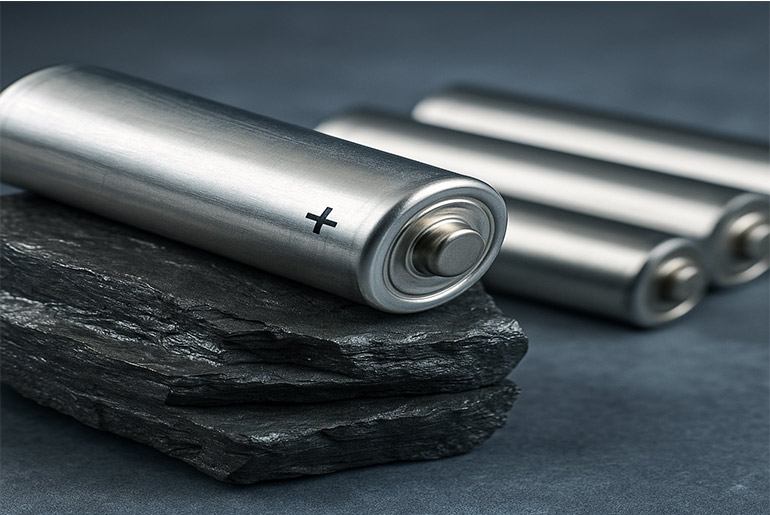
Imagine a battery that charges like a supercapacitor, uses aluminium and graphite (cheap, abundant materials), and skips lithium entirely. That’s the promise of Aluminum–Graphite Chemistry — a dual-ion architecture that’s suddenly moving out of labs and into real-world demonstrators. In energy-hungry applications where rapid response, safety and low cost matter more than maximum range per kilogram, this chemistry is emerging as a serious contender.
What is Aluminum–Graphite Chemistry (AGDIB)?
Aluminum–graphite dual-ion batteries (AGDIBs) operate differently from the familiar “rocking-chair” lithium-ion cells. In AGDIBs the aluminum anode undergoes plating/stripping while complexed anions (for example AlCl₄⁻) intercalate into graphite at the cathode during charge. This dual-ion mechanism separates the cation and anion movements and enables very high power and fast kinetics, while relying on inexpensive aluminium and natural graphite.
Why it matters for energy storage
Aluminum–Graphite Chemistry brings several practical advantages for energy storage systems:
- Cost and material security: aluminium and graphite are abundant and low-cost compared with lithium and cobalt.
- Safety: many AGDIB chemistries are non-flammable, lowering thermal-runaway risk — a key advantage for grid and stationary storage.
- High power / fast charge: demonstrators report energy densities around ~160 Wh/kg with power densities exceeding 9 kW/kg, making them ideal for fast-response grid services and frequency regulation.
These attributes make AGDIBs highly attractive for short-duration, high-power roles (grid balancing, UPS, frequency response) where cycle life, safety and cost per kW — rather than maximum energy per kg — are the priority.
Key players and R&D groups
- Fraunhofer IISB / INNOBATT (Germany) — Led the recent full-system demonstrator: pouch cells → modules → BMS and recycling pathway. Their system validation showed ~160 Wh/kg and very high power density, proving system-level feasibility for grid and high-power applications.
- Fraunhofer IKTS / BALU consortium (Germany) — Working on production technologies to transfer AGDIB cells from lab to industry-compatible manufacturing (project BALU focuses on scale-up, process robustness and safe, low-cost production).
- Albufera Energy Storage (Spain) — An R&D/industrial group with long-standing aluminium-battery projects. Albufera has participated in national and EU projects developing aluminium-based cells and production know-how.
- Graphene Manufacturing Group (GMG) / industry collaborations — GMG has announced graphene-aluminium battery prototypes and partnerships (e.g., with mining/industry partners) to develop aluminium-based pouch cells — exploring graphene additives and manufacturing routes to improve performance.
- Commercial & emerging teams listed in market surveys (examples) — Market analyses of the aluminium-ion field name several companies pushing aluminium-based batteries (examples include Great Power, TasmanIon, Phinergy (aluminium-air specialists) and other startups identified in industry market reports). These groups approach aluminium chemistries from different angles — dual-ion, aluminium-air, graphene-assisted aluminum-ion systems — broadening the commercialization pathways.
Technical strengths — and the tradeoffs
Strengths
- Very high power capability and ultra-fast charging.
- Non-flammability and simpler recycling pathways.
- Lower raw-material costs and reduced critical-mineral dependency.
Challenges
- Electrolyte chemistry: many AGDIBs rely on chloride-based ionic systems (e.g., AlCl₃-based), which pose corrosion and handling constraints and require careful cell engineering.
- Voltage window & energy density ceiling: while 160 Wh/kg is promising, it still lags some advanced lithium chemistries for EV range. AGDIBs are therefore better suited to stationary and power-centric roles.
- Cycle life and anode stability: plating/stripping aluminium reliably over many cycles requires optimized current collectors, electrolyte formulations and pressure management. Research reviews highlight these as active areas of improvement.
Comparisons: AGDIB vs. Lithium-Ion (LFP / NMC)
- Energy density: LFP/NMC cells commonly reach 150–260 Wh/kg (pack level varies); AGDIB demonstrators report ~160 Wh/kg — competitive for stationary uses but generally lower than highest-end lithium cells for long-range EVs.
- Power & charge rate: AGDIBs excel — power densities of multiple kW/kg and rapid charge/discharge outperform typical Li-ion.
- Cost & materials: aluminium + graphite give AGDIBs an advantage in raw-material cost and supply security.
- Safety & recyclability: AGDIB chemistries can be non-flammable and simpler to recycle, an edge for regulated stationary deployments.
Case studies & application scenarios
Grid stabilization & fast frequency response: Fraunhofer’s demonstrator explicitly targets grid balancing and rapid response services where milliseconds matter. The system-level tests show AGDIBs can provide virtual inertia and fast dispatch.
UPS and hybrid power systems: the chemistry’s safety and fast-power nature suits data centers, telecom sites and industrial hybrid systems where cycling and rapid discharge are routine.
Path to commercialization — what needs to happen
- Scale up electrolyte and cell manufacturing with corrosion-resistant materials and standardized assembly lines.
- Improve cycle life and lower cost through optimized electrode interfaces, electrolyte additives and module engineering.
- Standards & safety testing: regulators and industry consortia must develop test protocols for aluminium-based chemistries. The Fraunhofer demonstrator helps create that dataset.
Aluminum–Graphite Chemistry won’t replace lithium-ion across the board, but it could rewrite parts of the energy storage playbook — especially where safety, cost and rapid power delivery are king. The recent system demonstrator is a clear signal: dual-ion aluminium-graphite cells are transitioning from promising chemistry to practical option for grid-scale and high-power applications.
 Electrify your feed! Click here to join our Whatsapp group and to get the latest updates, expert insights, and innovations driving India’s energy storage revolution.