For more than a decade, lithium-ion batteries were not just dominant — they were synonymous with energy storage. Whether it was electric vehicles, rooftop solar, mobile devices, or grid-scale storage, one chemistry defined everything. Success in batteries meant success in lithium. Manufacturing strategies, mineral procurement, gigafactory investments and even national energy policies revolved around a single assumption: lithium-ion would scale endlessly, cheaply, and smoothly.
2025 has not broken lithium’s relevance — but it has ended lithium’s monopoly.
This year, the battery industry crossed a strategic threshold. For the first time, manufacturers, utilities, policymakers and investors are no longer talking about the best chemistry. They are talking about the right chemistry for the right job — a mindset that has formally launched the industry into a multi-chemistry future.
Sodium-ion is expanding into grid storage. Flow batteries are being selected for long-duration use. Lithium–sulfur is being reconsidered for aviation and defense. CAES is resurfacing as serious grid infrastructure. Recycling is being treated as production capacity.
What has changed is not chemistry.
What has changed is thinking.
The battery world in 2025 is no longer defined by a single winner — it is structured around a multi-chemistry future.
Lithium-Ion Didn’t Fail — It Hit Its Natural Limits
Lithium-ion remains an engineering miracle. But every industrial technology hits economic, geographic and operational limits when pushed too hard.
Global lithium deployment is now facing challenges that were invisible during the growth phase. Mineral processing concentration in China and Latin America exposed vulnerability. Lithium price volatility underscored dependence on geopolitically fragile supply chains. Gigafactories expanded faster than upstream refining. Recycling lagged behind EV deployment. Safety incidents, recycling constraints and energy density ceilings began to matter at scale.
Grid operators also started to realise something fundamental: lithium works brilliantly for fast-response storage, but becomes inefficient and costly when stretched into long-duration roles. As power systems absorb more solar and wind, the need is no longer just about short bursts of energy. It is about shifting electricity across hours, days and seasons.
These realities didn’t destroy lithium’s future. They redefined it. And in doing so, they opened the door to a multi-chemistry future instead of a lithium-only industry.
The Era of Portfolio Thinking
In finance, portfolios reduce risk by diversification. In batteries, the same principle is now being applied to technology.
- No chemistry excels at everything.
- No system solves all problems.
- No material is immune to supply risk.
Energy storage in 2025 is no longer a race toward a single miracle battery. It is the construction of an ecosystem that supports a multi-chemistry future.
- Manufacturers are segmenting their production.
- Grid planners are distributing risk across technologies.
- Governments are funding diversification instead of betting on one solution.
- Investors are backing platforms, not products.
What is emerging is a battery economy built not around lithium dominance, but around a resilient multi-chemistry future.
Sodium-Ion: The First Alternative to Move at Scale
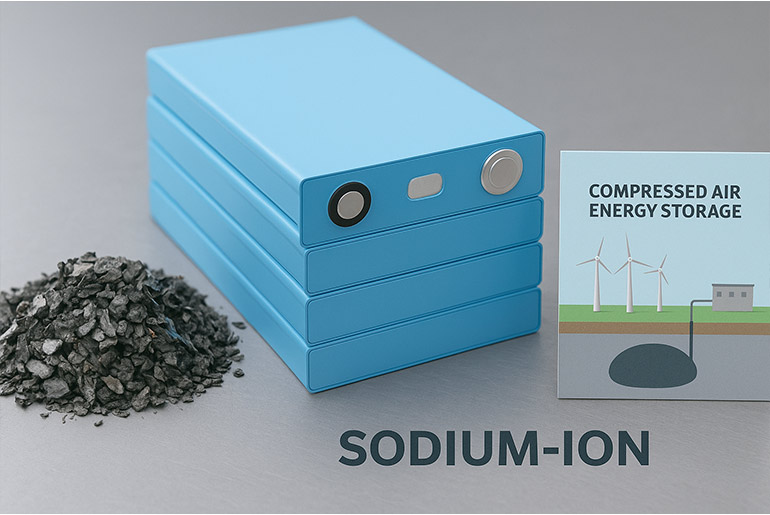
Of all post-lithium chemistries, sodium-ion is the fastest to exit the lab and enter production lines — a defining pillar of the multi-chemistry future.
It uses sodium instead of lithium — a basic but powerful shift. Sodium is widely available. Extraction is simpler. Environmental pressure is lower. Supply risk is minimal. Battery safety improves. Temperature resilience increases. Cost declines become achievable at scale.
Sodium-ion is not replacing lithium-ion in premium EVs.
It is replacing lithium-ion where lithium adds no real advantage:
- Grid storage
- Low-speed mobility
- Telecom backup power
- Industrial stationary systems
- Rural electrification
China has led commercialization. Startups and state firms have announced multi-GWh manufacturing capacity. European manufacturers have begun pilot deployments. Sodium-ion has already entered two-wheelers, buses and energy storage installations in Asia.
The message is clear:
- Where energy density isn’t critical, sodium is enough.
- Where cost matters, sodium wins.
- Where safety matters, sodium scales.
Sodium-ion is not hype.
It is infrastructure thinking for the multi-chemistry future.
Flow Batteries: Where Longevity Beats Density
Flow batteries solve problems lithium was never designed for — and that is precisely why they are indispensable in a multi-chemistry future.
Instead of storing energy within solid electrodes, flow batteries store energy in liquid electrolytes held externally in tanks. Capacity depends on tank size. Power depends on stack size. The two are decoupled.
The result:
- Long discharge periods
- Stable output
- Lossless scaling
- Operational life beyond 20 years
- Minimal degradation
That matters for infrastructure:
- Solar fields
- Wind farms
- Industrial microgrids
- Data centers
- Island grids
Utilities are choosing flow batteries not for hype — but for durability economics.
Lithium runs faster.
Flow batteries endure longer.
Both now coexist in the multi-chemistry future.
CAES: Infrastructure Returns to Energy Storage
Compressed-Air Energy Storage is older than lithium-ion — but its revival is powered by the same truth driving the multi-chemistry future: grids need long-duration storage at infrastructure scale.
In CAES systems, off-peak electricity compresses air into underground caverns or storage chambers. That air is later released through turbines to generate power when demand spikes.
Why is CAES returning?
- Because renewables need storage measured in days, not minutes.
- Because lithium cannot economically fill seasonal gaps.
- Because energy storage must now resemble power infrastructure.
New hybrid CAES projects in China and Europe integrate heat recovery and efficiency improvements. These are no longer dinosaur systems. They are engineered grid assets.
CAES will not power vehicles.
It will not sit inside buildings.
But in the multi-chemistry future, it will stabilise national grids.
Lithium–Sulfur: Performance Without Apology
Lithium–sulfur is not a grid solution.
It is not a mass-market chemistry.
It is a precision technology within the multi-chemistry future.
The chemistry offers energy density far beyond conventional lithium-ion. Aerospace, military systems, drones and future aviation platforms value one thing above all else: weight reduction.
Yet hurdles remain:
- Cycling instability
- Electrolyte breakdown
- Volume expansion
- Polysulfide migration
Lithium–sulfur will not dominate markets. It will dominate missions.
Recycling Is No Longer Sustainability — It Is Production and Recycling is not a moral choice. It is a strategic one.
Black mass, hydrometallurgical processing and battery-grade material recovery now influence manufacturing planning globally. Every country has learned the same lesson:
- Who controls recycling
- Controls capacity.
- End-of-life lithium becomes next-life supply.
- Scrap becomes strategic material.
- Waste becomes voltage.
The circular economy is the invisible engine behind the multi-chemistry future.
What This Shift Actually Changes
- Manufacturers move from cell sellers to portfolio managers.
- Utilities procure storage based on duration, not headlines.
- Governments design incentives across materials, not technologies.
- Investors hedge across chemistries.
- Nations recognise energy security as material security.
The multi-chemistry future changes not just batteries — it reshapes industrial strategy.
2025: The Year Strategy Took Over Technology
- 2025 did not invent sodium-ion.
- 2025 did not perfect flow batteries.
- 2025 did not rescue CAES.
- 2025 did not commercialise lithium–sulfur.
What 2025 did was redefine the game.
The industry stopped chasing miracles and started building systems. The battery economy matured into a multi-chemistry future.
Conclusion: Strategy Is the New Breakthrough
The battery world no longer waits for one perfect chemistry. It designs resilience instead. The future is not lithium versus alternatives. The future is lithium alongside alternatives. The battery economy is no longer a chemistry race. It is a systems revolution.
And that revolution has a name:
- The multi-chemistry future.
 Electrify your feed! Click here to join our Whatsapp group and to get the latest updates, expert insights, and innovations driving India’s energy storage revolution.