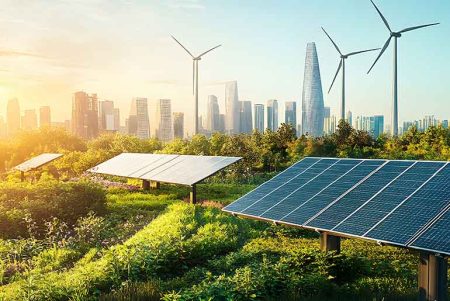
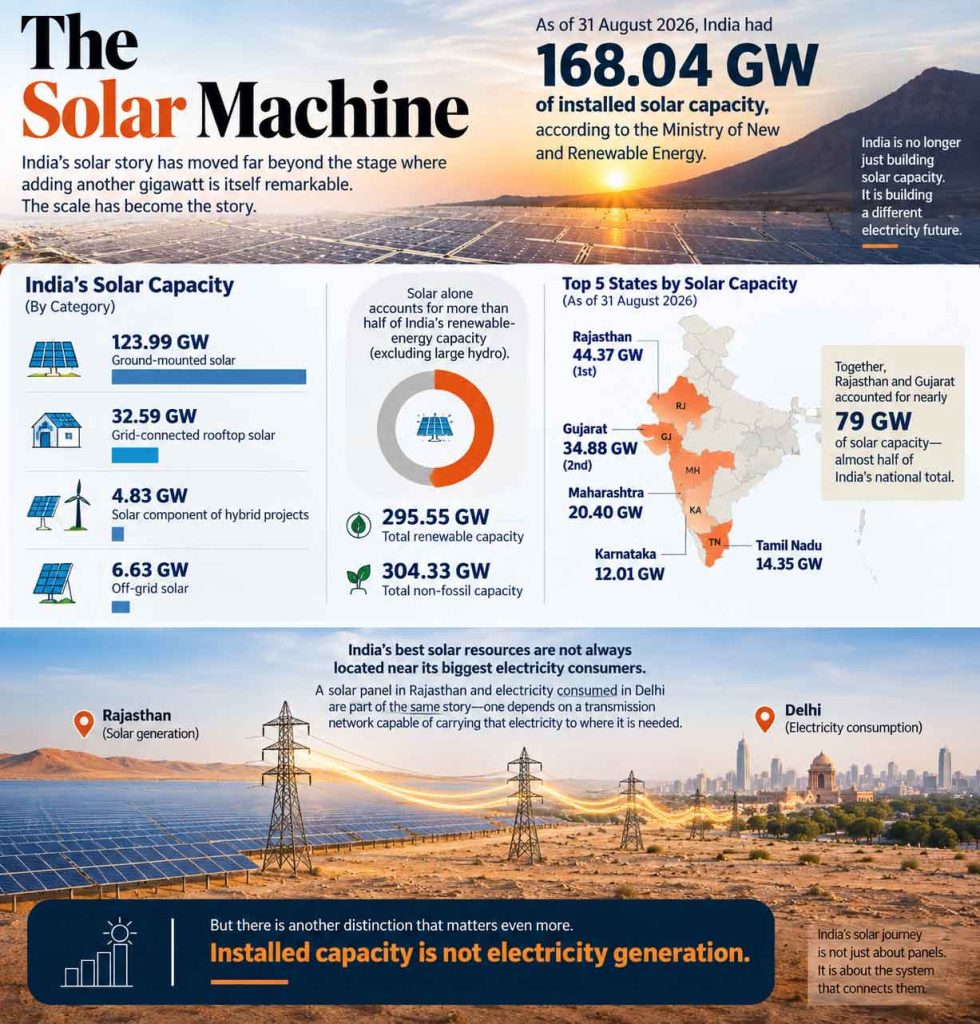
India has crossed a point where solar power can no longer be treated simply as an alternative source of electricity. With solar capacity reaching 168.04 GW by the end of August 2026, the question is no longer whether India will build a large solar industry.
It already has one.
The harder question begins after the panels start producing.
Solar can generate enormous amounts of electricity through the day. But India’s electricity demand does not disappear when the sun does. The grid still has to supply homes, factories, transport systems and other loads through the evening and night.
This creates the central contradiction of India’s solar ambition: India may have enough sunlight to produce vast quantities of electricity, but sunlight alone cannot guarantee electricity when the grid needs it most.
The scale of that distinction becomes clearer when capacity is placed beside actual generation. India generated 1,845.921 billion units of electricity in FY2025-26, of which solar contributed 173.525 billion units. Solar and wind together accounted for 276.614 billion units, or 15.14% of total generation.
That gap between what the country can install and what the system can deliver, when and where it is needed, will become increasingly important as solar capacity continues to expand.
The bigger question is therefore no longer simply how much solar India can install.
Can solar become India’s primary source of electricity—and can the rest of the power system evolve quickly enough to support it?
The expansion is not limited to generation capacity. India’s domestic solar manufacturing base has also scaled rapidly. According to Union Minister for New and Renewable Energy Pralhad Joshi, solar module manufacturing capacity has reached 192 GW, while solar cell manufacturing capacity has touched 30 GW.
India’s solar fleet is also becoming more diverse. As of August 2026, the 168.04 GW installed base included 123.99 GW of ground-mounted solar, 32.59 GW of rooftop solar, 4.83 GW of solar capacity within hybrid projects and 6.63 GW of off-grid solar.
This matters because these are not interchangeable forms of generation. A large ground-mounted project in a high-resource region serves the grid differently from rooftop solar located close to consumers. Hybrid projects can combine generation profiles, while distributed systems can reduce demand on parts of the network.
India has therefore built more than a collection of solar plants. It has built the beginning of a new electricity resource.
But whether that resource can become India’s primary source of power depends on what happens after the sun begins to fall.
Because solar’s real test does not begin at noon. It begins when generation falls and demand remains.
The After-Sunset Problem
The most important number in India’s solar story may not be its solar capacity at all. It may be the hour at which that capacity stops producing.
India’s solar fleet reached 168.04 GW by the end of August 2026, making solar the country’s largest renewable-energy technology by installed capacity. But the electricity system does not consume capacity. It consumes electricity, hour after hour, against a demand profile that changes throughout the day.
That distinction is becoming harder to ignore.
Solar output rises through the morning, reaches its strongest levels around the middle of the day and then falls as evening approaches. Demand, meanwhile, does not follow the same curve. Cooling loads can remain high, households return home, commercial activity continues and industrial demand persists. The result is a growing gap between the hours when solar is most productive and the hours when the system still needs substantial amounts of electricity.
This is not an argument against solar. It is the central engineering problem of a solar-heavy electricity system.
India has already demonstrated how significant renewable generation can become. On 29 July 2025, renewable sources met 51.5% of the country’s electricity demand of 203 GW, the highest renewable share reported for a day at that point. But a high renewable share over a day does not mean renewable generation is available in the same proportion at every hour.
The changing shape of demand is now becoming visible in the data. In August 2026, India’s peak power demand reached 258.27 GW, while electricity consumption rose to about 169 billion units, according to data reported from official power-system sources. Evening peak demand was around 245 GW, and non-solar hours experienced shortages even though the overall monthly peak was met.
That is the emerging shape of India’s solar challenge: the system can have abundant electricity during some hours and still face tight supply during others.
The phenomenon is often described through the duck curve. As solar generation rises, the amount of demand that must be met by dispatchable sources falls during the middle of the day. As the sun sets, that net demand rises again, creating a steep evening ramp.
For India, this is becoming more than a theoretical grid-planning concept. Recent analysis of India’s net-load profile shows a pronounced midday decline followed by a sharp evening rise as solar generation disappears.
During periods of high solar output, the system therefore faces a different problem: where does the surplus electricity go? It can be absorbed by demand, exported through the transmission network, stored for later use or, when those options are insufficient, curtailed.
Then comes evening.
Solar output falls rapidly, but electricity demand remains. The system must replace the generation disappearing from the solar fleet while continuing to serve the load already on the grid.
The recent September experience illustrates the point. Peak demand crossed 260 GW on September 8, while hydro generation was running below the previous year’s level. Gas-based generation subsequently rose sharply as flexible generation was called upon to help meet evening requirements. From September 1–9, gas-based plants generated 1,088.64 million units, 80.32% more than during the same period a year earlier.
The question is therefore no longer simply:
How much solar can India install?
It is:
How much of that solar capacity can the electricity system actually use when it needs it?
This is where the next 100 GW becomes different from the first 100 GW. The value of additional solar will increasingly depend not only on how cheaply it can generate electricity, but on whether the grid has enough storage, transmission, flexible generation and responsive demand to absorb that electricity and deliver it beyond the hours in which the sun is available.
Solar can provide enormous quantities of low-cost electricity. But its growing scale also changes the operating requirements of everything around it.
And that is where the story moves from solar generation to system flexibility.
The Battery Bridge
If solar is going to become the backbone of India’s electricity system, something has to bridge the gap between when solar electricity is produced and when consumers need it.
The logic is simple. Solar can produce more electricity than the grid needs during certain daytime hours. A battery can absorb part of that surplus and release it later, when solar generation is falling and demand remains high. Unlike a conventional generator, a battery does not need to generate electricity from fuel. Unlike a transmission line, it does not need to move electricity across geography. Its primary job is to move electricity through time.
That makes Battery Energy Storage Systems (BESS) particularly relevant to a solar-heavy power system.
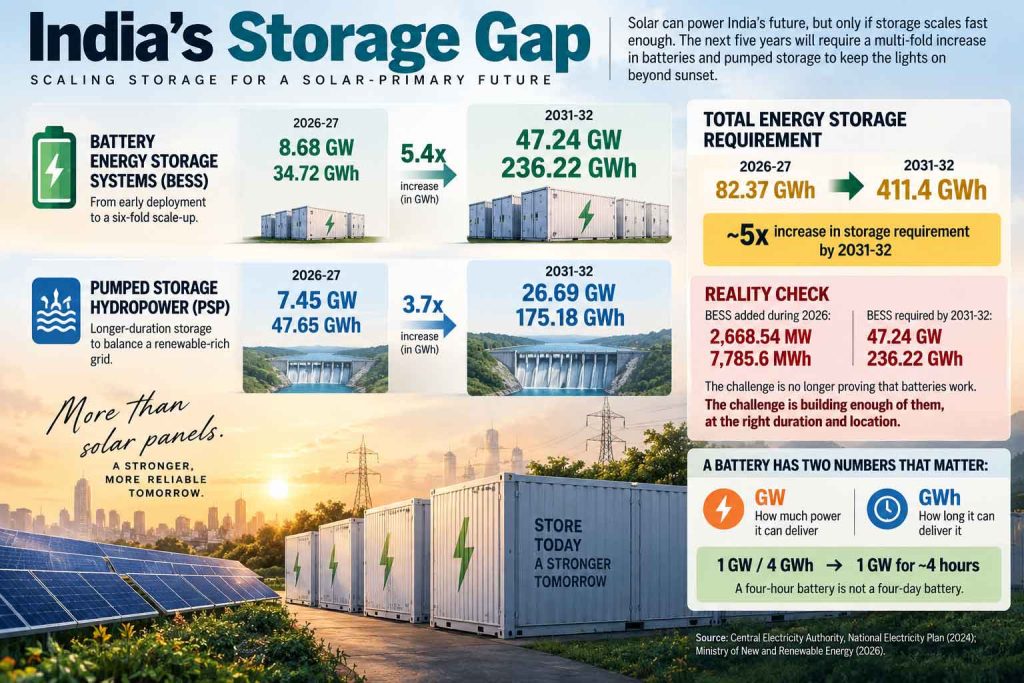
But the scale of India’s storage requirement is already moving beyond demonstration projects. The National Electricity Plan projects 8.68 GW/34.72 GWh of BESS by 2026-27, rising to 47.24 GW/236.22 GWh by 2031-32. When pumped-storage requirements are included, India’s total energy-storage requirement is projected to rise from 82.37 GWh in 2026-27 to 411.4 GWh in 2031-32.
The numbers matter because a battery has two fundamentally different specifications: power and energy.
Power, measured in megawatts or gigawatts, tells us how much electricity a battery can deliver at a given moment. Energy, measured in megawatt-hours or gigawatt-hours, tells us how long it can sustain that output. A 1 GW/4 GWh battery, for example, can theoretically deliver 1 GW for about four hours before its stored energy is exhausted.
India’s actual deployment is still far below the requirement being projected. The government reported that 2,668.54 MW/7,785.6 MWh of BESS capacity was added during 2026, while the National Electricity Plan envisages 47.24 GW/236.22 GWh by 2031-32.
The gap is therefore not simply about building more batteries. It is about building the right duration of storage, in the right locations, for the right system services.
A four-hour battery is not a four-day battery.
A battery can shift solar from noon into the evening. But during a prolonged period of weak renewable generation, a short-duration battery cannot discharge indefinitely. It must eventually be recharged, and that electricity has to come from somewhere.
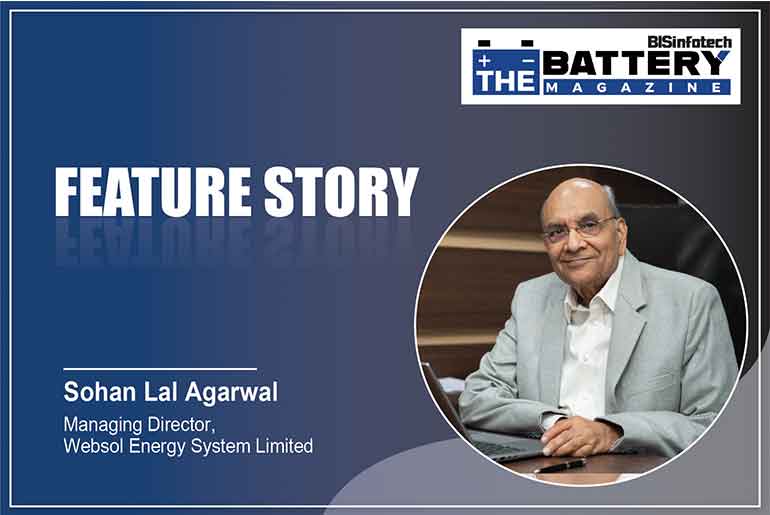
Sohan Lal Agarwal, Managing Director, Websol Energy System Limited, sees this as a fundamental change in how the power system itself is being designed.
The power sector is undergoing a fundamental transition from generation to a flexibility in usage. For decades, the objective was simply to add enough generation capacity to meet demand. Today, with renewable energy contributing an increasing share of electricity, the challenge is no longer how to generate clean power, but how to deliver it when and where it is needed.
Solar generation is inherently variable and concentrated during daylight hours, while electricity demand often peaks in the evening. This temporal mismatch requires resources that can shift energy availability across time, respond rapidly to fluctuations, and provide grid support services. Battery Energy Storage Systems (BESS) address all these requirements by storing surplus renewable energy, improving grid stability, and enabling dispatchable clean power.
As renewable penetration rises beyond 30–40% in many power systems, storage is evolving from a value-added asset into essential grid infrastructure. In this context, BESS should no longer be viewed as an accessory to solar projects but as a core component of the next generation of power systems.
Traditional electricity system was designed around the principle, Generate electricity when consumers need it. Whereas the emerging renewable system increasingly works on a different principle, Store renewable electricity when it is abundant, then deliver it when consumers need it.
That shift explains why Battery Energy Storage Systems are becoming a foundational part of modern power systems rather than simply an optional addition to solar projects. Germany’s experience demonstrates that once renewable penetration becomes sufficiently high, grid flexibility becomes just as important as generation capacity.
The argument captures the central transformation underway in renewable power: the industry is moving from simply building generation capacity towards building flexible electricity resources.
But storage capacity alone does not determine how useful a battery will be. Location matters too. A battery connected near a renewable-energy hub can absorb surplus electricity when transmission corridors are constrained. One located closer to a major demand centre can discharge during peak hours and reduce the amount of electricity that must be delivered through the network.
This is why the question for India is no longer simply:
How many gigawatts of BESS will India install?
It is:
How much storage energy will the system need, for how many hours, where, and for which grid services?
The answer also points towards the next stage of renewable procurement. Traditional solar asks how much electricity a project can generate. Firm and Dispatchable Renewable Energy (FDRE) asks whether that electricity can be delivered when the buyer requires it.
Solar, wind and BESS can therefore be combined into a portfolio: solar provides daytime energy, wind can complement its profile and batteries shift electricity across hours.
The individual solar plant remains intermittent.
The portfolio becomes more flexible.
India’s procurement is beginning to reflect this shift. SECI’s FDRE-IX tender, for example, sought 1,500 MW of FDRE capacity with four-hour assured peak supply, equivalent to 6,000 MWh, moving procurement beyond a simple requirement for renewable generation towards a defined delivery profile.
And if batteries can bridge hours, the next question becomes harder:
What bridges the days, seasons and geography of India’s electricity system?
Beyond Batteries
A battery can move electricity across hours. But India’s electricity challenge extends beyond the evening peak.
What happens when renewable output remains weak beyond a battery’s discharge duration, or when electricity is generated hundreds of kilometres from where it is needed? A battery alone cannot answer these questions.
Pumped-storage hydropower can absorb renewable electricity and release it when demand rises. Unlike batteries, it can provide longer-duration storage, although it depends on sites and infrastructure.
India plans 26.69 GW of pumped-storage capacity by 2031-32, with about 175 GWh of storage capability. In July 2026, 11 pumped-storage projects totalling 15.87 GW were under construction, while 8.14 GW across six projects had been concurred or appraised by the CEA.
Wind and hydro add another layer. Solar and wind have different generation profiles, while hydro can provide flexibility, subject to water availability.
Coal, gas and firm resources are unlikely to disappear. Their role may shift towards low renewable output, steep demand ramps or prolonged supply gaps. Markets will need to value flexibility and reserve capacity.
Demand is another resource: EV charging, flexible industrial processes, commercial loads and cooling can respond to price signals.
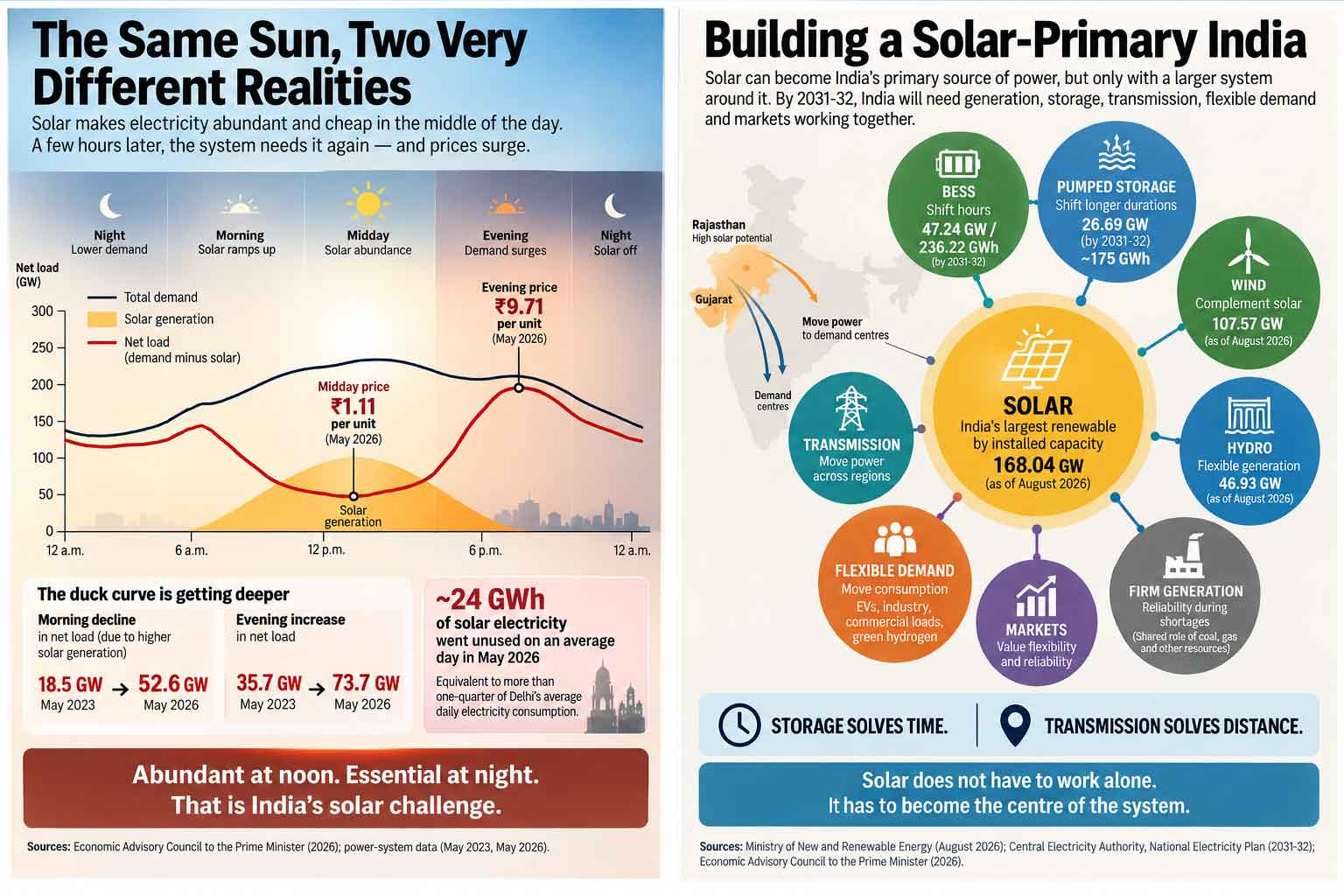
Storage solves time. Transmission solves distance.
A battery can move noon into the evening; transmission can move electricity from Gujarat or Rajasthan to demand centres.
The solar-primary system depends on solar, wind, BESS, pumped storage, hydro, firm generation, transmission, flexible demand and markets working together.
Solar does not have to work alone. It has to become the centre of the system.
The Grid Test
Transmission infrastructure almost as important to a solar-primary future as the solar panels themselves. A solar plant can produce electricity. A transmission network determines whether that electricity can reach someone who needs it.
India has been planning for this geographic mismatch for years. The Ministry of Power says intra-state and inter-state transmission systems are being planned to integrate more than 500 GW of renewable energy capacity by 2030 and more than 600 GW by 2032. The planned inter-regional transmission capacity is expected to increase from 120 GW as of January 2026 to 168 GW by 2032.
The scale of the planned network tells us something important. India is not simply building renewable generation. It is building the infrastructure required to move that generation around the country.
The Green Energy Corridor is one part of this effort. Phase I and Phase II of the programme cover intra-state transmission systems across ten renewable-rich states, with the Ministry of Power reporting that the programme is designed to facilitate evacuation of around 44 GW of renewable energy, of which about 26 GW had been integrated at the time of its latest update.
But the transmission challenge becomes much larger as renewable capacity increases.
The Central Electricity Authority’s planning now extends beyond the 2030 target. Its March 2026 transmission plan is designed to integrate more than 900 GW of non-fossil-fuel capacity by 2035-36.
That is an important shift in the way India’s electricity infrastructure is being imagined.
The question is no longer simply:
Where can we build solar?
It increasingly becomes:
How do we connect large renewable-energy regions to a national electricity system that is becoming more variable, more geographically distributed and more dependent on power transfers between regions?
CEA’s transmission planning shows the scale of infrastructure required around Gujarat’s renewable-energy zones. Its plans include transmission systems associated with Khavda, Lakadia, Bhuj and Radhanesda, with the identified system for evacuating renewable power from Gujarat totalling around 60 GW.
This reveals a fundamental truth about solar:
Transmission solves geography. Storage solves time.
A transmission line can move electricity from Rajasthan or Gujarat to a distant demand centre. It cannot move noon into 8 p.m.
During strong midday generation, transmission capacity determines how much renewable electricity can leave resource-rich regions. If corridors are constrained, additional solar may have limited value unless it can be stored or consumed locally.
That makes the location of BESS increasingly important.
A battery near a renewable-energy hub can absorb surplus generation when the grid is constrained and discharge later. A battery near a major demand centre can reduce the amount of power that must arrive through the network during peak hours.
The same megawatt-hour can therefore have very different system value depending on where it is stored.
India’s renewable geography makes this critical: solar in Rajasthan and Gujarat, wind and solar in Tamil Nadu and Karnataka, and major demand across Maharashtra, Delhi and industrial centres.
Transmission must therefore move ahead of generation.
Because a renewable plant can have plenty of sunshine—and still have nowhere to send its electricity.
When There Is Too Much Sun
India’s solar challenge has two sides. The first is obvious: when the sun goes down, solar generation falls while demand remains.
The second is less visible:
What happens when the sun is shining too well?
As solar capacity expands, there will be more hours when generation exceeds what the system can immediately absorb. Demand may be lower, transmission corridors constrained, or storage insufficient to capture the surplus. The same resource that reduces daytime pressure can therefore create a flexibility problem when too much power arrives at once.
The Economic Advisory Council to the Prime Minister’s 2026 analysis estimated that around 24 GWh of solar electricity went unused on an average day in May 2026, because the grid could not absorb it before demand shifted towards the evening. That was equivalent to more than one-quarter of Delhi’s average daily electricity consumption.
The problem is therefore not simply how much electricity solar generates, but when it generates it.
Between May 2023 and May 2026, the morning decline in net load as solar output increased rose from 18.5 GW to 52.6 GW, while the evening increase nearly doubled from 35.7 GW to 73.7 GW. This is the emerging duck curve: conventional generation requirements fall sharply during sunny hours, then rise rapidly as solar output disappears.
Prices reflect the same imbalance. In May 2026, average day-ahead prices during the midday solar peak fell to ₹1.11 per unit, while evening prices reached ₹9.71 per unit.
Curtailment can manage occasional surplus, but persistent or large-scale curtailment can reduce the value of new renewable capacity.
The alternatives are increasingly clear. BESS and pumped storage can shift surplus electricity into later hours. Transmission can move it to areas where demand is higher. Flexible demand can also help: EV charging, industrial processes, commercial loads and green-hydrogen electrolysers can consume more power when renewable generation is abundant.
Time-of-day pricing can reinforce this behaviour.
But demand cannot always move. Hospitals, railways, homes and many industries have fixed requirements. Flexible demand can reduce the imbalance, not eliminate the need for storage, transmission and firm generation.
As solar expands, electricity’s value will increasingly depend on when it is generated, where it is generated and whether the system can use it.
The cheapest electricity is not necessarily the most valuable.
And every new solar project will eventually have to answer one question:
What happens to the electricity after it is generated?
The Firm-Power Test
Moving solar electricity from noon to the evening is only the first test. The harder test comes when renewable generation remains weak for longer than a battery can cover.
A power system cannot be planned only around annual electricity generation. It must also have enough firm capacity when demand is highest and renewable output is low.
A 1 GW solar plant can generate large quantities of electricity over a year, but cannot be counted on to deliver 1 GW at 8 p.m. A 1 GW/4 GWh battery can deliver 1 GW for four hours, but not after its stored energy is exhausted.
India therefore needs a portfolio rather than one technology replacing another. Solar can provide low-cost daytime electricity; wind can complement it across hours and seasons; batteries can respond rapidly and shift energy across the day; pumped storage can provide longer-duration flexibility; hydro can provide dispatchable generation when water permits; and thermal generation can continue providing firm capacity as the system develops alternative sources of flexibility.
The challenge becomes sharper when several conditions coincide. India’s September 2026 experience illustrated this: gas generation rose sharply during the first nine days as evening demand increased while hydro generation was constrained. Meanwhile, 59 coal-fired plants had critically low coal stocks as of September 9.
This is why resource adequacy is becoming central to the renewable transition. CEA’s planning framework considers not only generation, but also storage and flexible resources needed to meet demand reliably during peak periods.
By 2031-32, CEA projects 47.24 GW/236.22 GWh of BESS, 26.69 GW of pumped storage, and peak electricity demand of about 366.4 GW.
These are not simply technology targets. They represent a change in how India defines electricity security.
The question is no longer only:
How much renewable electricity can India produce?
It is:
How much electricity can India guarantee when renewable generation is unavailable or insufficient?
That is the real meaning of firm power.
Solar may become India’s largest source of electricity. But becoming its primary source of power requires enough firm capacity around it to ensure that a system built increasingly on sunlight does not become dependent on sunshine being available precisely when it is needed.
The Power Plant Is Changing
For much of India’s renewable-energy expansion, the basic unit of development was straightforward: build a solar plant, connect it to the grid and sell the electricity it generates.
That model is becoming harder to sustain as solar penetration rises.
The next generation of renewable projects will increasingly be designed around a delivery profile, rather than simply an installed capacity figure.
A buyer may not only want 500 MW of solar capacity. It may want renewable electricity during specific hours, a minimum level of supply during the evening peak, or power that can be delivered according to a predetermined schedule.
This is where Firm and Dispatchable Renewable Energy (FDRE) changes the proposition.
Instead of asking a renewable plant to generate whenever the resource is available, FDRE projects combine different resources and storage so that electricity can be delivered according to a contracted requirement.
Solar can provide substantial daytime generation. Wind can complement solar across different hours and seasons. BESS can shift electricity from periods of surplus into periods of demand. Together, they can create a much more predictable supply profile than a standalone solar project.
Sohan Lal Agarwal, Managing Director, Websol Energy System Limited, describes this transition as follows:
“As renewable energy penetration increases, the electricity sector is moving from simply generating green power to delivering reliable, flexible, and dispatchable power. The five concepts mentioned above represent successive stages in this evolution. They are also the primary drivers behind the rapid deployment of Battery Energy Storage Systems (BESS).
Among these developments, Firm & Dispatchable Renewable Energy (FDRE) is likely to have the most transformative long-term impact.
FDRE fundamentally changes the value proposition of renewable energy by shifting the focus from generating electricity whenever the sun shines or the wind blows to delivering electricity according to a predetermined schedule. This requires renewable plants to combine solar, wind, and battery storage in a coordinated manner so that they can meet contractual delivery obligations with high reliability.
Unlike conventional solar projects, FDRE places a premium on predictability, flexibility, and operational performance. Battery storage becomes indispensable because it enables energy shifting, balances renewable variability, and provides the fast response needed to maintain schedule adherence.
At the same time, FDRE assets can participate in multiple value streams—including energy arbitrage, ancillary services, and capacity support—making storage economically attractive as well as technically essential. As electricity markets increasingly reward reliability and flexibility, FDRE is likely to become one of the strongest drivers of large-scale BESS deployment.”
The significance of this shift is larger than the emergence of another renewable procurement category.
It changes what developers have to optimise.
A standalone solar project is primarily concerned with resource quality, land, transmission availability, equipment performance and the cost of generation. An FDRE project has to solve a more complicated problem: how to assemble several assets so that the combined portfolio can meet a delivery obligation reliably and economically.
That means project design increasingly becomes an exercise in portfolio optimisation.
How much solar should be installed relative to wind? How much storage is required? What duration should the battery have? Where should the project connect to the grid? How much oversizing is economically justified? And what happens when actual renewable generation differs from the forecast?
These questions will determine whether a project merely has renewable capacity or can actually provide firm renewable power.
India’s procurement is already moving in this direction. SECI’s FDRE-IX tender sought 1,500 MW of FDRE capacity with four-hour assured peak supply, equivalent to 6,000 MWh. The requirement illustrates how procurement is beginning to specify not just how much renewable capacity is contracted, but what that capacity must be capable of delivering.
This is an important distinction for India’s solar ambitions.
If solar is eventually to become the primary source of electricity, the country does not need every solar project to behave like a conventional power plant.
It needs the overall renewable system to provide a reliable power supply.
That is why the future electricity plant may no longer be a single generating station at all.
It could be a coordinated portfolio of solar, wind, batteries, pumped storage, transmission capacity and flexible demand—managed together as one electricity-delivery system.
The solar panel will remain the starting point.
But increasingly, it will not be the finished product.
What Does the System Look Like by 2035?
By 2035, the question may no longer be whether solar can generate enough electricity.
The question will be whether India’s electricity system has become sophisticated enough to organise that generation around demand.
That would represent a fundamental change from today’s model.
Solar, wind and storage would increasingly operate not as separate assets, but as parts of an integrated electricity system. Renewable generation would be forecast more precisely, electricity would move across regions through a stronger transmission network, storage would shift energy across hours, and flexible demand would respond to changing system conditions.
The scale of that transformation is already visible in India’s planning.
The Central Electricity Authority’s long-term planning envisages more than 900 GW of non-fossil capacity by 2035-36. At that scale, the challenge cannot be solved by adding renewable generation alone. The supporting infrastructure has to expand alongside it.
This includes transmission, energy storage, flexible generation, advanced forecasting and smarter grid-management systems.
Sohan Lal Agarwal, Managing Director, Websol Energy System Limited, sees the relationship between solar and storage evolving accordingly:
“By 2035, the relationship between solar power and battery storage is likely to evolve from complementary technologies to an integrated energy platform. Solar will remain the primary source of renewable electricity generation, while BESS will increasingly determine how effectively that electricity can be delivered to the grid.
As solar capacity expands, the value of electricity will increasingly depend on when it is available rather than simply how much is generated. Battery storage will therefore play a critical role in shifting solar generation from low-demand periods to peak-demand hours, reducing curtailment, and providing ancillary grid services.
The combination of solar and BESS will increasingly resemble a dispatchable power plant rather than an intermittent renewable asset. This shift will also influence how renewable projects are financed, contracted, and valued in electricity markets.
However, the integration of solar and storage will not eliminate the need for broader grid infrastructure. High renewable penetration will require:
- Stronger transmission networks
- Greater inter-state power transfer capability
- Flexible generation
- Advanced forecasting and scheduling
- Demand-side flexibility
Without timely investment in: Transmission infrastructure, Battery storage, Flexible generation, Advanced forecasting, Smart grid technologies, India could face such challenges as renewable penetration increases. This is one reason policies promoting BESS, FDRE, and RTC renewable power are becoming increasingly important.”
The significance of this vision is that solar’s role changes from being simply a source of electricity to becoming the foundation around which the electricity system is organised.
But there is an important distinction.
Solar does not necessarily have to supply electricity at every hour to become the primary source of India’s power. It needs to provide the largest share of the system’s energy while complementary resources provide the flexibility, balancing and firm capacity required to keep the system reliable.
That is a very different proposition from building a grid powered by solar alone.
It is closer to building a solar-led electricity system.
In such a system, the solar fleet could generate the bulk of inexpensive electricity during resource-rich hours. Wind could diversify the renewable generation profile. Batteries and pumped storage could move energy across time. Transmission could move it across regions. Hydro and flexible thermal generation could provide additional firm capacity when renewable output is insufficient. Consumers themselves could become more responsive to system conditions.
The result would not be a single technology replacing the existing power system.
It would be an electricity system in which solar becomes the dominant energy resource while other technologies increasingly perform specialised supporting functions.
That distinction matters because it changes the question India should ask about its 2035 power mix.
Not:
How much solar can India install?
But:
How much of India’s electricity system can be designed around solar without compromising reliability?
The answer will depend less on the next solar tender than on whether the infrastructure around those solar projects is built at the same speed.
India’s solar ambition is therefore ultimately an infrastructure question.
The panels are only the beginning.
 Electrify your feed! Click here to join our Whatsapp group and to get the latest updates, expert insights, and innovations driving India’s energy storage revolution.