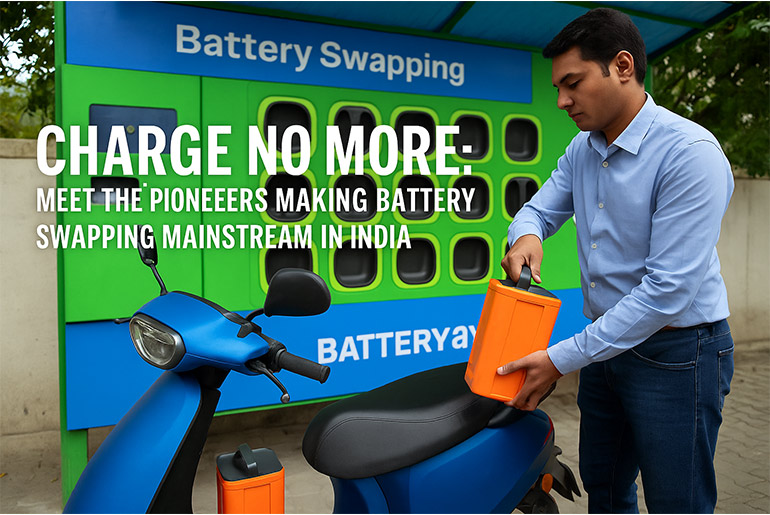
There’s a quiet revolution happening on the streets of India — not in boardrooms, not in policy meetings, but at every traffic signal where an electric scooter hums past, or at every delivery hub where dozens of riders unplug and move. The real transformation is not in how these EVs run but how they refuel. Because in India’s fast-moving cities, time is the new fuel. And nothing saves time like battery swapping.
Battery swapping doesn’t wait for a charger. It doesn’t need an empty parking bay. It doesn’t ask consumers to adapt their lifestyle. It simply says: swap, lock, and go.
Three minutes — and an EV is back on the road.
Behind this simple idea is an ecosystem of innovators building India’s most ambitious alternative to charging infrastructure. These are the companies rewriting how we think about mobility, ownership, and even energy itself.
Let’s meet the pioneers making battery swapping mainstream in India.
1. Gogoro: The Taiwanese Powerhouse Redefining India’s Urban Mobility
When Gogoro announced its India entry, the EV industry felt something shift. This was the company that transformed Taiwan’s streets with more than 12,000 swap stations and 400,000+ daily swaps. Their model is simple: riders subscribe to a battery service instead of owning the battery.
In India, Gogoro partnered with Belrise Industries and the Maharashtra Government to build an EV battery-swapping ecosystem and smart energy hubs worth $2.5 billion.
Their promise?
Create one of the world’s largest swapping networks — one that supports 2Ws, 3Ws, and even fleet mobility.
India’s dense cities, heavy last-mile demand, and sky-high delivery traffic are exactly where Gogoro thrives. And for riders, the service feels magical — swap a drained battery in 20 seconds, tap the e-wallet, ride again.
2. Sun Mobility: The Homegrown Swapping Visionary
If battery swapping had a heartbeat in India long before the world took it seriously, that pulse came from Sun Mobility.
Founded by Chetan Maini — the man behind Reva — Sun Mobility is building a network of interoperable, modular swapping stations across India.
What sets them apart is their focus on fleets:
- e-rickshaws
- cargo loaders
- delivery scooters
- urban micro-mobility vehicles
Their battery packs are lightweight, smart, and uniquely designed for Indian usage conditions. The swapping kiosks are compact enough to sit in kirana stores, metro stations, or fuel stations.
They’ve partnered with:
- Amazon fleets
- Zypp Electric
- Piaggio
- Bengaluru Metropolitan Transport Corporation (BMTC)
Sun Mobility is solving India’s EV transition at the scale and speed the country requires — by making swapping universally accessible.
3. Yulu – Powered by Yuma Energy (Yulu + Magna)
The blue Yulu bikes you see gliding silently across Bengaluru and Mumbai aren’t just EVs — they are part of a battery-swapping ecosystem that already supports millions of swaps every month.
Yulu rides on a unique model:
The user rents the vehicle, but the “fuel” — the battery — is powered by Yuma Energy, a joint venture between Yulu and Magna International.
Yuma has built over 100+ swapping stations in key Indian cities with plans for thousands more. The system is fully digital: riders simply swap at a kiosk, get a full battery instantly, and continue their commute.
For short-distance urban mobility, Yulu has become the blueprint others want to copy.
It’s clean, it’s fast, and it works beautifully at scale.
4. Battery Smart: India’s Fastest-Growing Swapping Network for E-Rickshaws
In the North Indian belt, battery swapping has a different story — one powered by the needs of e-rickshaw drivers who cannot afford downtime.
Here, the champion is Battery Smart, a company that has turned swapping into an economic lifeline.
Battery Smart runs a franchise-based swapping model, enabling thousands of small shop owners to host swap stations. Today, they have a presence in 30+ cities and complete millions of swaps every month.
Their success comes from:
- Pay-per-swap pricing
- Zero upfront cost for drivers
- Compatibility with major e-rickshaw OEMs
- Walk-in convenience at every corner
For many drivers, this isn’t just technology — it’s livelihood.
5. RACEnergy: The Hyderabad Innovator Building India’s “100% Swap-Ready” EVs
Where many companies build stations, RACEnergy built both the vehicles and the swappable batteries together.
Their retrofit kits turn old e-rickshaws into fully electric vehicles, while their second-generation swapping stations offer fast, affordable, climate-proof power.
RACEnergy focuses heavily on:
- Cell safety
- Thermal stability
- Fleet uptime
- Real-time monitoring
Their systems are designed to handle India’s heat, dust, humidity, and high-usage cycles — a reality many OEMs overlook.
With rapid expansion into Tier 2 and Tier 3 cities, RACEnergy is opening the swapping ecosystem beyond metros.
Why Battery Swapping Is Becoming India’s Fastest-Growing EV Fuel
Battery swapping is more than a convenience — it solves India’s hardest EV problems:
No waiting for charging
- Swaps take 20–120 seconds.
Lowers EV cost
- Users don’t buy the battery — the most expensive part.
Perfect for delivery fleets
- High uptime = higher earnings.
Ideal for crowded cities
- No charging bays or long queues.
Excellent for commercial and shared mobility
- Businesses can rotate batteries across fleets.
Reduces pressure on the grid
- Charging happens at controlled times, not during peak load.
This is why India is embracing swapping faster than almost any country in the world — because it fits naturally into the way Indians work, earn, and move.
The Road Ahead
Battery swapping likely won’t replace traditional charging everywhere — cars, heavy EVs, and highways still need fast chargers and slow chargers.
But in India, where millions rely on two-wheelers, three-wheelers, and shared mobility, swapping is becoming the heartbeat of EV logistics.
The companies leading this space aren’t just building stations. They’re building trust — making EVs dependable, affordable, and unbelievably convenient.
 Electrify your feed! Click here to join our Whatsapp group and to get the latest updates, expert insights, and innovations driving India’s energy storage revolution.