As the global energy landscape shifts towards renewable sources, the need for efficient and scalable energy storage solutions has never been more critical. Compressed Air Energy Storage (CAES) has emerged as a promising technology to address this challenge. By storing excess energy in the form of compressed air, CAES systems can release it during peak demand, ensuring a stable and reliable power supply. According to a recent report by MarketsandMarkets, the global CAES market is projected to grow from USD 0.48 billion in 2025 to USD 1.88 billion by 2030, at a CAGR of 31.4%.
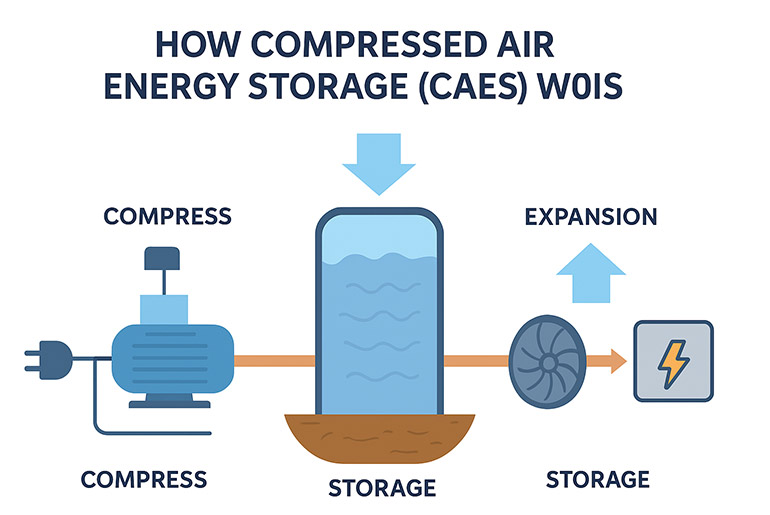
How Compressed Air Energy Storage (CAES) Works
A Compressed Air Energy Storage system stores electricity using compressed air. The CAES system compresses air and then stores it in underground caverns, or some other storage medium. When electricity demand is higher, the system releases the compressed air, heats the air, and expands it through turbines to produce electricity. There are three main categories of CAES systems:
- Conventional CAES, which burns natural gas to heat the compressed air before expansion.
- Adiabatic CAES (AA-CAES), which captures the heat generated during compression to reuse it during expansion improving the overall efficiency of the system. In AA-CAES systems to accomplish this process a heat exchanger is used to store the heat generated during compression.
- Isothermal CAES builds on the concept of adiabatic, using work expended to compress the air to keep it at a constant temperature, potentially increasing cycle efficiency.
Each type offers unique advantages and challenges, with ongoing research focused on enhancing efficiency and reducing costs.
Top 5 Companies Leading in CAES Innovation
1. Hydrostor (Canada)
Hydrostor is at the forefront of CAES technology with its Advanced Compressed Air Energy Storage (A-CAES) systems. The company has developed a 2.2 MW/10 MWh system in Ontario, Canada, which is the world’s first commercially contracted A-CAES facility. Hydrostor is also advancing larger-scale projects, including the 500 MW Willow Rock Energy Storage Center in California and the 200 MW Silver City Energy Storage Centre in Australia.
2. Storelectric (United Kingdom)
Storelectric is a leader in Green CAES™ technology, which incorporates thermal energy storage in order to recover and to reuse heat generated by the compression. This means improved efficiency and reduced emissions. Storelectric’s projects are intended to offer grid-scale energy storage, lasting anywhere between 4 hours and several days.
3. Corre Energy (The Netherlands)
Corre Energy focuses on underground energy storage systems based in salt caverns, storing compressed air in such caverns. The goal of the company’s Ahaus project in Germany is to generate over 320 MW of capacity and last longer than 3 days. Corre Energy is also exploring the integration of hydrogen as a co-fuel in its CAES systems.
4. Apex CAES (USA)
Apex CAES focuses on modular CAES systems that store compressed air in underground salt domes. The company’s Bethel project in California is set to have a storage capacity greater than all battery storage in the state combined. Apex’s approach emphasizes scalability and cost-effectiveness.
5. Baromar (Israel)
Baromar is working on a unique compressed air energy storage (CAES) system that utilizes compressed air storage in solid structures that are anchored on the sea floor. Baromar’s pilot project in Cyprus aims to demonstrate the feasibility of an underwater CAES for long-term energy storage. . This innovative concept utilizes hydrostatic pressure to increase the storage capability.
Market Trends and the Future
The CAES market is growing due to key drivers:
- Integration of Renewable Energy: Wind and solar energy is rapidly expanding and CAES systems allow for safe storage of excess energy for later use.
- Grid Stability: CAES provides long duration energy storage solutions that can help stabilize the grid during peak demand schedules.
- Government Efforts: There are liner of incentives taking shape to enable civil authorities to procure and deploy the systems / storage periods that transform energy use and management for communities and economy, while renewable or mixed storage providers work to advance CAES implementations.
Although there are challenges to CAES in place such as high upfront capital costs and the requirement for affordable geological formations for underground storage, many anticipate that innovation and increased investment will solve many of these problems making CAES options more viable on a utility-scale.
To conclude, Compressed Air Energy Storage offers a viable option for overcoming the challenges associated with integrating renewable energy into the grid. Heads and shoulders above the competition, a variety of innovative CAES technologies are being developed by Hydrostor, Storelectric, Corre Energy, Apex CAES, and Baromar. As the market grows, these systems will be important in enabling the promise of renewable energy to shine through in a stable and sustainable energy future.
 Electrify your feed! Click here to join our Whatsapp group and to get the latest updates, expert insights, and innovations driving India’s energy storage revolution.