The global energy transition has reached a critical inflection point. Renewable energy capacity is expanding at record speed, clean energy investment is at historic highs, and net-zero commitments now cover the majority of the global economy. Yet power systems across regions are becoming more complex, more stressed, and in many cases, more fragile.
Grid congestion, renewable curtailment, intermittency, and peak-demand volatility are no longer isolated technical issues. They are fast becoming defining challenges of this phase of transition.
It is in this context that the Energy Transition assessment by the World Economic Forum deserves close attention — not as a ranking exercise, but as a system-level diagnosis of where the transition is succeeding and where it is struggling.
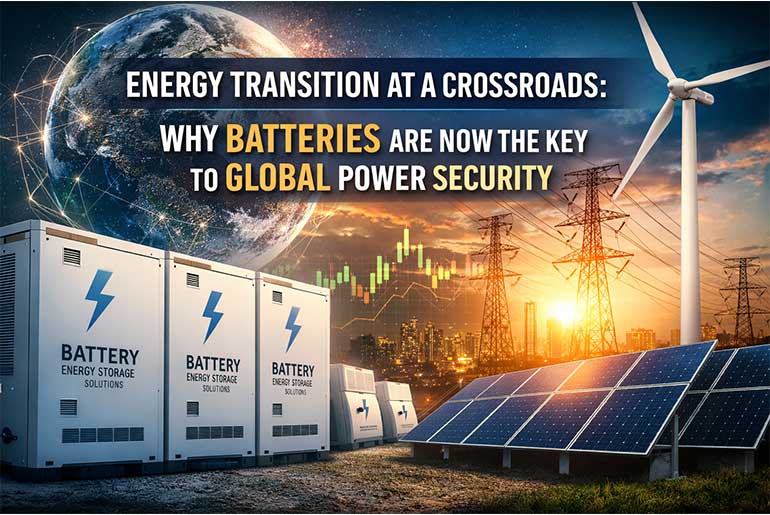
Read carefully, the message is clear: the global energy transition is no longer constrained by renewable ambition or generation capacity. It is constrained by flexibility, resilience, and storage.
What Is the WEF Energy Transition Report?
The World Economic Forum publishes its annual Fostering Effective Energy Transition report, built around the Energy Transition Index (ETI). The index benchmarks how effectively countries are shifting from fossil-fuel-based systems toward energy systems that are cleaner, more affordable, and more secure.
The ETI is not a climate scorecard.It is a system performance and readiness assessment, designed to capture how energy transitions work in the real world.
The Purpose of the ETI
The Energy Transition Index:
Assesses 118 countries across two broad dimensions:
- System Performance — how well the current energy system delivers security, affordability, equity, and sustainability
- Transition Readiness — how prepared a country is for future transformation across policy, regulation, investment, infrastructure, innovation, and human capital
Uses more than 43 quantitative indicators, aggregated into a score ranging from 0 to 100, to enable comparison across diverse energy systems
Highlights global trends, structural challenges, and transition pathways, recognising that countries move at different speeds and follow different routes based on their economic and energy realities
What the Latest ETI Data Shows
Global Progress — Real, but Uneven
The most recent ETI assessment shows measurable progress:
- Global ETI scores improved by around 1.1%, marking the fastest improvement since 2021
- Approximately 65% of assessed countries improved their overall score year-on-year
However, progress is uneven across pillars:
- Sustainability and energy access have improved, driven by higher renewable deployment and broader electrification
- Energy security and system resilience have improved only marginally, reflecting grid stress and reliability challenges
Crucially, clean energy investment crossed USD 2 trillion globally in 2024, nearly double the level seen in 2020. Yet this remains far below the estimated USD 5.6 trillion per year required by 2030 to stay aligned with climate and reliability goals — particularly when grid infrastructure and storage are taken into account. Who Is Performing Well — and Why
The top performers in the ETI continue to be European and Nordic countries, including Sweden, Finland, Denmark, Norway, and Switzerland.
Their strength lies not only in renewable penetration, but in:
- Stable and predictable policy frameworks
- Advanced grid infrastructure
- Strong investment environments
- Early integration of flexibility and storage into system planning
These countries illustrate a critical lesson: high renewable shares alone do not guarantee transition success — system integration does.
What the ETI Really Tells Us (Beyond Rankings)
At its core, the ETI evaluates how countries balance three pillars:
- Sustainability
- Affordability and equity
- Energy security
As renewable penetration increases, these pillars become more tightly interconnected. Variability in generation directly affects affordability and security. This is where battery energy storage emerges as a central enabler.
Battery storage is one of the few technologies that simultaneously strengthens all three pillars:
- It enables higher renewable utilisation (sustainability)
- Reduces curtailment and peak power costs (affordability)
- Enhances grid stability and resilience (security)
This is why the energy transition is no longer generation-limited.
It is storage-limited.
The Silent Shift: From Generation to Grid Stability
One of the most important signals embedded in the WEF assessment is a quiet but profound shift in what defines transition readiness.
As renewable capacity scales rapidly, power systems designed for predictable, centralised generation are struggling to cope with variability. Without flexibility, grids face:
- Renewable curtailment
- Frequency instability
- Greater reliance on fossil-based peaking assets
- Volatile power prices
Battery energy storage directly addresses these challenges by absorbing surplus power, supplying energy during demand peaks, and providing fast-response ancillary services.
In short, storage has moved from being a support technology to a system necessity.
India’s Energy Transition: Progress at Scale, Pressure at Scale
India’s energy transition is among the most complex globally. The country is simultaneously expanding renewable capacity, managing one of the fastest-growing electricity demand curves, and supporting industrialisation, electrification, and urban growth.
In the latest Energy Transition Index, India ranked 71st out of 118 countries, with a score of approximately 53.3. While this represented a decline from the previous year, the ranking reflects the scale and structural difficulty of transforming a large, demand-heavy power system — not a lack of ambition.
India’s Clean Energy Progress — By the Numbers
Despite system challenges, India’s real-world progress on clean energy deployment is significant and measurable:
India’s non-fossil fuel installed capacity reached approximately 266.8 GW in 2025, marking an increase of over 49 GW year-on-year. Solar capacity crossed 135.8 GW, while wind capacity stood at around 54.5 GW, reinforcing India’s position among the world’s leading renewable energy markets.
In a key operational milestone, renewable sources met over 51% of India’s electricity demand (about 203 GW) on a single day in 2025 — a clear demonstration that large-scale renewable integration is already occurring on the grid.
India now ranks among the top four globally in total renewable and wind capacity, and among the top three in solar PV capacity, underlining the scale of deployment achieved in a relatively short period.
Beyond power generation, the National Green Hydrogen Mission aims to enable around 125 GW of renewable capacity dedicated to green hydrogen production and catalyse investments exceeding ₹8 lakh crore by 2030, positioning hydrogen as a strategic pillar for industrial decarbonisation and energy security.
These figures highlight a critical reality: India’s challenge is no longer building clean energy — it is integrating it reliably and efficiently.
Where Challenges Persist
At the same time, the report points to areas requiring acceleration:
- Grid reliability and stability
- Decarbonisation of power generation beyond capacity additions
- Transition readiness, particularly investment frameworks and infrastructure
- Dependence on imported energy and fossil fuels
This combination places India at a pivotal moment.
Why Storage Will Decide India’s Next ETI Leap
India’s future performance in the Energy Transition Index will not be determined by how many gigawatts of renewable capacity are announced. It will be determined by how effectively that capacity is integrated into the grid. Battery energy storage offers a clear pathway:
- Utility-scale BESS can reduce renewable curtailment
- Hybrid renewable-plus-storage projects can deliver firm power
- Grid-scale storage can manage peak demand stress
- Long-duration storage can support deeper renewable penetration
Without storage, renewable expansion risks inefficiency.With storage, India can convert ambition into reliability.
Storage as Infrastructure: What Stakeholders Must Act On
For Policymakers
Energy storage must be treated as critical infrastructure, not optional equipment. Long-term revenue visibility, market mechanisms for flexibility, and procurement frameworks that recognise multiple value streams will be essential.
For Battery & BESS Companies
Grid-scale storage demand is becoming structural, not cyclical. Differentiation will increasingly depend on safety, lifecycle performance, integration capability, and system-level value — not just cell chemistry.
For Investors & EPCs
As policy clarity improves, energy storage is emerging as a bankable infrastructure asset, aligned with grid resilience and long-term energy security rather than short-term market cycles.
From Lower Half to Upper Half
The Energy Transition Index makes one reality unmistakable: India’s next phase of progress will be storage-led. With continued policy focus, improving tender design, and growing recognition of storage’s system value, India has the structural opportunity to strengthen transition readiness and move into the upper half of the index over time — not through announcements, but through execution.
Final Reflection
The World Economic Forum’s Energy Transition assessment does not explicitly declare batteries as the future of energy systems. It does not need to. The data already does. As the world moves deeper into renewable-heavy grids, energy transition without storage is no longer a strategy — it is a risk. For India and for the global power sector, batteries are no longer supporting actors. They are the stabilising force holding the transition together.
 Electrify your feed! Click here to join our Whatsapp group and to get the latest updates, expert insights, and innovations driving India’s energy storage revolution.